
Lieferung heute & morgen

Qualitätsgarantie

Willkommens-Angebote freischalten: KOSTENLOSE Lieferung | Bis zu 80 % RABATT | Kostenlose 30-Tage-JoyPlus-Testphase
App herunterladen
A no-drill roller blind promises a simple, damage-free solution for privacy and sun protection. This seems like the ideal choice, especially in rental properties where structural changes are often prohibited. However, the market is flooded with products of widely varying quality. Inaccurate material specifications or unreliable mounting systems can quickly lead to frustration. This guide will show you what to look for to make an informed decision and avoid poor purchases.
Many buyers focus only on colour and price, overlooking critical technical flaws that severely impact functionality and durability.
To avoid these pitfalls, you should check three core aspects before buying. These will determine whether a product is suitable for your needs.
The installation method is the heart of a no-drill roller blind. The most common method is the clamp-on roller blind, also known as a clip-on blind.
The function of the blind is determined by its fabric. Think carefully about what purpose it needs to serve.
To minimise side light gaps, getting the measurements right is crucial.
Based on these criteria, we have compiled a few products for different user profiles.
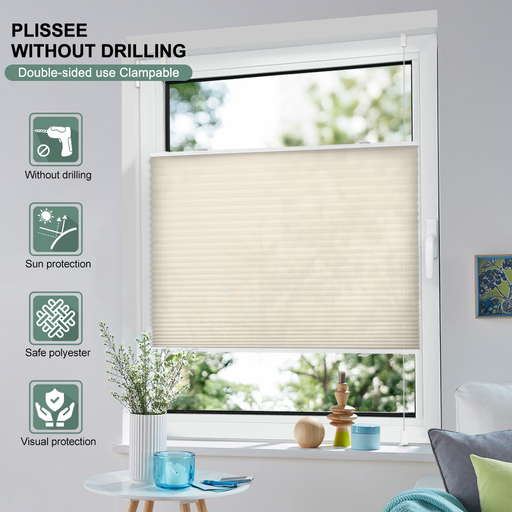
Why This Fits Their Persona: Ideal for renters seeking a straightforward and cost-effective solution for basic privacy and light sun protection in living areas. The installation is tool-free and leaves no marks.
The product is clearly declared as a translucent privacy pleated blind, setting no false expectations of blackout performance. The simple clamp-on system is designed for standard windows, avoiding complex, error-prone mechanisms.
Tool-free clamp-on installation. Provides good privacy while maintaining room brightness.
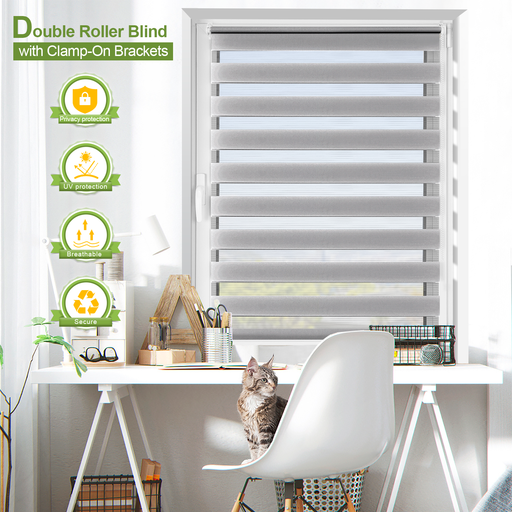
Why This Fits Their Persona: Perfect for users who want to switch between light exposure and privacy in their living room or office depending on the time of day, without needing to install two separate products.
The dual-function design solves the problem of choosing the wrong fabric by combining both transparent and opaque properties in one blind. Light control is precise and not limited to a single fabric type.
Seamless adjustment of light and privacy with two parallel fabric panels. Modern look and high functionality.

Why This Fits Their Persona: For individuals who need maximum room darkening for restful sleep. The additional thermal property helps regulate room temperature in both summer and winter.
This blind bypasses the "false blackout" trap with an explicitly mentioned silver-coated backing. This technical feature ensures high light-blocking capability and is a clear mark of quality.
High degree of blackout and thermal insulation. Also offers child-safe, cordless operation.
We have compiled a complete, up-to-date list of products that fully meet these strict selection criteria and German safety regulations.
1. How do I measure correctly for a no-drill roller blind? Measure the width of the glass pane (from seal to seal) and add about 2 cm on each side to minimise light gaps. The resulting width should be your order width. However, check that it does not obstruct the window handle. Additionally, measure the thickness of your window sash to ensure the clamp brackets will fit (typically 16-22 mm).
2. Is a clamp-on roller blind truly secure? When installed correctly on a suitable window sash and within the manufacturer's specified size and weight limits, a clamp-on system is very reliable. It is important to tighten the screws on the clamp brackets firmly but not excessively, to avoid damaging the plastic. For very large or heavy blinds, a drilled installation may be more stable.
3. What is the difference between a pleated blind and a roller blind? A roller blind consists of a smooth panel of fabric that is rolled up and down onto a tube. A pleated blind, in contrast, consists of a fabric folded into pleats, which compresses like an accordion. Pleated blinds are often more flexible as they can frequently be adjusted from both the top down and the bottom up, allowing for very precise placement of privacy screening.