
Lieferung heute & morgen

Qualitätsgarantie

Willkommens-Angebote freischalten: KOSTENLOSE Lieferung | Bis zu 80 % RABATT | Kostenlose 30-Tage-JoyPlus-Testphase
App herunterladen
By a Joybuy Product Recommendation OfficerDate: August 28, 2026
Finding the right privacy and sun protection for a rental apartment or your own home often presents a key challenge: how to install a solution without permanently damaging the window frames with drill holes? A no-drill roller blind is the obvious answer. However, the market is flooded with products whose promises don't always hold up in practice. Before you make a decision, it's crucial to understand the common pitfalls that can lead to frustration and wasted money.
Two common problems are unreliable mounting systems and misleading fabric descriptions. Many buyers report clamp brackets that give way after a short time, scratch the window frame, or are unsuitable for their specific window frame thickness. Another annoyance is a blind advertised as "blackout" that turns out to be merely translucent in sunlight, failing to darken the room as desired.
To avoid these problems, you should carefully check three core parameters. These determine whether a product will meet your needs and provide a durable, functional solution.
The most common and generally most stable method is the clamp-on roller blind. This involves clamping adjustable brackets directly onto the window sash.
The fabric's description indicates its primary function. There are clear distinctions here:
An incorrectly measured blind is the most common reason for dissatisfaction. Note the difference between fabric width and order width.
Rule of thumb for ordering: Measure the width of the glass pane (glass width) and add about 2 cm to each side to minimise light gaps. Recommended Order Width = Glass Width + approx. 4 cm
Make sure the blind does not interfere with the window handle. The order height should be at least the height of the entire window sash.
Instead of making a one-size-fits-all recommendation, we have identified products tailored to specific use cases and their requirements.
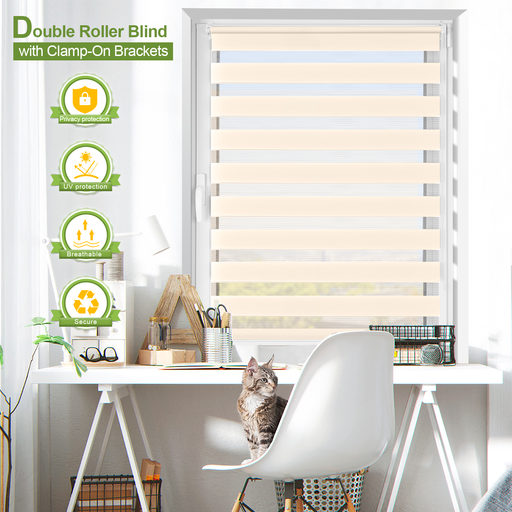
Why This Fits Their Persona: Ideal for renters looking for a versatile solution for living rooms or home offices. The dual-functionality allows you to switch between privacy and full daylight depending on the time of day, without needing to install two separate products. The neutral colour complements many interior design styles.
The product uses a standardised clamp-on system designed for common window frame thicknesses, minimising the risk of an incompatible or unstable mount. Its clear function as a dual roller blind prevents false expectations regarding its blackout performance.
Infinitely variable light control via two fabric panels; tool-free installation without damaging the window frame.
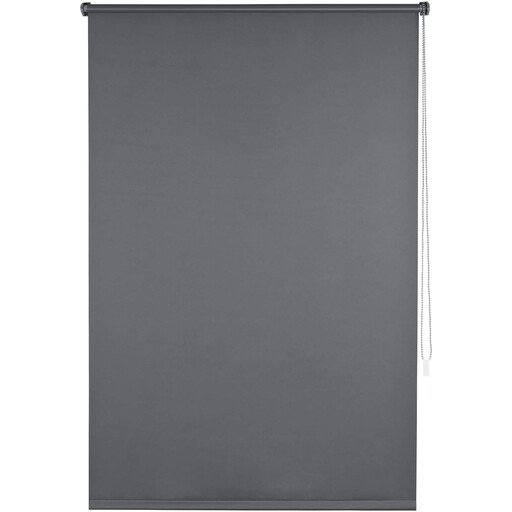
Why This Fits Their Persona: For families who need reliable blackout for a nursery or bedroom. The ability to almost completely darken the room supports a healthy sleep cycle. The additional thermal function helps maintain a comfortable room temperature.
This blind avoids the trap of misleading fabric claims. According to the manufacturer, a special aluminium coating provides high-performance blackout, preventing it from being mistaken for a mere room-darkening blind.
High degree of blackout thanks to a functional coating; additional thermal insulation to regulate room temperature.

Why This Fits Their Persona: Perfect for the home office, where screen glare must be avoided. Since the pleated blind can be freely adjusted from both the top and bottom, light can be controlled with great precision—for example, by covering only the upper part of the window while leaving the lower part opaque.
This pleated blind solves the problem of inflexible light control common with simple roller blinds. Its top-down, bottom-up adjustability offers far more precise adaptation to lighting conditions than a conventional blind that only operates from top to bottom.
Freely adjustable for targeted light control; honeycomb structure with insulating and sound-dampening properties.
We have compiled a complete, up-to-date list of products that fully meet these strict selection criteria and all relevant safety regulations.
When correctly installed on a compatible window frame, a clamp-on blind is very stable for daily use. The stability depends on the clamp brackets being firmly adjusted and tightened to the specified frame thickness. For normal operation with the side chain or handle, the mount is perfectly adequate.
No, most clamp-on systems are specifically designed for modern uPVC windows with a standard frame thickness that can be opened. As mentioned in some product descriptions, they are often not suitable for skylights or old wooden windows with non-standard frame profiles. For such cases, models with suction cup or adhesive mounting are a possible alternative, but their suitability must be checked on a case-by-case basis.
The main difference lies in the method of light control and the fabric design. A dual roller blind (or zebra blind) consists of two parallel fabric panels with alternating sheer and opaque stripes. By shifting these panels, you regulate the amount of light. A no-drill pleated blind consists of a single, pleated fabric panel. Many pleated blinds are freely adjustable, meaning they can be positioned anywhere on the window (e.g., only in the middle), which allows for even more flexible light control.