
Lieferung heute & morgen

Qualitätsgarantie

Willkommens-Angebote freischalten: KOSTENLOSE Lieferung | Bis zu 80 % RABATT | Kostenlose 30-Tage-JoyPlus-Testphase
App herunterladen
As a Joybuy Product Recommendation Officer, I see countless options for privacy and sun protection daily. The no-drill roller blind is an especially attractive solution for renters and DIY-averse homeowners. However, the market is flooded with products of widely varying quality. False promises and unclear product details often lead to disappointment.
This guide will help you identify the crucial features and avoid the three most common purchasing pitfalls, ensuring you find a solution that truly fits your needs.
Many buyers focus on colour and price, overlooking technical flaws that can render a blind useless.
To avoid a bad purchase, you should check three technical aspects before making a decision.
The mounting method is the core of any no-drill roller blind. The most common systems have specific pros and cons:
The fabric determines how much light enters the room and how much privacy you have.
This is the most critical point for avoiding light gaps at the sides. Remember this rule: The fabric width is always narrower than the stated order width (the total width including the mounting hardware). The difference is typically about 4-5 cm.
How to Measure Correctly:
Here are some product recommendations tailored to specific use cases that take the aforementioned pitfalls into account.
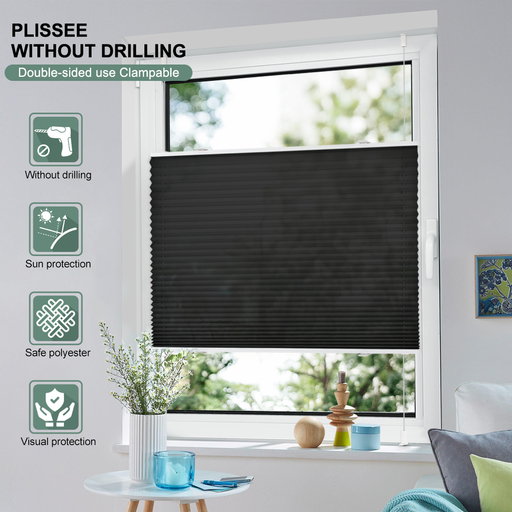
Why This Fits Their Persona: Ideal for students or first-time renters looking for a straightforward and cost-effective privacy solution. The pleated blind can be installed without tools and offers a modern look without risking the security deposit. It's a classic scenario for a rental-friendly blind.
The product uses a proven clamp-on system for standard window frames, avoiding the instability of universal suction cups. The product description clearly positions it as an opaque privacy screen, not a full blackout blind.
Tool-free installation in minutes. The fabric is opaque, providing good privacy while not completely darkening the room.
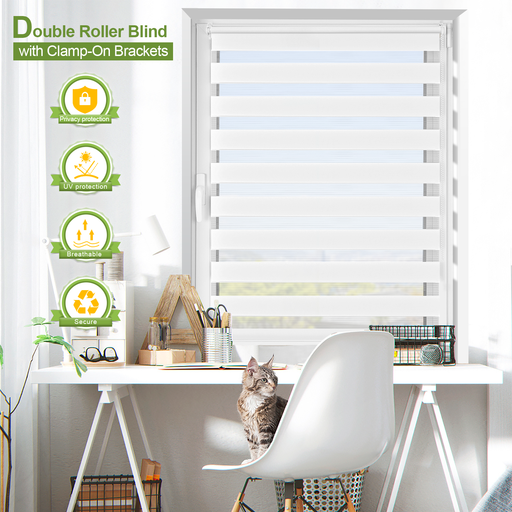
Why This Fits Their Persona: People who work from home need flexible lighting conditions—sometimes bright, sometimes dimmed to avoid screen glare. The no-drill dual roller blind provides exactly this level of seamless control.
This blind solves the problem of rigid "open-or-closed" functionality. Instead of a single fabric, it features two parallel panels that allow for precise control over light entry, delivering on its promise of flexibility.
Seamless adjustment of light and privacy. Installation is also tool-free via clamp brackets.

Why This Fits Their Persona: Maximum darkness is crucial for the bedroom. This no-drill blackout roller blind is specifically designed for that purpose and also offers a thermal effect from its coating, which helps improve the room's climate.
It counters the vague promise of "blackout" with a specific technical feature: a silver coating on the back. This is proven to reflect light and heat more effectively than a simple dark fabric.
High degree of blackout for undisturbed sleep. The thermal coating helps regulate room temperature. The blind is also cordless, making it child-safe.
We have compiled a complete, up-to-date list of products that fully meet these strict selection criteria and local safety regulations.
Measure the width of the glass pane and add about 4 cm to ensure a good overlap. This should be your order width. The fabric width will then completely cover the glass. Also, check the depth of your window frame to ensure the clamp brackets will fit.
No, there are limitations. Clamp-on systems are designed for standard uPVC windows that open. They are often not suitable for fixed-pane windows, sliding doors, skylights, or very thick wooden frames. For these cases, adhesive or suction cup versions are a better alternative.
Durability heavily depends on the material quality. Clamp brackets made of metal or high-quality reinforced plastic generally last for several years. For adhesive systems, it's important to follow the manufacturer's instructions precisely (e.g., cleaning the surface beforehand) and allow the adhesive time to cure. Temperature fluctuations can affect the lifespan of both adhesive and suction cup solutions.