
Lieferung heute & morgen

Qualitätsgarantie

Willkommens-Angebote freischalten: KOSTENLOSE Lieferung | Bis zu 80 % RABATT | Kostenlose 30-Tage-JoyPlus-Testphase
App herunterladen
By the Joybuy Product Recommendation Officer, August 29, 2026
The search for suitable privacy and sun protection for rental apartments or newly designed rooms often leads to one key challenge: drilling is not an option. A no-drill roller blind seems like the ideal solution, but the market is saturated with products whose quality and functionality vary widely. Before you make a decision, it's important to know the most common pitfalls that can lead to frustration and unnecessary expense.
This guide will help you identify the crucial features and make an informed choice that perfectly matches your requirements.
Many products promise simple installation and high functionality, but in practice, flaws often emerge. Pay special attention to these three points:
To avoid a bad purchase, you should focus on objective, technical features. These three aspects are crucial for selecting a durable and functional roller blind.
The most common no-drill systems are clamp-on blinds and adhesive blinds.
The functionality of a roller blind is determined by its material. Look for precise descriptions:
Besides the classic roller blind, there are other no-drill variants with specific advantages:
Instead of making generic recommendations, we have identified products that meet specific user profiles and avoid the pitfalls mentioned earlier.
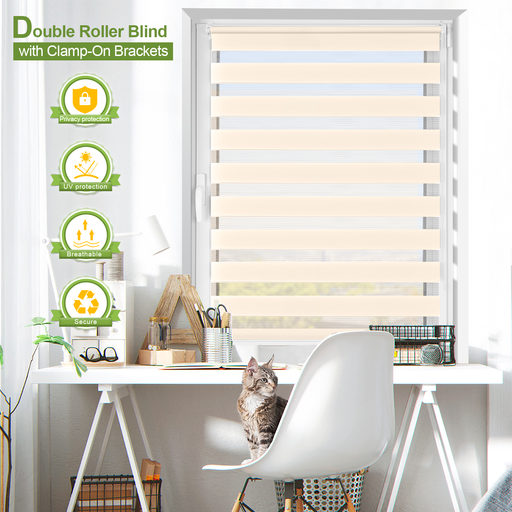
Why This Fits Their Persona: Ideal for a first home, as it offers a flexible solution for privacy and light control. The installation is straightforward and leaves no residue, which is crucial when moving out. The dual function makes it versatile for living and work areas.
The clamp bracket system is designed for common window frames, ensuring a stable fit. The alternating fabric panels of the double roller blind clearly define the degree of transparency, avoiding the ambiguity between 'opaque' and 'light-filtering'.
Infinitely variable light control via a chain pull; combines privacy and brightness control in one product.

Why This Fits Their Persona: Safety comes first. The cordless design eliminates the risk of strangulation from loose chains. The complete blackout function is ideal for children's rooms to ensure undisturbed sleep.
The silver-coated backing provides a true blackout function, solving the problem of misleading fabric descriptions. The cordless system completely bypasses the complexity and hazards of chain mechanisms.
Cordless design for enhanced child safety; thermal coating for blackout effect and temperature regulation; OEKO-TEX certified material.
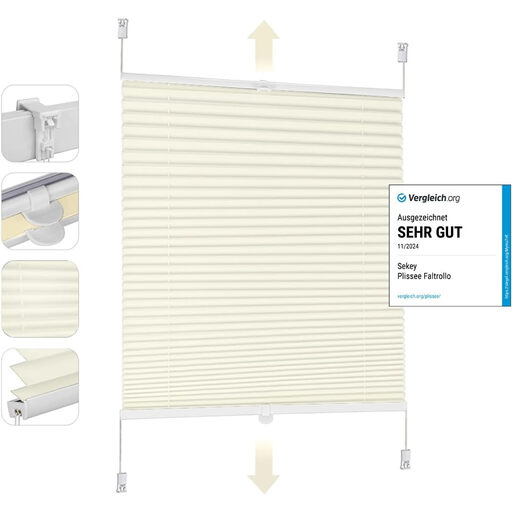
Why This Fits Their Persona: In a home office, controlling screen glare is crucial without completely darkening the room. This pleated blind can be operated from both the top and bottom, allowing for precise control of incoming light.
The adjustable clamp brackets are designed for a secure and stable installation. The flexible top-down, bottom-up operation offers far more nuanced light control than a standard roller blind, solving the specific problem of workplace glare.
Flexible positioning with top-down and bottom-up operation; simple, tool-free clamp installation; opaque fabric for privacy and glare protection.
We have compiled a complete, up-to-date list of products that fully meet these strict selection criteria and all relevant safety regulations.
1. How do I correctly measure my window for a clamp-on blind? First, measure the width of the glass pane. For optimal coverage and to minimize light gaps on the sides, the order width of the blind should be about 4 cm wider than the glass (2 cm on each side). Make sure the blind does not interfere with the window handle. Also, measure the thickness of your window sash to ensure the clamp brackets will fit.
2. Do clamp-on blinds hold securely on tilted windows? Yes, many models are designed for this. Systems with side guide wires (thin cords that secure the blind to the bottom of the frame) or a sturdy bottom rail that runs firmly in guide rails prevent the blind from swinging away from the frame when the window is tilted. Check the product description to see if such a feature is included.
3. What is the difference between a double roller blind and a pleated blind without drilling? A double roller blind offers infinitely variable transparency control via a chain pull, thanks to its two striped fabric panels. It moves up and down as a single unit. A pleated blind consists of a folded fabric and can often be positioned flexibly on the window by sliding it from the top down or from the bottom up. It is excellent for covering only specific areas of the window.