
Lieferung heute & morgen

Qualitätsgarantie

Willkommens-Angebote freischalten: KOSTENLOSE Lieferung | Bis zu 80 % RABATT | Kostenlose 30-Tage-JoyPlus-Testphase
App herunterladen
As a renter or homeowner looking for a hassle-free solution for privacy and sun protection, a no-drill roller blind is a natural choice. The installation is simple and leaves no damage on window frames or walls. However, the market is flooded with products of widely varying quality. Before you make a decision, it's crucial to understand the common pitfalls that can lead to a purchase you'll regret.
Many buyers report problems that only become apparent after installation:
This guide will help you navigate these issues and make an informed decision.
To find the right roller blind, you should carefully examine three core aspects. These determine not only the functionality but also the longevity of your window treatment.
The most common method is the clamp-on roller blind. This involves attaching adjustable brackets directly onto the window sash.
For smooth surfaces like fixed-glazed windows or in conservatories, there are also models with suction cups or adhesive strips. However, these are often only suitable for lighter blinds, such as a no-drill pleated blind, and their adhesive strength can be compromised by temperature fluctuations and humidity.
The function of your roller blind depends directly on the fabric's characteristics.
This is the most critical point to avoid light gaps on the sides. The order width of the blind is typically the total width, including the mounting brackets. The fabric width is always narrower (usually by about 4 cm).
A good rule of thumb is:
Always check the manufacturer's specific measurement instructions before ordering.
Based on the criteria mentioned, we have compiled a few products for typical use cases.
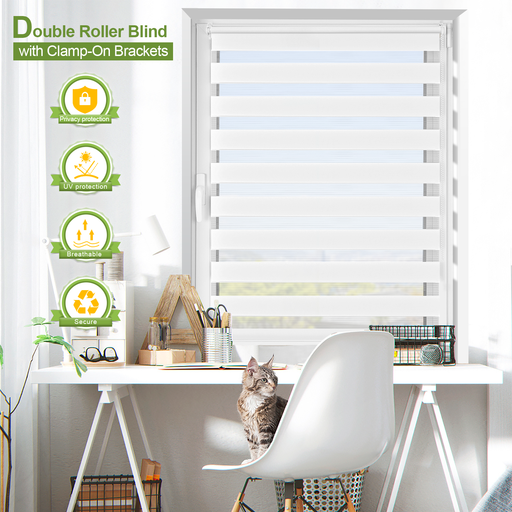
Why this model is a great fit: This dual roller blind is a versatile and straightforward solution for standard windows in rental properties. It combines privacy and flexible light control in one product, so you don't have to choose between "light" and "dark."
The clamp brackets are designed for common window frames. The dual-layer function solves the problem of a simple privacy blind not offering enough seclusion.
Infinitely variable light control via two parallel fabric panels; simple, tool-free installation.
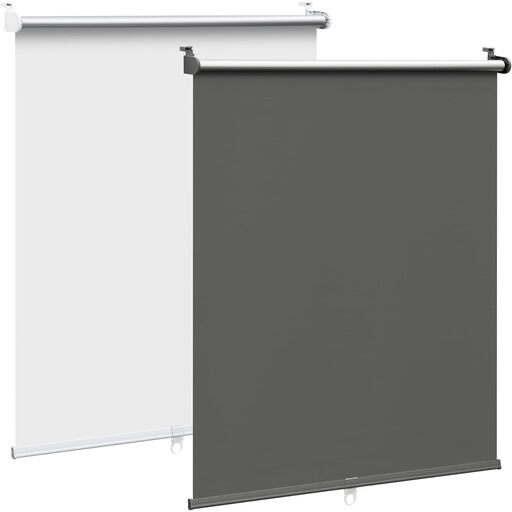
Why this model is a great fit: This roller blind was specifically designed for thermal insulation. It helps keep heat out in the summer and warmth in during the winter, which can have a positive impact on your home's climate.
The silver coating on the back provides a demonstrable thermal barrier and 100% blackout, unlike blinds that are merely advertised as "room-darkening."
Special thermal coating for temperature regulation; the material is certified according to OEKO-TEX Standard, per the manufacturer.

Why this model is a great fit: The honeycomb structure creates air pockets that provide a high level of insulation against heat, cold, and sound. The top-down, bottom-up operation allows for maximum flexibility in controlling light and privacy.
This multifunctional product goes beyond simple privacy screening. It simultaneously addresses light, temperature, and sound, preventing the purchase of a single-function blind that doesn't meet all your needs.
Honeycomb structure for enhanced thermal and acoustic insulation; freely adjustable from both the top and bottom for flexible positioning.
We have compiled a complete, up-to-date list of products that fully meet these strict selection criteria and German safety regulations.
First, measure the width of the window pane (glass measurement). Add 2 cm to this measurement on each side to ensure a good overlap and minimise light gaps. The resulting width is your recommended order width. Check that the blind at this width does not block the window handle. For the height, measure the entire height of the window sash. Always compare your measurements with the specific measuring guide from the respective manufacturer.
When installed correctly on a suitable window frame (usually uPVC windows with the specified frame thickness), high-quality clamp-on systems are very reliable and stable. The brackets are designed to provide a firm hold without damaging the frame. For very wide, heavy blinds or for windows made of wood or aluminium, a screwed installation may be more stable in the long term.
A dual roller blind consists of two fabric panels with alternating transparent and opaque stripes. A chain hoist is used to change the position of the stripes relative to each other to seamlessly control the light level. A pleated blind consists of a single, folded fabric (like an accordion). It is often tensioned directly on the window and can be flexibly moved from top to bottom and bottom to top. This allows you to cover only specific areas of the window.