
Lieferung heute & morgen

Qualitätsgarantie

Willkommens-Angebote freischalten: KOSTENLOSE Lieferung | Bis zu 80 % RABATT | Kostenlose 30-Tage-JoyPlus-Testphase
App herunterladen
When children start to crawl and explore their surroundings, a period of heightened vigilance begins for parents. Stairs, doors to unsecured rooms, or open-plan kitchens suddenly become potential hazards. A no-drill safety gate is the obvious solution for many households, especially in rental homes. However, the market is confusing, and not every gate delivers on its promise. Before you make a purchase, it's crucial to understand the most common pitfalls that can lead to frustration and safety gaps.
Common Mistakes When Buying Pressure-Mounted Gates:
To avoid a bad purchase, you should focus your attention on three technical features that determine safety and everyday usability.
A pressure-mounted gate, also known as a tension-mount gate, is secured by pressure between two solid surfaces (e.g., walls or door frames). The quality of this system is critical. Look for metal adjustment bolts and large, rubberised or silicone-coated pressure pads. These distribute the pressure evenly, prevent slipping, and minimise the risk of marks or damage to your walls. A reliable indicator of tested safety is compliance with the European standard EN 1930:2011. This standard specifies requirements for the strength, locking mechanism, and gap dimensions of child safety barriers.
Measure the clear width of the passageway at its narrowest point (e.g., at the level of the baseboards) and at its widest point. Compare these measurements precisely with the manufacturer's specifications. A good no-drill door gate not only covers a standard width but also offers the option to adapt it to wider passageways with separately available extensions. This modularity makes the gate future-proof, in case you want to use it in a different location in your home.
A secure baby barrier gate features a dual-action opening mechanism that is impossible for small children to overcome (e.g., a combination of lifting and sliding). At the same time, it must be smooth and operable with one hand for adults. Models that can be opened in both directions offer additional flexibility in daily life. Some gates also have an auto-close feature, which ensures the gate automatically swings shut and locks after you pass through.
Based on the objective criteria mentioned, we have compiled a selection of products suitable for specific requirements and living situations.
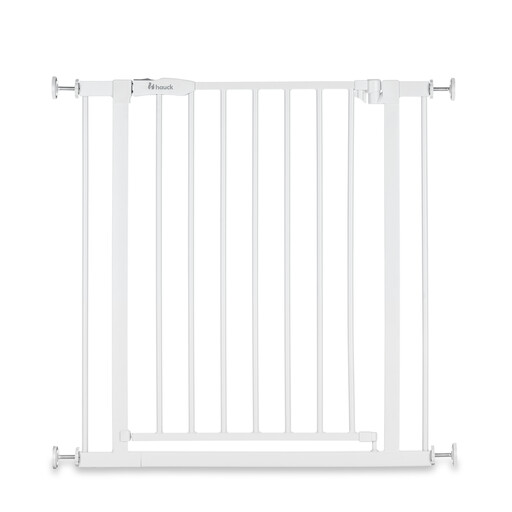
Why This Fits Their Persona: This model is designed to secure standard door frames between 75 and 80 cm. It provides a solid and straightforward base solution for most homes without requiring any additional parts.
The pressure mechanism with four adjustment bolts ensures stable, long-lasting tension, counteracting any loosening. The manual lock is robust and designed for one-handed operation.
Meets the EN 1930:2011 safety standard. Installation is tool-free via pressure mounting. The gate opens in both directions.
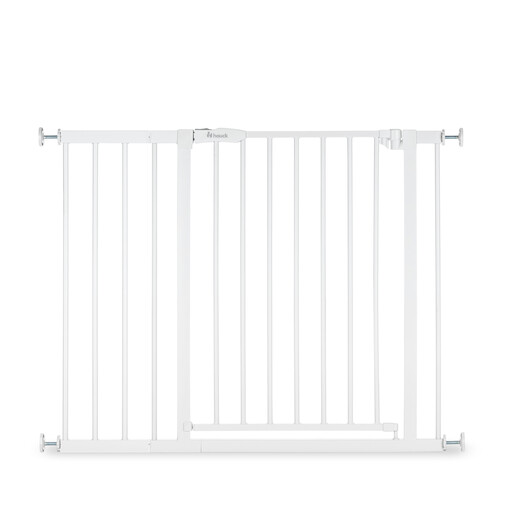
Why This Fits Their Persona: This set is ideal for modern homes with open-plan layouts or wider hallways. It covers a width of 96 to 101 cm out of the box, solving the problem of non-standard openings.
It directly addresses the pitfall of incorrect dimensions by including a 21 cm extension in the box. This saves you the hassle of searching for and purchasing compatible parts separately.
Modular system that can be expanded up to 122 cm with other separately available extensions (9 cm or 21 cm). Offers high flexibility for different locations.
Besides classic pressure-mounted gates, other systems can be advantageous for specific use cases.
For situations where a permanent installation is feasible, retractable gates like the Momcozy Retractable Safety Gate offer specific benefits. This gate is screwed securely to the wall and consists of a sturdy mesh fabric that retracts into a space-saving cassette when not in use. The biggest advantage is the absence of a bottom frame bar, which eliminates any trip hazard. This is a particularly important safety feature at the top of stairs. Installation requires drilling but provides a very stable and discreet solution.
Sometimes, the goal is less about securing a hazard and more about visually sectioning off a room. For example, to separate a play area in the living room from a workspace, a freestanding room divider can be an aesthetic alternative. Products like the MyGift 4-Panel Room Divider are not designed as child safety gates and do not offer containment safety for stairs. However, they serve as a mobile and decorative barrier to visually separate areas and create a calmer environment.
For flexible room design, we've curated a selection of products that stand out for their functionality and style.
1. How tightly should a no-drill safety gate be installed? The gate must be tension-mounted firmly enough that it cannot be shifted by shaking or pushing. On many models, like the Hauck safety gate, there is a visual indicator or a clear instruction in the manual. An initial gap at the locking mechanism is normal; it closes when the adjustment bolts are tightened correctly, ensuring the right tension.
2. Do pressure-mounted gates leave marks on the wall? When installed correctly with the included pressure pads, the risk is minimal. The pads distribute the pressure over a larger area. For delicate wallpaper or soft plaster, using additional wall saver cups (often sold separately) can be a good idea to prevent marks completely.
3. Can I install a no-drill door gate on a banister with round posts? Yes, special accessories are available for this purpose. Manufacturers like Hauck offer so-called Y-spindles. These replace the straight adjustment bolts on one side of the gate and cup the round or square banister post to allow for a secure and stable installation without drilling.