
Lieferung heute & morgen

Qualitätsgarantie

Willkommens-Angebote freischalten: KOSTENLOSE Lieferung | Bis zu 80 % RABATT | Kostenlose 30-Tage-JoyPlus-Testphase
App herunterladen
Are your shampoo bottles and shower gels cluttering the floor or the narrow rim of your shower tray? For many renters, students, and even homeowners, drilling holes into bathroom tiles isn't an option—whether due to rental agreements or the desire to keep walls pristine. A no-drill shower caddy is the ideal solution for creating order without leaving permanent marks.
This guide introduces various mounting methods and helps you find the right drill-free storage for your bathroom. We'll showcase a selection of products that stand out for their functionality and easy installation.
Before you decide on a model, a few practical considerations will help. The right choice depends on your bathroom's layout and your personal needs.
The installation method is the most critical factor. Each option has specific advantages and disadvantages:
The bathroom is a damp environment, so material choice is crucial to prevent rust and mould. A rustproof shower basket is a smart investment.
Also, look for a design with drainage holes. Good ventilation ensures that your toiletries and the shelf itself dry quickly.
From a compact corner shower shelf to a multi-tiered bathroom organizer, there's a format for every need. Measure the available space in your shower and consider how many products you need to store. A corner shelf often makes efficient use of underutilised space, while multi-level shelves provide ample storage within a small footprint.
Here is a selection of practical solutions that meet different requirements for mounting and design.

Why It Stands Out: This caddy combines a simple hanging mechanism with additional suction cups for stability. The two tiers offer plenty of space, while the bottom hooks are perfect for washcloths or shower sponges. The material combination of white metal and bamboo accents blends harmoniously into many bathroom designs.
Pros:
Who It's For: Anyone looking for a straightforward and flexible hanging shower caddy that is ready to use immediately and offers extra space for accessories.
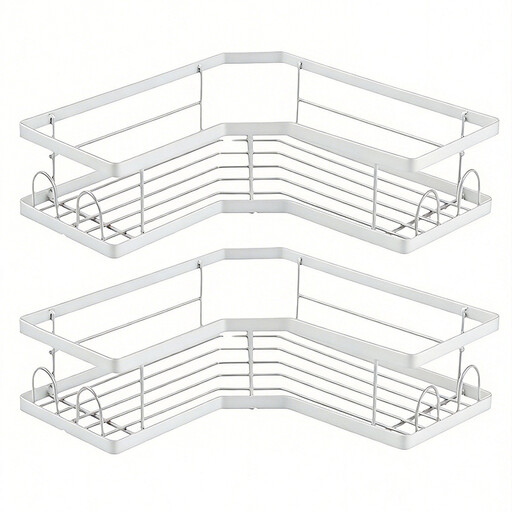
Why It Stands Out: This set of two corner shelves is designed to make optimal use of unused space in the shower. The minimalist, white design is subtle and modern. As a 2-pack, the shelves can be mounted one above the other or in different corners, allowing for flexible organization.
Pros:
Who It's For: Users looking for a space-saving corner solution who appreciate the flexibility of a two-piece set to customize their storage space.

Why It Stands Out: This set relies on a powerful suction cup technology, which the manufacturer claims is based on the principle of octopus tentacles. It promises a high load capacity of up to 10 kg (22 lbs) on suitable surfaces. Installation is done by simply pressing it on, with no tools required.
Pros:
Who It's For: Individuals with smooth, non-porous tiles or glass walls who need a very stable and high-capacity shampoo holder for the shower and value residue-free repositioning.
The products featured provide a good overview of the available options. However, if you are looking for different sizes, designs, or mounting systems, you can find more options in our collection.
? Explore more compact shower caddies here
1. How well do no-drill shower caddies actually hold? The durability heavily depends on the mounting type and the wall surface. Hanging caddies are always a safe option. Suction cup systems hold very well on smooth, clean, and non-porous surfaces but can fail on textured tiles. Adhesive systems often provide the strongest and most permanent hold but require correct installation and curing time.
2. Can you attach a no-drill shower caddy to rough tiles? Suction cups are unsuitable for rough or textured surfaces as they cannot create a vacuum. In this case, a hanging shower caddy or models with special adhesive systems designed for slightly uneven surfaces are the better choice. Always read the manufacturer's specifications regarding surface suitability.
3. How do you remove an adhesive shower caddy without leaving residue? Most modern adhesive systems are designed to be removable. Typically, the adhesive is heated with a hairdryer to soften it. Then, the caddy can be carefully pried off the wall. Adhesive residue can often be removed with a plastic scraper or a suitable cleaning agent. Check the manufacturer's instructions for the correct procedure.