
Lieferung heute & morgen

Qualitätsgarantie

Willkommens-Angebote freischalten: KOSTENLOSE Lieferung | Bis zu 80 % RABATT | Kostenlose 30-Tage-JoyPlus-Testphase
App herunterladen
Manually defrosting a freezer is one of the least favorite household chores. It's time-consuming, inconvenient, and often involves temporarily storing food in unsuitable cooler boxes. A freezer with No-Frost technology solves this problem by preventing ice buildup from the start. This not only saves you work but also ensures consistent cooling performance and more efficient energy consumption.
This article serves as a guide. We will outline objective criteria to help you select the right appliance and present a curated selection of models with various features to meet different household needs.
The decision to buy a new deep freezer depends on several factors. The following points will help you narrow down your choices based on objective features.
A freezer runs 365 days a year. An energy-efficient freezer is therefore a wise investment to reduce ongoing electricity costs. Since March 2021, the new EU energy label with classes from A (very efficient) to G (less efficient) has been in effect. Pay attention to the annual energy consumption, specified in kilowatt-hours (kWh/a). While a model with a better energy efficiency class may have a higher initial price, it can save you money over its lifespan. No-Frost technology also contributes to efficiency, as an ice-free environment reduces the strain on the compressor.
The required capacity depends on your household size and storage habits. As a rule of thumb, plan for about 50 to 80 litres per person.
A freestanding freezer offers maximum placement flexibility. If the appliance is to be placed in a basement or garage, the Climate Class is crucial. The SN-T class, for example, guarantees reliable operation at ambient temperatures from +10 °C to +43 °C. A freezer for the basement should therefore be designed for lower temperatures.
In open-plan kitchens, a quiet freezer is a significant advantage. The noise level is indicated in decibels (dB) and rated on the energy label in airborne acoustical noise emission classes from A (very quiet) to D (louder). Appliances under 40 dB are generally considered quiet.
A freezer with drawers makes it easier to organise and quickly access frozen goods. Transparent fronts provide a better overview. However, the key convenience feature remains frost-free freezing (No-Frost), which reduces maintenance to a minimum.
Here is a selection of appliances that cover different requirements for size, function, and placement.

Why this model stands out: The Haier H4F306WCH1 combines a very large capacity with modern technology. The Total No Frost function reliably prevents ice formation. A special feature is the Instaswitch function, which allows the appliance to be used as a refrigerator if needed.
Advantages:
Who is this appliance for? For families and individuals who need a lot of space for frozen goods and value flexibility and energy efficiency. The ability to use the appliance as a refrigerator offers practical added value.
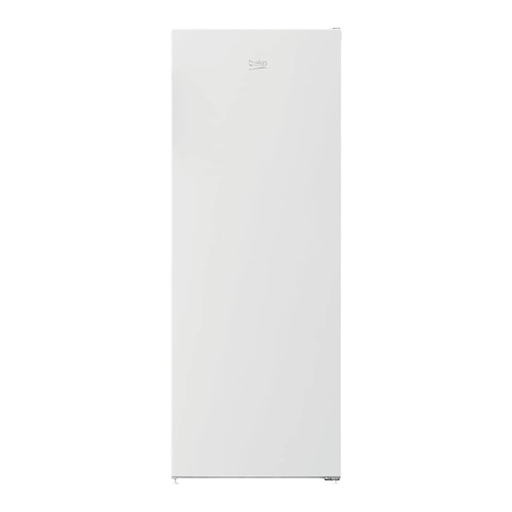
Why this model stands out: This model from Beko offers solid No-Frost features in a medium size. Its ability to operate even in low ambient temperatures down to -15 °C makes it an excellent choice for unheated spaces.
Advantages:
Who is this appliance for? For households looking for a reliable freezer for the basement or garage. The medium size is ideal for couples or small families who prefer a low-maintenance solution.

Why this model stands out: The Gorenje freezer is a compact and budget-friendly solution. Although it requires manual defrosting, it stands out with its broad climate class (SN-T), which ensures reliable operation even in high ambient temperatures up to 43 °C.
Advantages:
Who is this appliance for? For budget-conscious buyers looking for a compact freezer for a small apartment or as a supplementary unit, and for whom the No-Frost feature isn't the top priority. Its robustness against temperature fluctuations is a clear advantage.
The models presented here cover common requirement profiles. If you haven't found the right fit for your specific needs—be it a different size, a particular energy efficiency class, or a special feature—you can find more options in our category.
? Explore our full range of standalone freezers here
No-Frost technology (or frost-free freezing) uses a circulating air system to distribute cold, dry air throughout the freezer compartment. Moisture is continuously extracted and channelled away before it can settle as ice on the interior walls or on the frozen goods. This completely prevents ice formation and makes manual defrosting obsolete.
Modern No-Frost appliances are very energy-efficient. The technology itself can even reduce energy consumption compared to a heavily iced-over conventional unit, as the compressor doesn't have to work against an insulating layer of ice. The exact consumption depends on the energy efficiency class, size, and usage. A look at the energy label and the annual consumption specified there in kWh/a provides the most reliable figure.
Yes, many models are suitable for this. The crucial factor is the appliance's climate class, indicated on the specifications label. For unheated basements where the temperature can drop below 10 °C, you need appliances with the SN class (Subnormal, +10 °C to +32 °C) or special models approved for even lower temperatures (like the Beko model, down to -15 °C). A standard freezer of class N (Normal, +16 °C to +32 °C) might stop working correctly in temperatures that are too low.