
Lieferung heute & morgen

Qualitätsgarantie

Willkommens-Angebote freischalten: KOSTENLOSE Lieferung | Bis zu 80 % RABATT | Kostenlose 30-Tage-JoyPlus-Testphase
App herunterladen
A no-frost fridge freezer should reliably perform three key tasks in everyday use: keep food clearly organised and chilled, store frozen food without excessive ice build-up, and suit the space and budget available in your household. In practice, however, some common purchasing decisions can lead to unnecessary costs or space problems.
No-frost systems actively remove humid air from the freezer compartment, thereby reducing ice formation. This usually means you do not need to defrost the freezer compartment manually. However, the seals, interior and ventilation areas still need to be cleaned. Cooling performance also depends on ensuring that air outlets are not blocked by food.
A freestanding fridge freezer needs more space than its width alone. Also check:
Some models have a reversible door or are designed to open to 90 degrees. This can be crucial in kitchens with walls nearby and in compact utility rooms.
The EU energy label ranges from A to G. For comparison purposes, the specific annual consumption in kWh per year is more meaningful than the letter alone. A larger appliance with a C rating may use more electricity than a smaller model in the same class. Multiply the annual consumption by your current electricity tariff and take the expected service life into account.
A 250-litre fridge freezer often has a net capacity of approximately 180 litres in the fridge compartment and 70 litres in the freezer compartment. This is suitable for couples or smaller households. A 300-litre fridge freezer, or a fridge freezer with more than 320 litres of capacity, offers more space for families and larger shops.
Do not just look at the total capacity; consider how it is divided as well. A large freezer compartment is useful if you regularly store frozen food, provisions or home-cooked meals. If you mainly buy fresh food, a larger fridge compartment may be more practical.
Noise is stated in dB(A). Even a difference of a few decibels can be noticeable in an open-plan kitchen and living area. For living spaces, models producing around 32 to 39 dB(A) are a sensible, measurable choice. Also compare the airborne acoustical noise emission class, as this puts the figure into context.
A fridge freezer with an inverter compressor typically adjusts its output to match cooling demand. Whether this is financially worthwhile depends on the specific annual consumption, how the appliance is used and its purchase price. The name alone is no substitute for checking the energy label.
Kitchens and cellars have different conditions from garages. Check the stated climate class and the permitted ambient temperature range. Not every appliance is suitable for unheated rooms. Models specified for temperatures from 10 to 43 °C may be more suitable for a utility room or garage, provided all other installation requirements are met.
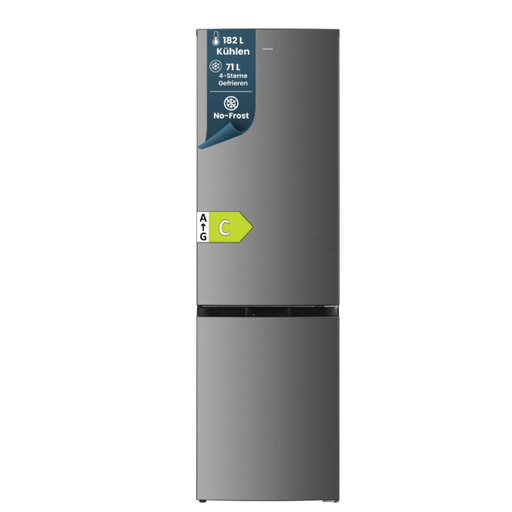
Why this product suits this profile: This freestanding fridge freezer offers 253 litres of net capacity, including 182 litres in the fridge compartment and 71 litres in the freezer compartment. It is suitable for couples and smaller households that regularly do a weekly shop.
The technical specifications clearly state the net capacity, annual consumption and noise level: energy efficiency class C, 141 kWh per year and 39 dB(A). This makes it easy to assess the model objectively.
No Frost, four-star freezer compartment, Super Freeze function, reversible door hinge and height-adjustable feet.
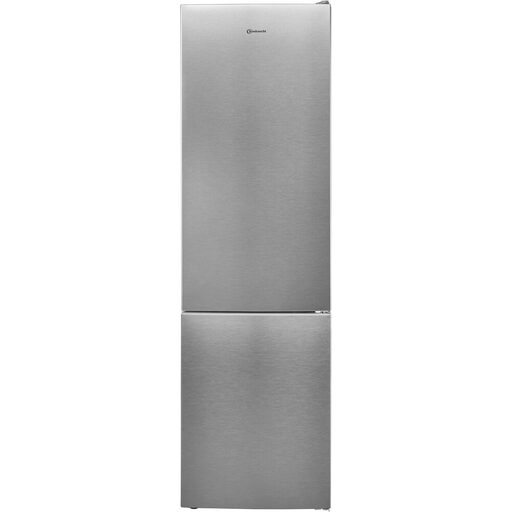
Why this product suits this profile: This model combines 355 litres of net capacity with an A energy efficiency rating, annual consumption of 112 kWh and a noise level of 32 dB.
As well as the total capacity, the specifications state the consumption, noise level, dimensions and climate range. The 90-degree door opening can make planning easier where space is limited.
No Frost in both compartments, inverter compressor, Multi-Zone conversion and three freezer drawers.
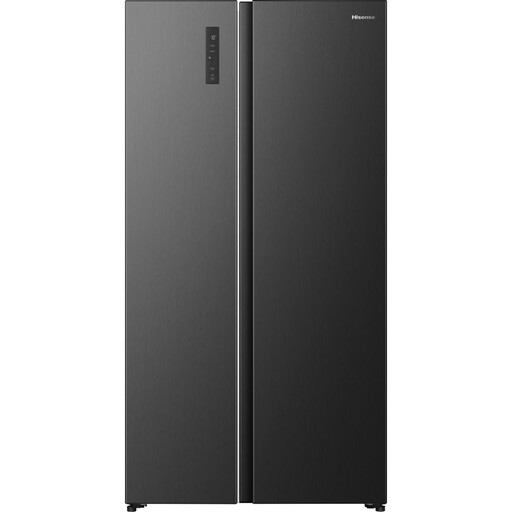
Why this product suits this profile: With 347 litres of fridge capacity and 197 litres of freezer capacity, this side-by-side model is designed for households that need plenty of storage. According to the product specifications, its climate classes allow operation from 10 to 43 °C.
The large appliance is listed with precise dimensions of 178,6 × 91,1 × 61,5 cm. Before buying, check the door width, floor space and room needed to manoeuvre the appliance.
544-litre total capacity, Total No Frost, Multi Air Flow, inverter compressor and 10 kg freezing capacity per 24 hours.
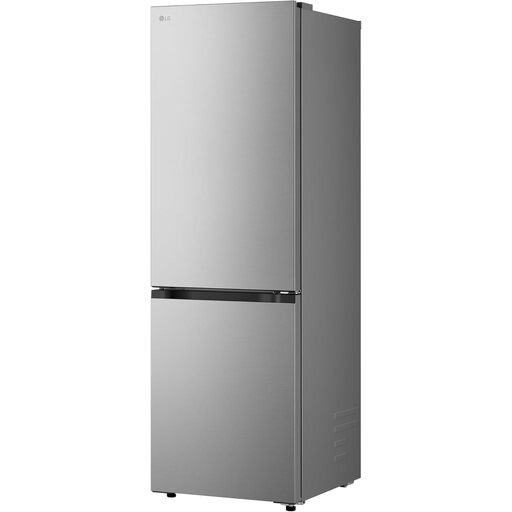
Why this product suits this profile: The 220-litre fridge compartment and 113-litre freezer compartment provide plenty of storage for families without requiring the width of a side-by-side fridge freezer.
The product specifications state annual consumption of 169 kWh, a noise level of 34 dB(A) and dimensions of 59,7 × 67,4 × 186 cm. This allows energy use, noise and space requirements to be assessed separately.
No Frost, energy efficiency class C, Smart Inverter compressor, three freezer drawers and reversible door.
We have put together a complete, regularly updated list of products that fully meet these strict selection criteria and the safety regulations applicable in the EU.
With a correctly functioning Total No Frost system, manually defrosting the freezer compartment is normally not necessary. Nevertheless, the interior, door seals and ventilation openings should be cleaned regularly.
In addition to the appliance dimensions, you need clearance for ventilation, opening the door and cleaning. The exact clearances are given in the installation instructions. In smaller kitchens, the door hinge, 90-degree opening and depth are particularly important.
Multiply the stated annual consumption in kWh by your electricity price per kWh. Example: an appliance using 141 kWh per year would cost approximately 49,35 Euro per year in electricity at 0,35 Euro per kWh. The actual amount depends on your tariff and how you use the appliance.