
Lieferung heute & morgen

Qualitätsgarantie

Willkommens-Angebote freischalten: KOSTENLOSE Lieferung | Bis zu 80 % RABATT | Kostenlose 30-Tage-JoyPlus-Testphase
App herunterladen
Purchasing a new fridge-freezer is a major decision for any household. The appliance operates around the clock, impacting not only the freshness of your food but also your energy bill. However, the market is saturated with marketing promises and technical specs that often confuse more than they clarify. Before you decide, it's crucial to understand the most common pitfalls that can lead to dissatisfaction and unexpected costs.
As your Joybuy Product Recommendation Officer, I'll help you define objective criteria for your selection and identify the features that truly matter.
Many appliances look convincing at first glance but only reveal their weaknesses during daily use. Pay close attention to these three points to avoid buyer's remorse:
To make an informed decision, focus on verifiable technical data rather than marketing slogans. These three factors are crucial for performance, cost, and comfort.
Since 2021, the new EU energy label has been in effect, with a scale from A (very efficient) to G (less efficient). The old plus classes (A+++, A++) have been discontinued. A Class C refrigerator is now considered one of the most economical models on the market under the new standard. Pay attention to the annual consumption in kilowatt-hours (kWh) indicated on the label to estimate long-term operating costs. An efficient appliance can save you several hundred pounds over its lifespan.
For couples and small families, a large fridge-freezer is generally sufficient if it offers a net usable volume of around 250 litres. An XXL fridge-freezer with over 300 litres is suitable for larger households. Check if the layout meets your needs: Are the glass shelves height-adjustable? Are there enough door compartments for bottles and smaller items? A well-designed interior makes a bigger difference than a few extra litres on paper.
Calling a fridge-freezer quiet is subjective. The decibel rating makes it objective. Appliances with a value below 40 dB(A) are considered quiet and are suitable for open-plan living areas. Models around 35 dB(A) are barely perceptible. This value is found on the EU energy label under the noise emission class (A to D) and is a reliable indicator of day-to-day comfort.
Based on the objective criteria above, we have identified a model that offers a thoughtful combination of functionality, efficiency, and design.
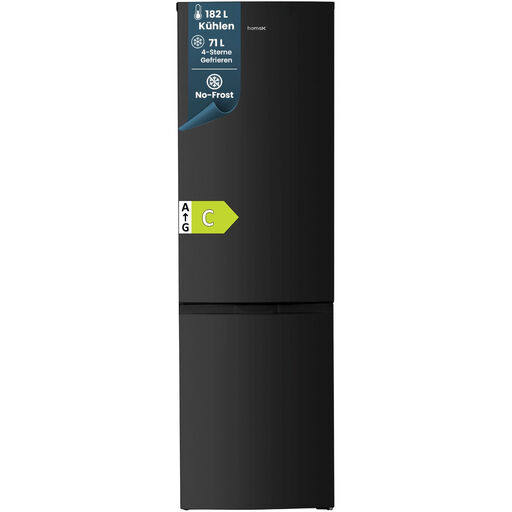
Why This Fits Their Persona: This model is an ideal solution for households seeking a spacious appliance with modern aesthetics without breaking the bank. The freestanding black refrigerator blends seamlessly into contemporary kitchens, while the 253-litre net capacity (182 L fridge, 71 L freezer) provides ample space for a family's weekly groceries.
The appliance features Total No-Frost, making manual defrosting of both the fridge and freezer sections obsolete. The usable capacity is clearly declared, and the noise level is specified at 39 dB(A), making it suitable for open-plan kitchens.
The combination of Energy Efficiency Class C (only 141 kWh/year), Total No-Frost, and quiet operation offers a strong overall technical package at this price point. The Super-Frost function also allows for the rapid freezing of fresh food.
We have compiled a complete, up-to-date list of products that fully meet these strict selection criteria.
1. Is Energy Efficiency Class C good or bad for a refrigerator? Following the 2021 revision of the EU energy label, Energy Efficiency Class C is a very good rating. It is roughly equivalent to the former A+++ class. Appliances in this category are among the most economical on the market and help keep electricity costs low.
2. What does "Total No-Frost" really mean for a fridge-freezer? "Total No-Frost" means that both the refrigerator and freezer compartments are equipped with a circulating air system that reduces humidity and prevents the formation of ice and frost. This completely eliminates the need for manual defrosting, ensuring consistently high cooling performance and low energy consumption.
3. How loud is a quiet fridge-freezer in dB? An appliance is considered quiet if its noise emission is below 40 decibels (dB). This is comparable to a soft whisper or the ambient noise in a quiet library. Models with ratings around 35-39 dB are ideal for open-plan kitchens, as they are barely perceptible during normal daily operation.