
Lieferung heute & morgen

Qualitätsgarantie

Willkommens-Angebote freischalten: KOSTENLOSE Lieferung | Bis zu 80 % RABATT | Kostenlose 30-Tage-JoyPlus-Testphase
App herunterladen
A STAEDTLER Lumocolor Non-Permanent Marker is designed for situations where markings need to be visible without being permanent. Typical surfaces include OHP transparencies, glass, plastic, laminated documents, whiteboards and other smooth materials. For office workers, teachers, students, facilitators, technical draughtspeople, laboratory staff and frequent travellers, however, there is more to consider than just the colour.
Water-soluble ink can generally be removed from non-porous surfaces with a damp cloth. On paper, cardboard, textiles, untreated wood or wallpaper, however, the colour may soak in and leave stains. A water-soluble transparency marker is therefore not automatically suitable for every material.
Before using it for the first time, test it on an inconspicuous area. Plastic surfaces in particular can vary in terms of coating, gloss and surface texture.
A fine tip is suitable for small labels, while a broad chisel tip may be more visible during presentations viewed from a greater distance. If you only consider the colour, you may end up buying a marker whose writing is too thin on transparencies or too broad for small labels.
Lumocolor is available in variants including:
The product specifications describe a fast-drying, water-soluble ink. This reduces smudging while writing, but does not mean that the marking is permanently protected against water. If you want the writing on a glassboard or transparency to remain in place, it should not come into contact with wet hands or a damp cloth.
For technical sketches, small tables or detailed notes, a Lumocolor marker 0,4 mm is a suitable choice. The fine plastic tip produces narrow lines, but on very smooth surfaces it requires controlled writing movements.
A Lumocolor marker 0,6 mm offers slightly greater visibility while remaining suitable for smaller labels. The medium 1,0 mm variant is practical for general notes, presentation cards and writing on glass. The B version with 1,0/2,5 mm has a broad chisel tip. Its angle allows you to create narrower or wider lines.
A wipeable marker for transparencies should be clearly labelled non-permanent and water-soluble. According to the product specifications, the Lumocolor variants mentioned here are intended for many smooth surfaces and OHP transparencies. Use a slightly damp cloth to remove the ink.
A whiteboard works differently from a classic dry-wipe marker: with a water-soluble transparency marker, a dry whiteboard cloth may not be enough. A little moisture should be allowed for when removing the ink.
A refillable marker can reduce ongoing costs and packaging waste when used regularly. The models mentioned are compatible with the STAEDTLER refill station 487 15; the product specifications for some M variants mention station 487 17. You should therefore check the relevant product page before refilling.
Close the cap after every use until it clicks into place. Several product specifications recommend storing the marker horizontally. Avoid direct sunlight and intense heat, as these can affect the material and ink.
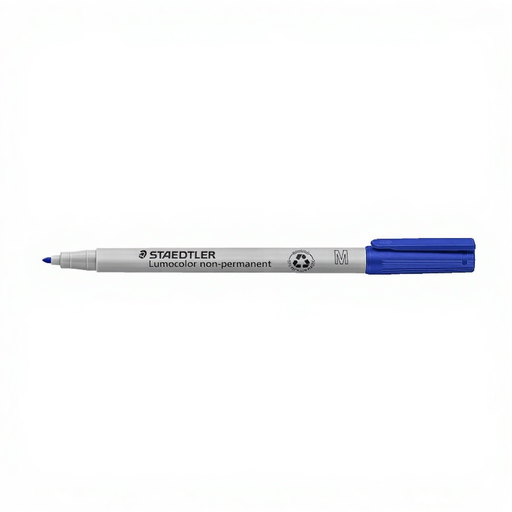
Why this product suits this profile: The medium line width is suitable for general labelling on glass, plastic and transparencies, without requiring an especially fine writing technique.
The product specifications state that it uses water-soluble ink and can be removed with a damp cloth. This makes its intended temporary use clearer than that of unmarked universal markers.
Approx. 1,0 mm line width, water-soluble ink, PP barrel and refill capability with station 487 17 according to the product specifications.
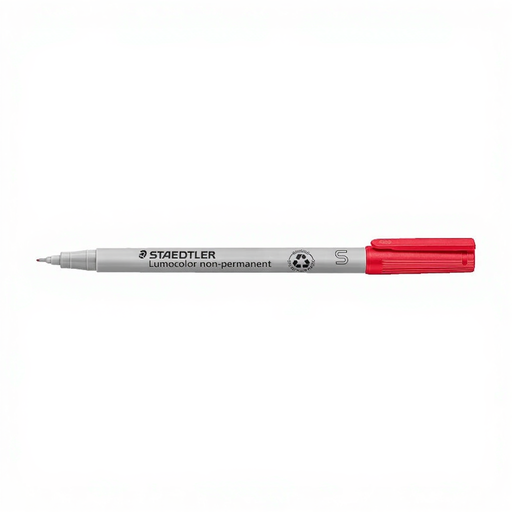
Why this product suits this profile: The superfine tip is designed for precise labelling, detailed drawings and small areas on OHP transparencies or glass.
The stated line width of approx. 0,4 mm prevents small labelling areas from losing unnecessary space. The surface should nevertheless be smooth and free from grease.
Superfine synthetic tip, water-soluble ink, fast drying and refillable with 487 15 according to the product description.
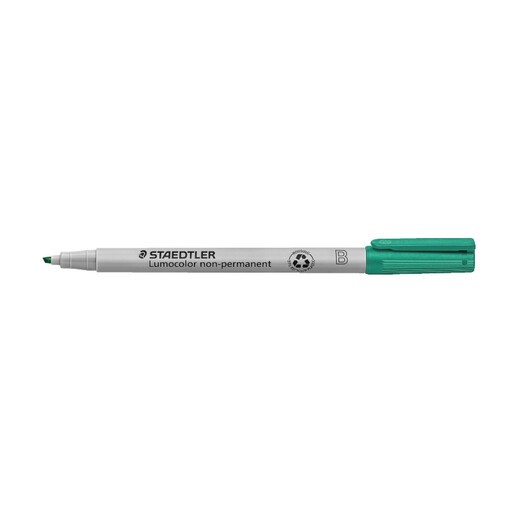
Why this product suits this profile: The chisel tip is designed for presentations, colour-coded diagrams and clearly visible markings where different line widths are needed.
The two stated line widths make the choice easy to understand. For small details, the B tip is less suitable than a 0,4-mm or 0,6-mm model.
Variable line width, water-soluble ink, PP barrel and refill station 487 15 according to the product specifications.
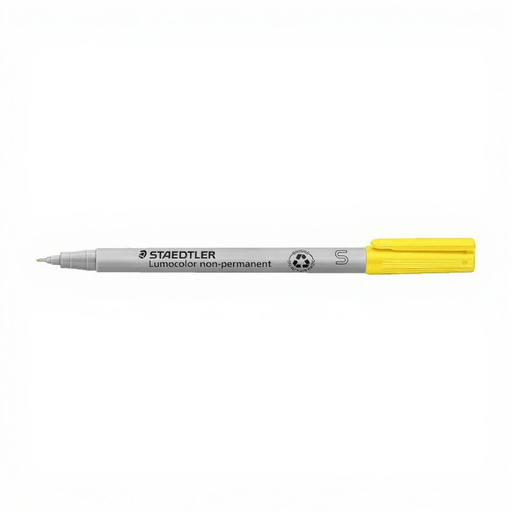
Why this product suits this profile: The fine yellow marking can be used on OHP transparencies, glass and transparent documents when colour coding with a narrow line is required.
The product description refers to automatic pressure regulation for air transport. For flights, the marker should also be securely closed and packed with suitable protection.
Approx. 0,4 mm line width, water-soluble ink, fast drying, PP barrel and refillable with 487 15 according to the product specifications.
Depending on the version, STAEDTLER Lumocolor is available in red, blue, green, yellow, orange, brown or purple, among other colours. Blue and black-like shades are often suitable for standard notes. Red can be used for corrections or prioritisation, while green, orange, yellow, brown and purple make it possible to assign colours in presentations or planning work.
Visibility depends on the surface and lighting. Yellow may appear less contrasted on light surfaces, so a test run is advisable for projections.
We have put together a complete, regularly updated list of products that fully meet these strict selection criteria and the safety regulations applicable in the EU.
According to the product specifications, the water-soluble ink is intended for smooth, non-porous surfaces and can be wiped off them with a damp cloth. With coated plastic, test the ink on a small area first to see how it behaves.
For small labels and technical details, 0,4 mm or 0,6 mm are suitable options. For general notes, 1,0 mm is a well-balanced choice. For presentations viewed from a greater distance, the B variant with 1,0/2,5 mm may be more practical.
Close the cap firmly immediately after writing. Storing the marker horizontally, protecting it from direct sunlight and using the appropriate refill station can help extend its use. Do not use the marker on porous materials if you expect it to be removed without leaving any residue.