
Lieferung heute & morgen

Qualitätsgarantie

Willkommens-Angebote freischalten: KOSTENLOSE Lieferung | Bis zu 80 % RABATT | Kostenlose 30-Tage-JoyPlus-Testphase
App herunterladen
A STAEDTLER Lumocolor Non-Permanent Marker is designed for temporary labelling on smooth, non-porous surfaces. These include overhead projector film, glass, plastic, laminate and certain coated boards. However, not every marker is equally suitable for pupils, students, teachers, office workers and technical draughtspeople.
The most common unsuitable purchases are not caused by the brand, but by choosing the wrong tip width, having unrealistic expectations about wipeability, or confusing the marker with a permanent or dry-erase marker.
The ink in a water-soluble film marker can generally be removed from smooth, non-porous materials with a damp cloth. On paper, textiles, untreated wood, wallpaper or other absorbent surfaces, however, it can soak in and leave permanently visible marks.
It is therefore advisable to test the marker in an inconspicuous area before using it for the first time. Plastic surfaces in particular can have different coatings: on very smooth materials, the ink may spread more or may not be completely removable.
A fine 0.6 mm tip is suitable for notes, tables and smaller labelling areas. For highly detailed technical drawings or tightly spaced overhead film, a 0.4 mm tip is more practical. A 1.0 mm tip, on the other hand, is easier to read when markings need to be visible from a greater distance.
Broad versions of around 1.0 or 2.5 mm create eye-catching headings and presentation markings. They are less suitable for small lettering.
A wipeable marker is not automatically a dry-erase marker. According to STAEDTLER product information, the ink from the Lumocolor Non-Permanent Marker is removed from smooth surfaces with a damp cloth. A dry felt eraser is therefore not reliably sufficient.
If you regularly change labels on glass or film, keep a soft cloth and a little water close at hand. The marker should not be used on absorbent materials.
Look for the tip designation:
The actual line width also depends on the writing angle, pressure and condition of the surface. With a chisel tip, you can switch between a narrower and a wider line by rotating the marker.
A universal marker for glass and plastic should be explicitly designed for smooth, non-porous surfaces. According to STAEDTLER product information, the Lumocolor Non-Permanent range is suitable for almost all smooth surfaces as well as overhead projection. The water-soluble ink dries quickly on the surface and can be removed from suitable film or smooth materials with a damp cloth.
However, “quick-drying” does not mean that the label is waterproof. Contact with moisture can dissolve the marking again.
A refillable marker can reduce the number of discarded pens when used regularly. According to product information, several Lumocolor variants are compatible with the STAEDTLER refill station 487 15 or, depending on the version, 487 17. Before buying, check which refill station is suitable for the particular model variant.
Close the cap fully after every use. This helps prevent the synthetic fibre tip from drying out. Storing the marker horizontally or in its original box can help keep the ink distribution even.
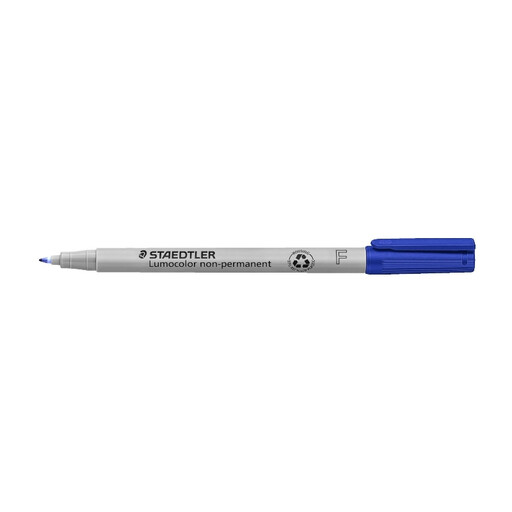
Why this product suits the profile: The blue F version, with a line width of around 0.6 mm, offers a balanced width for school, university and occasional office use on film, glass or plastic.
The specified F tip prevents small labelling areas from becoming cluttered with a line that is too broad. The ink is designed to be removed from smooth surfaces with a damp cloth.
Synthetic fibre tip, water-soluble blue ink, line width of around 0.6 mm and, according to product information, refillable with 487 15.
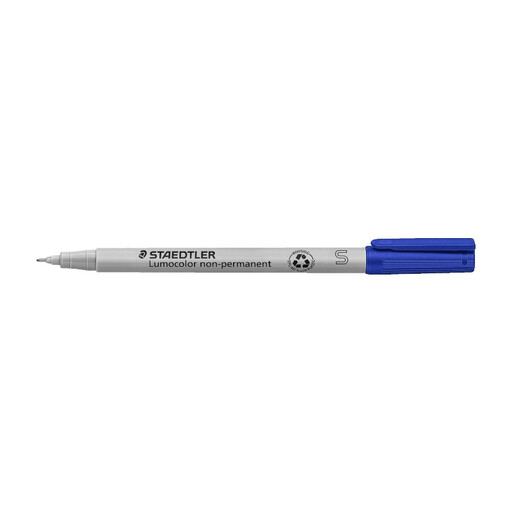
Why this product suits the profile: The 0.4 mm tip is designed for precise, fine lines and is suitable for technical drawings, small table fields and detailed presentation film.
The superfine tip reduces the risk of fine labels losing clarity because of an overly broad mark. A damp cloth is still required for low-residue correction.
Line width of around 0.4 mm, blue water-soluble ink, synthetic tip and, according to product information, aircraft-safe thanks to pressure equalisation.
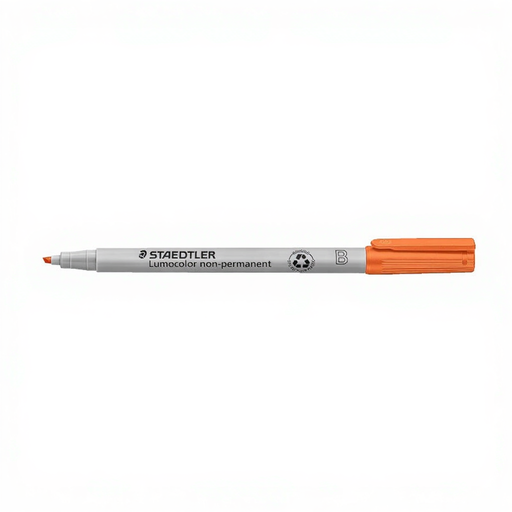
Why this product suits the profile: The orange B variant, with a width of around 1.0 or 2.5 mm, is suitable for presentations, training sessions and clear markings on film.
The variable width makes it easier to distinguish between headings and markings. The water-soluble ink is designed for temporary labelling, not permanent identification.
Chisel tip with approximately 1.0/2.5 mm width, orange ink, quick drying and, according to product information, refillable with 487 15.
Other suitable versions include the Lumocolor Marker in red, green, yellow and orange, as well as variants with 0.4 mm, 0.6 mm, 1.0 mm or 1.0/2.5 mm tips. For classic standard labelling, the red M Marker or green M Marker, for example, could be suitable. If you need an especially fine line, corresponding S variants are available in blue or red.
We have put together a complete, regularly updated list of products that fully meet these strict selection criteria and the safety regulations applicable in the EU.
With overhead film, the writing should have sufficient contrast without covering important projection areas. Depending on the lighting, yellow and orange may appear less distinct than blue, red or green. For technical drawings, line width is more important than an especially bold mark.
According to STAEDTLER product information, the marker is designed for smooth surfaces such as glass, plastic and film. Remove the ink with a damp cloth and check the particular glass coating before using it for the first time.
The service life depends on writing pressure, frequency of use, storage and the tip width used. A refillable marker can continue to be used after running dry with the appropriate STAEDTLER refill station. The cap should be firmly replaced after every use.
According to product information, several Lumocolor variants are described as aircraft-safe. An automatic pressure-equalisation system is intended to help prevent leakage caused by changes in pressure. The requirements of the relevant airline and hand-luggage regulations also apply to your specific journey.