
Lieferung heute & morgen

Qualitätsgarantie

Willkommens-Angebote freischalten: KOSTENLOSE Lieferung | Bis zu 80 % RABATT | Kostenlose 30-Tage-JoyPlus-Testphase
App herunterladen
A slipping mat can disrupt your concentration and increase the risk of injury during yoga, Pilates, or at-home fitness training. With so many options on the market, finding a mat that offers both grip and comfort can be overwhelming. As a Joybuy Product Recommendation Officer, my job is to provide you with objective information and clear guidance. This article outlines the criteria for selecting a suitable non-slip yoga mat and presents a selection of models for different needs.
Choosing the right mat depends on your individual needs and the type of exercises you practice. You should consider three key features in your decision.
The material is crucial for grip, cushioning, and durability. A TPE yoga mat (Thermoplastic Elastomers) is a popular option. TPE is a synthetic material that often has a closed-cell structure, making it moisture-resistant and easy to clean. Mats made from this material typically offer good slip resistance on many types of flooring and are often lighter compared to other materials like PVC or natural rubber. This makes them a practical sports mat for transport to the studio or for use as a yoga mat for home use.
The thickness of a mat affects both comfort and stability during balancing poses.
The dimensions of the mat should suit your height and practice style. A standard mat often measures around 183 x 61 cm. For taller individuals or for exercises with wide-ranging movements, a large yoga mat (e.g., 190 x 100 cm) can offer more freedom of movement. If you transport your mat regularly, a yoga mat with a carrying strap is a practical feature that makes rolling it up and taking it with you significantly easier.
Based on the criteria above, we have curated a selection of mats that are well-suited for various applications due to their specific features.

Why It Stands Out: This model combines a standard thickness of 6 mm with a dual-sided, anti-slip surface. The TPE material ensures a quick rebound and is lightweight, which simplifies transport.
Benefits:
Who It's For: This model is a great choice for yoga and fitness practitioners who need a versatile training mat for the studio or at home and who value a good balance between cushioning and stability.
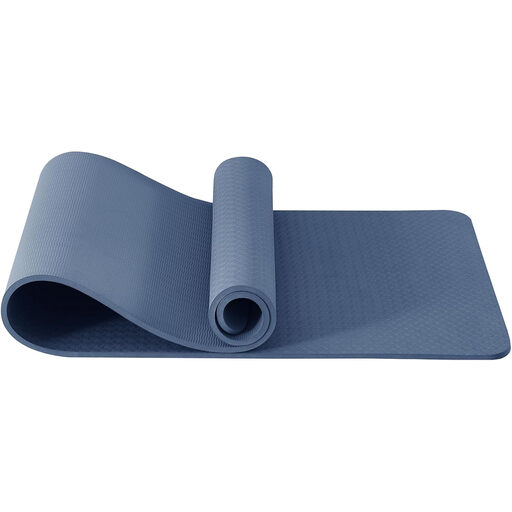
Why It Stands Out: With a thickness of 10 mm, this mat clearly focuses on comfort and joint protection. The high-density TPE material offers excellent cushioning, making it especially suitable for floor-based exercises.
Benefits:
Who It's For: This mat is aimed at users looking for an exceptionally well-cushioned fitness mat for Pilates, gymnastics, or stretching. It is ideal for individuals with sensitive joints or those who primarily practice lying down or seated.

Why It Stands Out: The key feature of this mat is its generous surface area of 190 x 100 cm. It offers significantly more space than standard mats, making it suitable for expansive movements or for people who appreciate more freedom of movement.
Benefits:
Who It's For: This large yoga mat is ideal for users who feel restricted on a standard mat or perform exercises with a wide range of motion. It is an excellent choice as a stationary yoga mat for home use.
If these models don't quite meet your specific requirements, you can find a broader selection of mats and accessories in our Pilates Equipment category. There, you can filter more models by material, thickness, and size.
1. How do you clean a non-slip TPE yoga mat? Most TPE mats can be easily cleaned with a damp cloth or sponge. If needed, a mild soap solution can be used. It is important to let the mat air-dry completely before rolling it up again. Machine washing is generally not recommended as it can damage the material.
2. What is the difference between a yoga mat and a fitness mat? The terms are often used interchangeably, but there are functional differences. A yoga mat is typically optimized for grip and a good connection to the floor for balancing poses. A general fitness mat or training mat is often thicker and more durable to absorb impact from high-impact exercises like jumping, but it may be less grippy.
3. Is a thicker yoga mat always better? Not necessarily. A thick yoga mat (e.g., 10 mm) offers more comfort and joint protection, which is beneficial for Pilates or restorative yoga styles. For dynamic yoga styles with many standing balance poses, a thinner mat (e.g., 4–6 mm) may be more advantageous as it provides more stability through a better connection to the floor. The choice depends on the primary use case.