
Lieferung heute & morgen

Qualitätsgarantie

Willkommens-Angebote freischalten: KOSTENLOSE Lieferung | Bis zu 80 % RABATT | Kostenlose 30-Tage-JoyPlus-Testphase
App herunterladen
A non-stick pan should release food reliably, be easy to clean and suit your hob. In practice, however, unclear coating information, wrong sizes and unsuitable care often lead to poor purchases. This applies just as much to a classic non-stick frying pan as it does to a ceramic pan, a sauté pan with lid or an electric cooking pot.
Not every pan works on an induction hob. What matters is a magnetic or induction-compatible base. A ceramic pan may be suitable for gas, electric and ceramic hobs, but expressly not for induction.
So before you buy, check the details for induction, gas, electric and ceramic hobs. If you move house or change your hob later, induction-compatible cookware can offer more flexibility.
Names like “Titanium”, “Granite”, “Stone” or “Ceramic” don’t automatically describe the overall material quality or a specific lifespan. What matters is the cookware’s construction, workmanship, maximum temperature and care instructions.
Even a surface advertised as easy-care can be damaged by metal utensils, abrasive cleaners or prolonged heating when empty. A non-stick coating is also no substitute for following the instruction manual.
PFOA-free cookware means, first of all, that according to the product information no PFOA has been added. This doesn’t automatically mean that all other groups of substances are excluded. With products that make such claims, you should pay close attention to the wording, for example “without intentionally added PFOA” or “PFAS-free according to the manufacturer”.
For a sensible choice, concrete material and care details count for more than sweeping advertising claims.
For induction, a pan needs a suitable magnetic base. For gas hobs, robust handles and a stable shape are practical, while on an electric or ceramic hob a flat base is important.
Examples from the selection:
A diameter of 20 to 24 cm often suits small households, singles or kitchens with limited storage space. 28 to 32 cm offers more surface area for family portions, but needs a large enough hob and more cupboard space.
A deep sauté pan with lid is ideal for stews, vegetables, pasta and sauces. A shallow crêpe pan, on the other hand, is specialised for pancakes, tortillas or omelettes. A saucepan of around 18 to 20 cm is useful if you want to prepare milk, sauces, pasta or small portions.
Pay particular attention to:
With electric appliances, power rating, capacity, overheat protection and boil-dry protection, as well as the instruction manual, are also relevant. A multi-function cooker with 1.6 to 2.6 litres is aimed more at individuals, couples, students or small households than at large families.
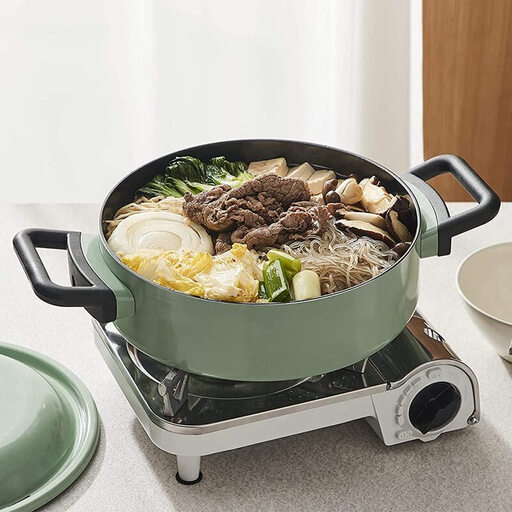
Why this product fits the profile: The 24 cm size is suitable for everyday portions. According to the product information, the cookware can be used on induction, gas and electric hobs, and combines a frying pan and shallow pot.
The hob compatibility is clearly stated. This helps avoid the common mistake of buying a pan that isn’t suitable for induction.
24 cm diameter, pressed aluminium, ceramic coating and Bakelite handle; suitable for sautéing, frying and sauces.
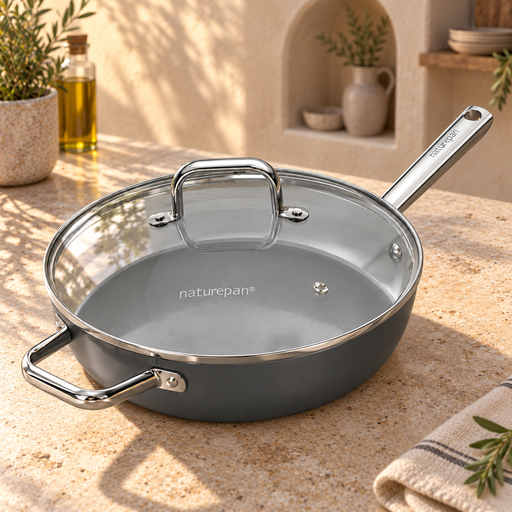
Why this product fits the profile: The 28 cm sauté pan with lid offers high sides for stews, sauces and one-pan dishes. According to the description, it is suitable for several hob types and is oven-safe up to 260 °C.
The details on hob types, lid, temperature limit and care are clearly listed. This makes it easier to match with your own hob and oven.
28 cm diameter, lid, aluminium body, ceramic coating and stated dishwasher suitability.
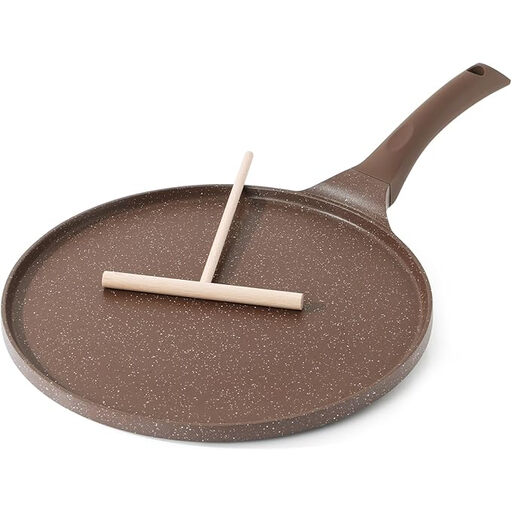
Why this product fits the profile: The shallow shape with low sides is designed for crêpes, pancakes, dosa, tortillas and omelettes. According to the product information, the pan is suitable for induction, gas and electric hobs.
The specific use is clearly described. You won’t buy a deep all-purpose pan when you need an even, flat surface.
10-inch format, flat cooking surface, Bakelite handle and, according to the manufacturer, without intentionally added PFOA, lead and cadmium.
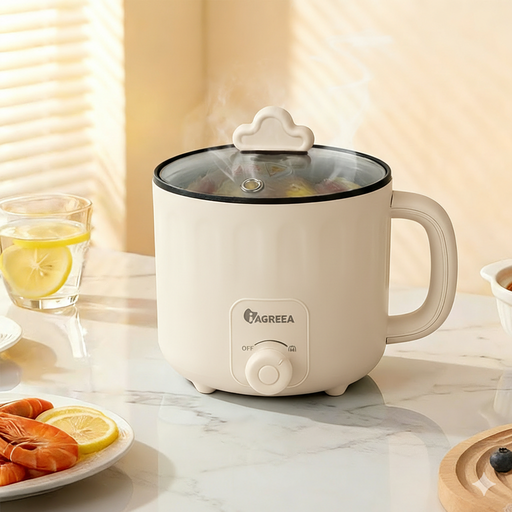
Why this product fits the profile: The 600 W electric cooker with 1.6 litres is aimed at students, singles, couples and small flats. According to the description, it is suitable for noodles, soups, shabu-shabu and stews.
The compact size prevents a large cooker from taking up unnecessary worktop and storage space. Auto shut-off and boil-dry protection are stated in the product information.
1.6 litre capacity, 600 W power, one-button control and compact dimensions for small kitchens or on the go.
We have put together a complete, regularly updated list of products that fully meet these strict selection criteria and the safety regulations in force in the EU.
It’s impossible to give a general lifespan for non-stick cookware. It depends on heat, frequency, cleaning method and the kitchen utensils used. For everyday use, we recommend:
With an electric cooking pot, additional safety rules apply: place it on a stable, heat-resistant surface, keep steam vents clear and never immerse the appliance or its power cord in water.
Only if the manufacturer expressly states this or the base is marked as induction-compatible. A coating alone says nothing about hob compatibility. Look for a magnetic base and check the details for your specific hob.
There is no fixed time frame. Gentle heating, suitable utensils and hand washing can keep the surface usable for longer. Scratches, overheating and abrasive cleaning agents can, on the other hand, damage the coating prematurely.
Consumption depends on power rating, running time and heat setting. A 600 W model theoretically uses 0.6 kWh during one hour of operation, a 1,000 W appliance 1 kWh. In practice, a cooker runs for different lengths of time depending on temperature control and cooking duration. So check the power rating and your intended usage before buying.