
Lieferung heute & morgen

Qualitätsgarantie

Willkommens-Angebote freischalten: KOSTENLOSE Lieferung | Bis zu 80 % RABATT | Kostenlose 30-Tage-JoyPlus-Testphase
App herunterladen
A new coated frying pan shines, and food slides out effortlessly. But often, this effect fades after just a few months. Food starts to stick, cleaning becomes a chore, and the disappointment is real. Many buyers fall into recurring traps, often disguised by clever marketing. This guide will help you identify the crucial features and make an informed choice.
Before we dive into the key features, here are two typical problems that can lead to a bad purchase:
To find a pan that meets your needs and is built to last, you should check three core parameters: the coating material, the base construction, and its overall versatility.
The choice of coating is fundamental to the cooking experience and the pan's longevity.
A good pan base is crucial for heat distribution and prevents the pan from warping under heat.
Depending on your cooking habits, additional features can make all the difference.
Here are some recommendations tailored to different user profiles.
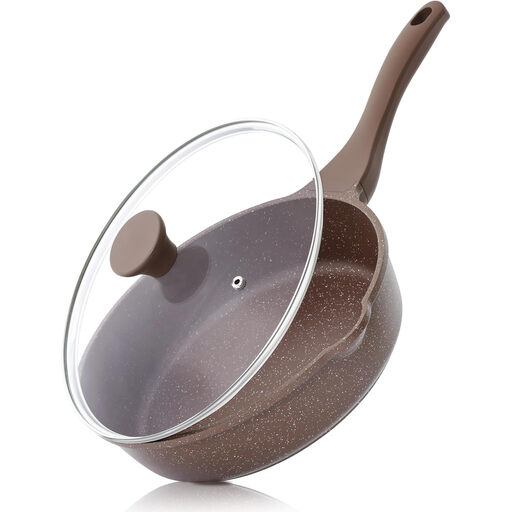
Why This Fits Their Persona: With its large diameter, high sides, and included lid, this pan is ideal for family-sized portions. It's suitable for frying, braising, and simmering saucy dishes, making it a versatile tool for daily use.
The granite non-stick coating is PFOA-free according to the manufacturer, directly addressing concerns about harmful substances. Its robust construction is designed for durability in everyday use.
High sides and a matching lid reduce splatters and allow for versatile cooking methods. Suitable for all cooktops, including induction.
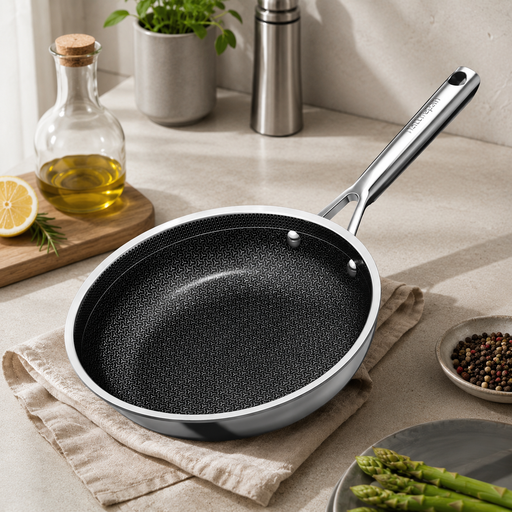
Why This Fits Their Persona: For home chefs who value performance and high-quality materials. The hybrid construction of stainless steel and ceramic coating is designed for high-heat searing, while its oven-safe nature enables complex recipes.
The diamond and titanium-reinforced ceramic coating is 5x more scratch-resistant than standard coatings, according to the manufacturer, thus countering the problem of short lifespan. It is explicitly certified as PFAS, PFOA, and PTFE-free.
The laser-etched honeycomb pattern protects the non-stick valleys while allowing for perfect searing on the stainless steel peaks. Oven-safe up to 260°C / 500°F.
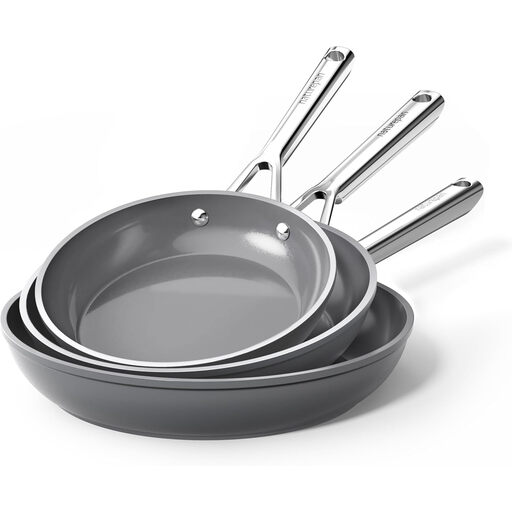
Why This Fits Their Persona: This set is a practical solution for anyone setting up a new kitchen or replacing their old cookware. With the three most common sizes (20, 24, and 28 cm), you're equipped for almost any task.
The set offers consistently high material quality across all sizes, avoiding the problem of mismatched pans. All pieces are induction-compatible, oven-safe, and free of PTFE/PFAS/PFOA.
A complete, coordinated induction pan set. The diamond and titanium-reinforced ceramic coating promises excellent durability.
We have compiled a complete, up-to-date list of products that fully meet these strict selection criteria and safety standards.
Avoid extreme temperature shocks (do not put a hot pan in cold water). Clean the pan by hand with a soft sponge and mild dish soap, even if it's labelled dishwasher-safe. Only use wooden, silicone, or plastic utensils, and never heat the pan empty on the highest setting.
There is no one-size-fits-all "better" option, only different strengths. A ceramic pan is often more heat-resistant and scratch-resistant, making it great for high-heat searing. A high-quality PTFE pan can offer unsurpassed non-stick performance at lower temperatures and for delicate foods. The choice depends on your cooking habits and personal material preferences.
Check the manufacturer's specifications for the maximum temperature. A key indicator is the handle: pans with solid stainless steel handles are typically heat-resistant to high temperatures and oven-safe. Pans with plastic, Bakelite, or wood handles are usually not suitable for the oven, or only at very low temperatures.