
Lieferung heute & morgen

Qualitätsgarantie

Willkommens-Angebote freischalten: KOSTENLOSE Lieferung | Bis zu 80 % RABATT | Kostenlose 30-Tage-JoyPlus-Testphase
App herunterladen
A non-stick frying pan should cook food evenly, use very little oil and be easy to clean. In practice, though, things can often disappoint: the pan may not work on an induction hob, the coating may overheat or the set may not include what you actually need. This guide explains which details to check before buying a frying pan or pan set.
The term describes only how the surface works. The coating itself could be PTFE, ceramic or a hybrid. Terms such as ‘granite’, ‘stone’ or ‘titanium’ don’t automatically tell you about the chemical composition or care requirements.
If you’re looking for a PFAS-free pan, check that the material is explicitly stated. According to their respective product details, certain ZEROPAN and SENSARTE models are free from PFAS, PFOA and PTFE. However, ‘PFOA-free’ on its own does not mean the same as ‘PFAS-free’.
A pan may be suitable for gas, electric and ceramic hobs without working on induction. An induction pan needs a magnetic base. So check claims such as ‘suitable for all hob types’ against the technical specifications.
Oven use varies, too. Some models are oven-safe with all parts fitted, while others can only go in the oven without the lid or with the handle removed. Always follow the stated maximum temperature.
A dishwasher-safe pan can be cleaned in the dishwasher according to the manufacturer. However, coatings often stay in good condition for longer if you wash them by hand with a soft sponge. Metal utensils, abrasive cleaners, prolonged heating when empty and sudden changes in temperature can all wear the surface, whatever the material.
Diameter isn’t the only thing to consider. High sides make stirring easier and help prevent splashes. A wide, flat base, on the other hand, is better for searing.
A stainless steel pan is robust and heat-resistant, but if it has a non-stick coating, you’ll still need to handle that coating with care. Multi-layer designs with an aluminium core can distribute heat across the surface. Cast iron and heavy aluminium retain plenty of heat, but are usually heavier.
For a ceramic pan, check whether the product details actually specify a ceramic non-stick coating and what temperature limits apply. Hybrid models often combine textured stainless steel areas with coated surfaces. This may appeal if you’re looking for a versatile cooking surface, but it doesn’t mean you can ignore the manufacturer’s care instructions.
Check the following:
It’s best to be cautious about health-related claims. A coating with stated material properties is not automatically a medical or health recommendation. What matters is clear, verifiable product information and using the pan correctly.

Why this product suits this profile: The set includes several pans and saucepans with lids, kitchen utensils and pan protectors. According to the product details, it’s suitable for induction, gas and electric hobs.
The contents of the set are clearly listed. The product details also state that the coating contains no intentionally added PFOA, PFOS, lead or cadmium.
13 pieces, glass lids and removable handles; according to the product details, it’s not suitable for oven use.
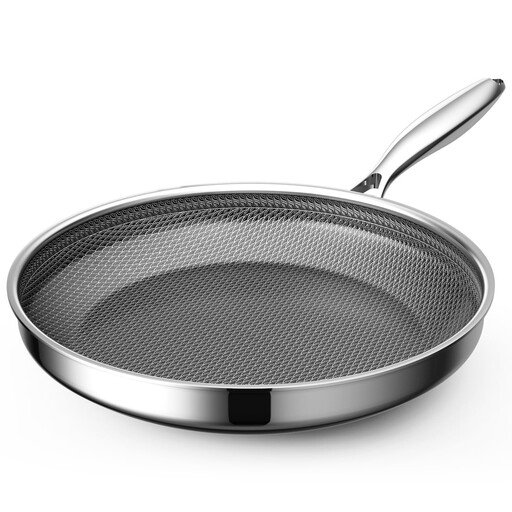
Why this product suits this profile: According to the product details, this compact pan has a three-layer construction, with stainless steel, an aluminium core and an induction base. It also has a ceramic coating that’s free from PFAS, PFOA and PTFE.
The product details clearly specify the material layers and compatibility with gas, electric, ceramic and induction hobs. It’s stated to be oven-safe up to 260 °C.
20 cm size, stainless steel handle and dishwasher-safe design according to the product details.
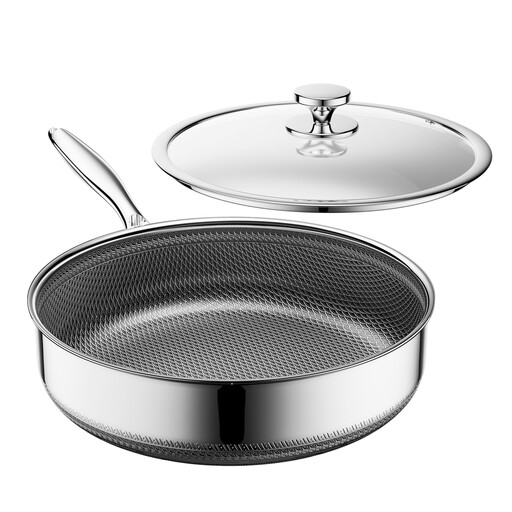
Why this product suits this profile: According to the description, this 28 cm pan with a glass lid is suitable for frying, braising and dishes with liquid. It’s designed for all the hob types listed.
The product details specify separate temperature limits: up to 260 °C for the pan and 148 °C for the lid. This makes the limits for oven use clear.
Deep shape, glass lid, aluminium core and a coating that’s free from PFAS, PTFE and PFOA according to the product details.
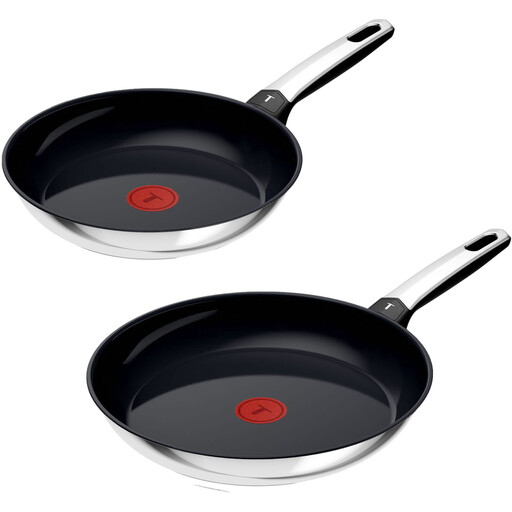
Why this product suits this profile: The two sizes, 24 and 28 cm, cover everything from individual portions to larger family meals. The deep design can be handy for sautéing and cooking generous portions.
With two clearly stated diameters, there’s no need to use an oversized pan for every task. The induction base and hob compatibility are also specified.
Two ceramic pans, Thermo-Signal indicator and dishwasher-safe design according to the product details.
We’ve put together a complete, regularly updated list of products that meet these strict selection criteria and fully comply with the safety regulations in force in the EU.
A 24 to 28 cm frying pan is usually big enough for two people. With very shallow models, the usable cooking surface may be smaller. If you often make sauces, vegetables or one-pot meals, you could choose a deep pan with a lid.
Look for models that are explicitly stated to be induction-compatible and have a magnetic base. This should be listed in the technical product details. Stainless steel alone doesn’t guarantee that a pan will work on an induction hob.
There’s no reliable way to give a fixed lifespan for every model. It depends on the type of coating, heat, utensils, cleaning and how often you use the pan. Gentle heating, hand-washing and avoiding metal utensils can help a coated pan last longer.