
Lieferung heute & morgen

Qualitätsgarantie

Willkommens-Angebote freischalten: KOSTENLOSE Lieferung | Bis zu 80 % RABATT | Kostenlose 30-Tage-JoyPlus-Testphase
App herunterladen
A non-stick frying pan should let you cook food with little oil, be easy to clean, and suit the hob you already have. In practice, however, unclear coating descriptions, wrong sizes and unsuitable handles often lead to a bad purchase. If you check a few technical details before buying, you can narrow down your options considerably.
A pan will only work on an induction hob if it has a magnetic base. Aluminium on its own is not suitable for induction. A frying pan for induction therefore usually needs a special stainless steel or magnetic base.
Oven suitability is also not a given. Plastic or Bakelite handles often significantly limit the maximum temperature. The Silit Belluna is listed as suitable for all hob types including induction, but is only oven-safe up to 70 °C. A claim like "oven-safe" should therefore always be considered alongside the maximum temperature.
"Ceramic", "Granite" or "Titanium" do not automatically describe a specific lifespan. What matters is the exact type of coating, how you handle heat, and the kitchen utensils you use. A ceramic pan can be damaged if overheated when empty or cooled down abruptly. Even a PTFE coating should not come into contact with metal cutlery, knives or abrasive cleaners.
If you are looking for a PFAS-free pan or PTFE-free pan, look for a specific statement from the manufacturer. PFOA-free does not automatically mean PFAS-free or PTFE-free. These terms are not interchangeable.
A dishwasher-safe frying pan saves time, but the coating can be more heavily stressed by detergents, high temperatures and contact with other dishes. With several models, hand washing is still recommended despite the stated dishwasher suitability. A soft brush or sponge and mild washing-up liquid are usually the gentler choice for coated surfaces.
First, check whether the pan is approved for gas, electric, ceramic and induction. A multi-layer base or an integrated aluminium core can distribute heat across the surface. An aluminium frying pan is often light and heats up quickly. Cast iron or heavier material, on the other hand, stores more heat but can be significantly heavier.
For delicate foods like fish, eggs or pancakes, even heat distribution is particularly useful. With induction, a flat base is also essential so that the energy transfer works reliably.
A 24 cm frying pan is suitable for smaller portions, omelettes or side dishes. It often fits hob zones around 18 cm in diameter. A 28 cm frying pan offers more space for several portions, but also needs a correspondingly large cooking zone. For families, a pan set with 24 and 28 cm can be a good idea, as it covers both small and larger dishes.
Alongside the outer diameter, the usable frying surface matters. High, straight sides increase capacity, while a flatter shape makes flipping easier. A lid is useful for braised dishes, but is not always included with every model.
With PTFE models, you should pay attention to the maximum temperature and generally cook on a medium heat. Ceramic coatings are often labelled as PTFE-free, but they still need careful handling. Use wooden, plastic or silicone spatulas and let the pan cool down before washing it.
An ergonomic handle makes cooking easier, especially with a large pan. For the oven, the handle must be explicitly approved for the temperature you need. With non-stick pans, the actual care instructions are more important than any general advertising claims about robustness.

Why this product fits the profile: The lightweight aluminium construction is designed for everyday frying, breakfast and simple family meals. According to the product description, the pan is suitable for induction, gas and ceramic hobs.
The specifications name specific hob types and recommend hand washing. This makes it easier to match the pan's features with your own household before buying.
26 cm diameter, wooden handle with heat insulation and aluminium body for fast heat conduction.

Why this product fits the profile: The set covers two common household sizes and, according to the product description, comes with a TransTherm universal base for various hob types including induction.
The two diameters avoid a one-size-fits-all approach. The stated oven suitability up to 400 °C should still be checked against the manufacturer's specific instructions.
Two sizes, stainless steel body and wide pouring rim according to the product description.
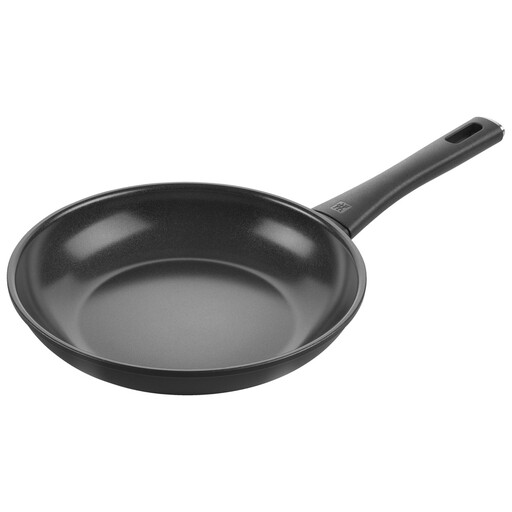
Why this product fits the profile: For households looking for a PTFE- and PFOA-free coating, this model combines an aluminium body with a CeraForce ceramic coating, according to the product description.
The type of coating and the absence of PTFE and PFOA are specifically stated. Gentle hand washing and medium heat are still required.
24 cm diameter, suitability for induction and stated oven suitability up to 250 °C.

Why this product fits the profile: The 24 cm model is designed for smaller daily portions and, according to the product description, features a Silitan PTFE coating and a plastic handle.
The limitation on oven temperature is clearly stated. This makes it easy to distinguish this model from a high-temperature oven-safe frying pan.
Aluminium construction, induction suitability and a stated five-year manufacturer's warranty.
The non-stick effect makes low-fat cooking easier, but it does not replace proper temperature control. A little oil can be enough; you do not have to do without it entirely.
We have put together a complete, regularly updated list of products that fully meet these strict selection criteria and the safety regulations in force in the EU.
For smaller portions, a 24 cm frying pan is often enough. If you regularly fry several ingredients at once or prepare leftovers for the next day, a 28 cm pan gives you more usable surface area.
It is not possible to give a reliable general lifespan. It depends on the type of coating, heat, cleaning and kitchen utensils. Scratches, prolonged heating when empty and abrasive cleaners will shorten its useful life. If you see visible peeling, you should stop using the pan.
PFAS- and PTFE-free claims describe the material choice of the coating, but they are not a medical promise of effectiveness. What matters is that the information is clearly stated on the product page or packaging and that the pan is used according to the care instructions.