
Lieferung heute & morgen

Qualitätsgarantie

Willkommens-Angebote freischalten: KOSTENLOSE Lieferung | Bis zu 80 % RABATT | Kostenlose 30-Tage-JoyPlus-Testphase
App herunterladen
A high-quality, non-stick frying pan that works flawlessly on an induction hob is an essential tool in the modern kitchen. However, the search is often more difficult than it seems. Many models promise durability and perfect searing results, but lose their non-stick properties after just a few months or heat unevenly on an induction hob. As your Joybuy Product Recommendation Officer, I'll help you recognise the typical marketing traps and make an informed decision.
Before you invest, you should be aware of the three most common problems that lead to disappointment and unnecessary expense:
To avoid a bad purchase, focus on three verifiable technical characteristics.
Induction compatibility depends entirely on the base. Look for a full-surface ferromagnetic base, usually made of stainless steel. This ensures fast, even heat distribution across the entire cooking surface and optimal energy transfer from the hob. A solid base thickness also prevents the pan from warping at high temperatures. Models designated as a pan for all hob types must have this feature.
The non-stick coating is the heart of the pan. There are significant differences here:
A pan's body is often made of aluminium, as it is an excellent heat conductor. A forged aluminium pan generally offers higher material density and stability than a cast one. A size like a 28 cm pan is ideal for most households.
Another important feature is its oven-safe capability. An oven-safe pan significantly expands your cooking options, for example, for finishing dishes or baking. Pay attention to the handle: stainless steel or cast iron handles are usually highly heat-resistant, while plastic or Bakelite handles limit or exclude oven use.
Here are some models tailored to specific needs that meet the quality criteria mentioned.
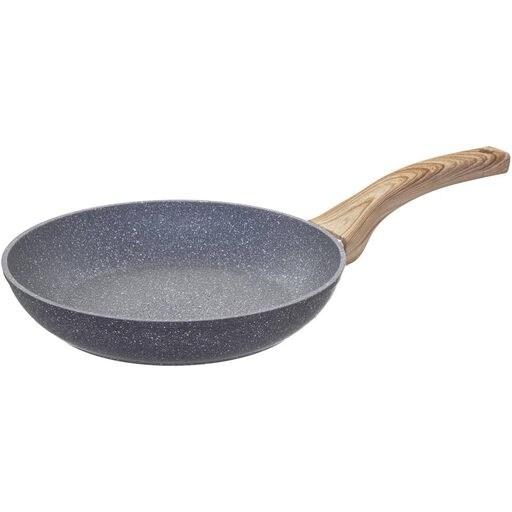
Why it's a great fit: A straightforward and functional pan for all hob types in the standard 28 cm size. It offers solid baseline performance for daily use, from fried eggs to sautéed vegetables, without breaking the bank.
This model features a clearly defined stainless steel induction base that ensures reliable compatibility, and a two-layer non-stick coating designed for everyday use without making exaggerated durability claims.
Universal hob suitability and a lightweight design for easy handling during quick, uncomplicated meals.
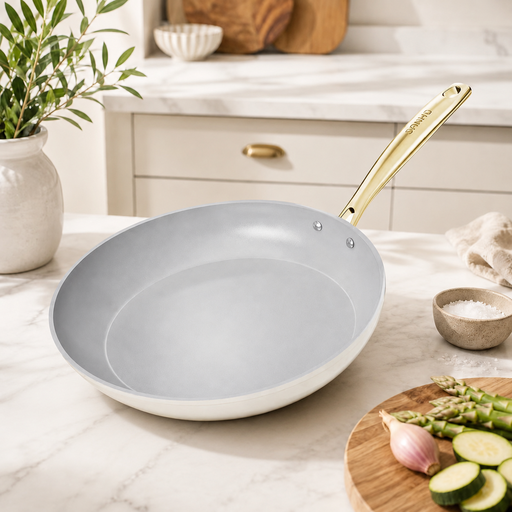
Why it's a great fit: The focus is clearly on safety and versatility. The ceramic coating, explicitly declared as PFAS-free, is ideal for families. Its high oven-safe temperature of up to 260°C allows for finishing dishes directly in the oven.
This model goes beyond vague "toxin-free" claims and guarantees a PFAS-free cooking surface. The patented diamond-titanium coating aims for greater robustness and longevity than simple ceramic pans.
A combination of proven health safety (PFAS-free) and high heat resistance for flexible cooking, from hob to oven.
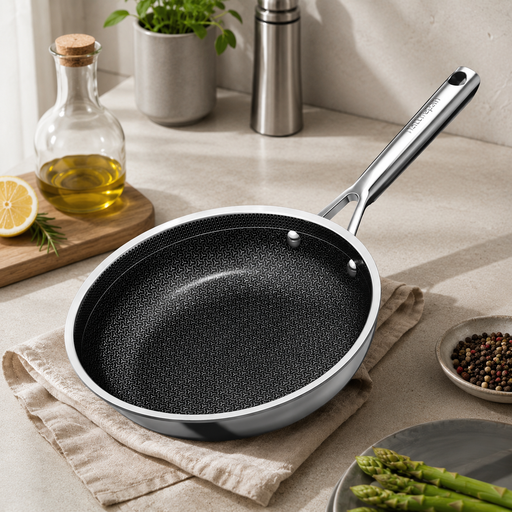
Why it's a great fit: The innovative hybrid technology with raised stainless steel ridges allows for searing like in a stainless steel pan, while the ceramic valleys ensure non-stick performance. Ideal for demanding dishes that require both.
This model resolves the trade-off between searing and non-stick. The robust 5-ply construction and laser-etched hexagon surface are engineered for performance and longevity, not just a simple coating.
Hybrid surface for both high-heat searing and non-stick functionality. The high oven-safe temperature (up to 260°C) and multi-layer construction deliver professional-grade performance.
We've compiled a complete, up-to-date list of products that fully meet these strict selection criteria and UK safety regulations.
The easiest way is the magnet test: hold a magnet to the bottom of the pan. If the magnet sticks firmly, the pan is ferromagnetic and therefore suitable for induction hobs.
Avoid overheating the empty pan. Use wooden, silicone, or plastic utensils instead of metal. Clean the pan by hand with a soft sponge and mild washing-up liquid, even if it is declared dishwasher-safe. Hand washing is gentler on the coating.
Modern ceramic coatings are generally manufactured without the use of PFAS. If you are looking for a healthy, toxin-free pan, an explicitly labelled PFAS-freeceramic induction pan is an excellent choice. Conventional PTFE coatings are also safe when used correctly (i.e., without overheating), but their manufacturing process can be more harmful to the environment.