
Lieferung heute & morgen

Qualitätsgarantie

Willkommens-Angebote freischalten: KOSTENLOSE Lieferung | Bis zu 80 % RABATT | Kostenlose 30-Tage-JoyPlus-Testphase
App herunterladen
A non-stick frying pan for induction should do more than just fry an egg. In many homes it often needs to work on several hob types, be easy to handle and clean with minimal effort. At the same time, terms like "granite", "Maifan stone" or "PFOA-free" don’t automatically lead to the right purchase.
So the key questions are: Does the pan suit your hob? Is the size right for your household? What care does the coating require? And is a specialist model like a crêpe pan or egg pan more sensible than a universal frying pan?
Aluminium on its own doesn’t react to an induction field. An induction pan therefore usually needs a magnetic base or an integrated induction plate. If a model is advertised as a "pan for all hob types", the suitability for induction, gas and ceramic or electric should be stated explicitly in the product details.
If you’re unsure, a magnet test on the base can help. However, the manufacturer’s specifications are decisive, because the construction and size of the magnetic base matter.
Terms such as granite coating, stone look or Maifan stone coating often describe the type of coating or appearance. They don’t replace information on care, maximum temperature or the use of suitable utensils.
Metal spatulas, steel wool and abrasives can damage the surface. You also shouldn’t heat an empty pan on a high setting for a long time. A coated pan is therefore not automatically suitable for every cooking method and every temperature.
Many lightweight non-stick pans are described as not dishwasher-safe. That applies to several models in this selection too. Gentle hand-washing with warm water, mild washing-up liquid and a soft sponge is therefore part of the ongoing care cost – not in money, but in time.
For a single portion or breakfast, an egg pan of around 19 to 20 cm is often enough. For two to three portions, veg, fish or stir-fries, 24 to 26 cm is usually more practical. A deeper shape also lends itself to sautéing and quick braising, while a flat crêpe pan makes flipping easier.
Also consider the dimensions of your induction zone. A very small pan base may be recognised less efficiently on some hobs. What counts is the actually magnetic base area, not just the top rim diameter.
A non-stick pan helps with low-oil frying when the surface is intact and used on low to medium heat. However, "low-oil" doesn’t mean you must avoid oil or fat entirely. With delicate foods such as eggs, fish or pancakes, a small amount of fat can make releasing easier.
Plastic, wooden or silicone turners are practical. A version described as a PFOA-free pan should state this explicitly in the specifications. For the SENSARTE crêpe pan, the product description states a coating with no intentionally added PFOA, lead or cadmium. This claim refers to that specific product and shouldn’t be applied across the board to other pans.
A lightweight aluminium pan is easier to move one-handed. That can help seniors, anyone with limited strength or when you’re rustling up breakfast quickly. A pan-with-wooden-handle model can feel comfortable in the hand; however, the handle may get warm during prolonged or high-heat cooking. Oven cloths or heat-resistant gloves are therefore still a good idea.
A glass lid makes it easy to keep an eye on things and is useful for braising or keeping food warm. Still check whether the lid is included and whether it needs to be cleaned separately.
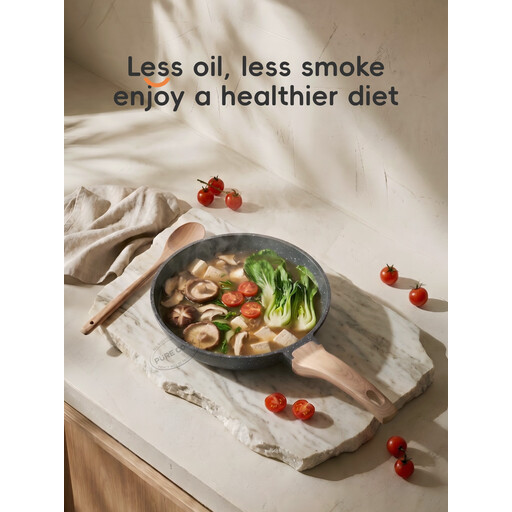
Why this product suits the profile: The 20-cm pan is designed for smaller portions, eggs, bacon, sandwiches and breakfast dishes. The included glass lid extends its use to quick braising.
The details explicitly list induction, gas and ceramic as suitable hob types. Hand-wash only is also clearly stated.
Aluminium body, wooden handle, flat recessed base plus glass lid; according to the specifications, suitable for low-oil frying.
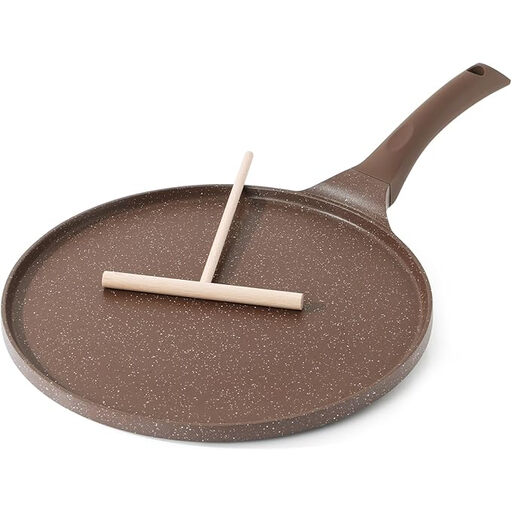
Why this product suits the profile: The flat 10-Zoll design with low sides is aimed at those who want to make crêpes, pancakes, tortillas or omelettes with precision.
The magnetic stainless-steel base is explicitly described as suitable for induction. The product details also state hand-wash only and a maximum oven temperature of 302 °F.
Aluminium core, flat shape, Bakelite handle and, according to the product description, a coating with no intentionally added PFOA, lead or cadmium.
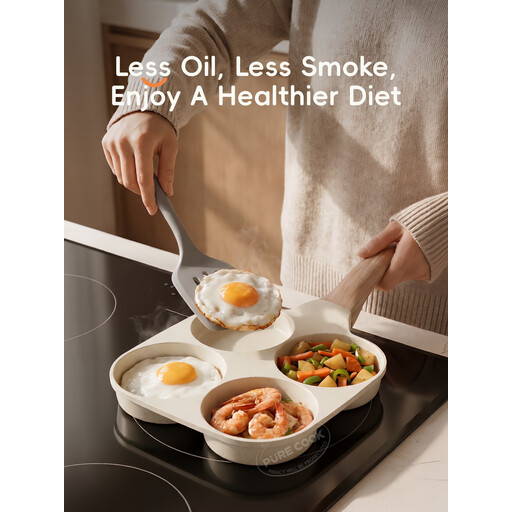
Why this product suits the profile: The four separate sections are designed to cook multiple eggs, small pancakes, patties or sausages in parallel and can bring structure to breakfast prep.
The compact design avoids buying a large universal pan for a tightly defined purpose. The details state suitability for induction, gas and ceramic.
Four sections, aluminium body, wooden handle and, according to the details, a smooth coated surface for cooking with little oil.

Why this product suits the profile: The larger diameter offers more surface for vegetables, fish, meat alternatives or multiple breakfast portions.
The product data clearly state the material, diameter, hob types and hand-wash requirement. That reduces the risk of inferring size or care needs from looks alone.
26-cm aluminium body, deeper flat base, rolled rim and wooden handle; designed for frying, sautéing and quick braising.
We’ve compiled a complete, regularly updated list of products that fully meet these strict selection criteria and the safety regulations in force in the EU.
20 to 24 cm is often sufficient for smaller portions and breakfast dishes. If you regularly cook for several people, 26 cm offers more flexibility. The size of your induction zone and available storage space also matter.
There’s no blanket lifespan. It depends on coating quality, temperature, utensils used and cleaning. Low to medium heat, hand-washing and soft utensils can protect the surface. If you see visible damage, replace the pan.
An intact non-stick coating can reduce the amount of oil needed for many dishes. The result, however, depends on the ingredient, temperature and cooking method. For low-oil frying, the right temperature control is just as important as the coating itself.