Hosts serving guests at different times
You prepare broth and need to decide whether to keep it hot for later servings or chill it for later.


If your pan has a ferromagnetic base, a portable induction hob may be suitable. For other pans, a radiant ceramic-glass or cast-iron hob could be a better fit. If you want to keep the broth hot for later servings, a claimed keep-warm function does not prove the temperature of the food: the Federal Institute for Risk Assessment (BfR) recommends keeping it at a minimum of 60 °C throughout. To cook noodles and broth at the same time, you’ll need two usable cooking zones, enough space and a suitable power connection.
You prepare broth and need to decide whether to keep it hot for later servings or chill it for later.
You want to choose the heating type to suit your pan’s material and base size, rather than assume it will work with induction.
You want to cook broth and noodles separately at the same time, so you need to consider the cooking zones, available space and power connection.
When choosing a hob for noodle broth with staggered mealtimes, the right option depends mainly on how you’ll serve the broth, which pan you use and whether you’ll have one or two pans on the hob at once.
| Consideration | What to check before buying | Who is it most relevant to? |
|---|---|---|
| Broth for later servings | Check the appliance’s temperature range and automatic shut-off; if keeping the broth hot, measure it with a food thermometer. | If I’m preparing broth for people arriving later, I need to know how it will be handled before serving. Around 36% of consumers are primarily concerned with keeping later servings at a suitable temperature. |
| Continuing to use your existing pan | Check the pan’s base and diameter against the specifications for the specific model. | If you want to keep using your own broth pan, start by checking its material and base size. Around 29% of consumers focus on whether the hob is compatible with their existing pan. |
| Cooking noodles and broth at the same time | Check the number and size of the cooking zones, total power, power connection and space for both pans, including their handles. | If I want to cook noodles and broth at the same time in separate pans, I need two suitable cooking zones. Around 21% of consumers prioritise cooking two dishes at once. |
| Limited worktop space | Check the appliance dimensions and that you have a safe place to set it up; consider whether a single hob is enough for your needs. | When worktop space is limited, it’s important to check whether the extra cooking appliance will really fit, along with the pan and its handles. Around 14% of consumers are primarily concerned with minimising the space and equipment needed. |
An appliance feature that specifies a temperature of around 60 °C does not prove that the broth reaches this temperature throughout.
The BfR recommends keeping heated food at a minimum of 60 °C throughout until it is eaten. Measure the broth if it is going to be kept warm for a while.
Induction hobs need a suitable ferromagnetic pan base, and the base diameter must also match the cooking zone.
Check the material and diameter of the pan base against the specifications for the specific model, or consider a different type of hob.
Two pans need space, and the total power must be suitable for the power connection you plan to use. Rommelsbacher advises against using multi-socket extensions with its high-powered double hobs.
Allow space for both pans and their handles, and check the instructions and power specifications for the appliance you choose.
The COMFORT C2000 is an example of a model for shoppers considering a keep-warm function on a portable single induction hob.
The CT 2010/IN is a portable induction hob, while the CT 2200/E is a radiant ceramic-glass hob.
The DK 1014 double cast-iron hob may suit you if you need two independently controlled cooking zones for broth and noodles.
The Kult X Mono is an example of a model for shoppers considering preset programmes on a portable single induction hob.
This selection includes portable single induction hobs and induction and ceramic-glass hobs with two cooking zones. Check that the heating type, pan and number of cooking zones suit the way you cook.
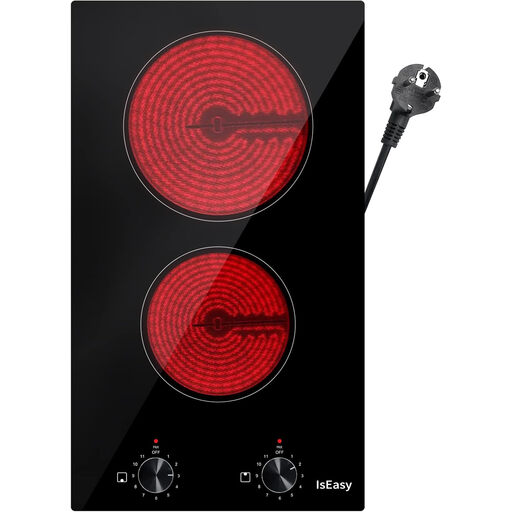 No image available
For two pans when you want to heat broth and noodles separately.
Listed in the product title: 3,200 W, 29.5 cm and 11 power levels.
 No image available
For one cooking zone when you want to adjust the heat in stages.
Listed in the product title: 28 cm, nine heat settings and a timer of up to eight hours. According to the product information, magnetic cookware with a base diameter of 12–26 cm is required.
 No image available
For two separate pans when you want to heat noodles and broth at the same time.
Listed in the product title: five temperature settings and a keep-warm function. This function does not prove that the broth reaches at least 60 °C throughout.
 No image available
For an extra cooking zone when you only need to heat one pan on the appliance.
Listed in the product title: tabletop hob with 1,000 W and five power levels.
 No image available
For one portable cooking zone when you want to choose between temperature settings.
Listed in the product title: ten temperature settings. According to the product information, compatible magnetic cookware is required.
No, on its own it does not prove the temperature of the food. The BfR recommends keeping heated food at a minimum of 60 °C throughout until it is eaten. Measure the broth if it is going to be kept warm for a while.
For longer storage, the BfR recommends cooling hot food quickly to below 7 °C. When reheating it later, the BfR specifies at least 70 °C for two minutes throughout.
The pan needs a suitable ferromagnetic base, and its diameter must also match the cooking zone on the specific model. For the Rommelsbacher CT 2010/IN, Rommelsbacher specifies a cooking zone of 120–230 mm. This specification does not automatically apply to other models.
Compare the appliance’s dimensions and total power with your available space and power connection, and follow the instructions for the model you choose. Rommelsbacher advises against using multi-socket extensions with its high-powered double hobs.
New electrical products within the scope of the Low Voltage Directive or the 1. ProdSV must meet the relevant conformity requirements. The BAuA describes the scope; for a specific product, a statement in the product description alone does not prove conformity.