
Lieferung heute & morgen

Qualitätsgarantie

Willkommens-Angebote freischalten: KOSTENLOSE Lieferung | Bis zu 80 % RABATT | Kostenlose 30-Tage-JoyPlus-Testphase
App herunterladen
A notebook should be reliable in everyday life: in your school bag, backpack, on your desk or when you’re out and about. Yet eye-catching designs and unclear product information often lead to disappointing purchases. It’s not just the colour or cover that matters, but also the format, paper weight, binding and features suited to how you plan to use it.
A product may, for example, be advertised as having 160 pages when it actually contains 80 sheets. When both sides are used, one sheet provides two writable pages. So if you want to keep notes, sketches or a diary over a longer period, always check whether the number refers to sheets or pages.
The paper weight, such as 70 g/m², 90 g/m² or 100 g/m², describes the weight of the paper per square metre. It is a useful guide, but does not by itself indicate how fountain pen, gel or felt-tip ink will behave. Thicker paper is often more practical for writing on both sides. However, when using more sensitive inks, the paper surface and type of pen remain important too.
A hardcover notebook protects its contents better in a full bag. A softcover, on the other hand, is often lighter and more flexible. A PU leather notebook can feel comfortable to hold and can be cleaned with a soft, damp cloth, but should be protected from heavy moisture, heat and sharp objects. For everyday transport, a rubber band is also useful if you want to keep the notebook closed.
The format determines how much writing space is available and how easy the notebook is to carry.
If you regularly make diagrams, write longer texts or create weekly overviews, don’t focus solely on portability. A format that is too small may mean having to spread your content across several pages.
A ruled notebook supports structured notes and written work. Squared paper is better suited to tables, mathematical tasks and precise sketches. Plain paper offers more freedom for drawings and bullet journalling, but requires you to create your own layout.
The paper weight should be clearly stated in the product information. For example, the Jubiluu models use 100-g/m² offset paper with an off-white colour. The LAMY B3 Softcover A5 is specified with 90-g/m² paper and college ruling. A Deli spiral notebook is listed with 70 g/m² paper. These figures provide an initial point of reference, but do not replace checking the specific usage information.
A spiral notebook can often be opened flat and is suitable for writing with one hand. At the same time, the spiral may take up more space in a bag. Traditional glued binding looks more compact, but does not always lie completely flat.
Useful features include:
The following recommendations group the products according to specific everyday situations. The stated formats, materials, paper specifications and features are the key considerations.
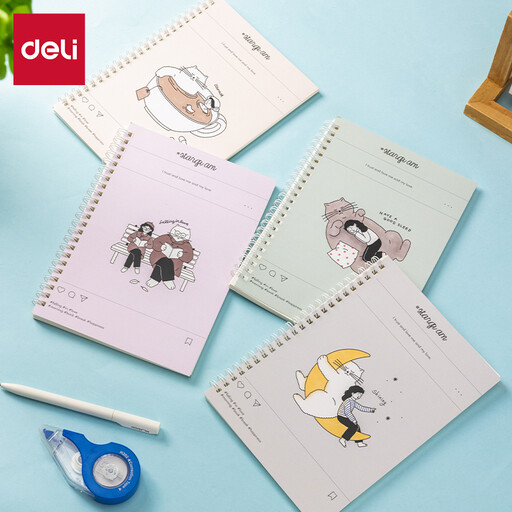
Why this product suits this profile: The A5 format provides plenty of space for school, university or the office. The four notebooks can be separated by subject, project or purpose.
The spiral binding makes page-turning easier, while the product information states the format, sheet and page counts, as well as 70 g/m² paper.
A5 format, spiral binding and a pack of 4 for different subject areas.
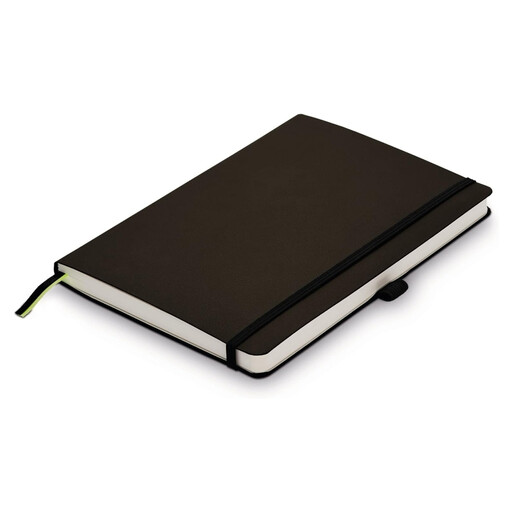
Why this product suits this profile: For professionals, teachers and students looking for a clearly structured A5 notebook with college ruling and additional fastening features.
The specifications state 90 g/m² paper, college ruling, 192 pages, a pen loop and a rubber band.
A5 format, 192 pages, paper with stated ink resistance and practical storage for writing instruments.
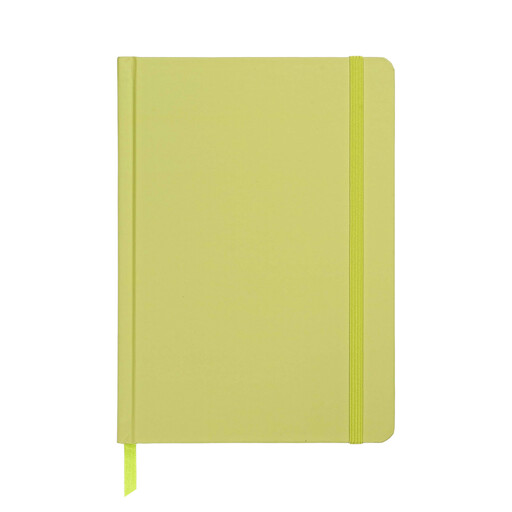
Why this product suits this profile: The undated planner is designed for users who want to use monthly and weekly overviews flexibly for work, study, goal planning or journalling.
Undated pages prevent unused calendar days from permanently taking up space in the planning section. The hardcover is designed for frequent opening and closing.
A5 format, 112 sheets, 100-g/m² offset paper, monthly and weekly layouts, plus a ribbon bookmark and rubber band.
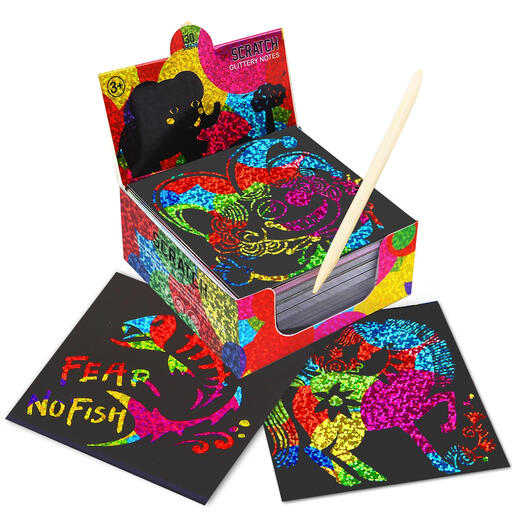
Why this product suits this profile: The Scratch Art set for children and creative adults includes small note cards for drawings, cards, labels or short messages.
The contents include 130 pre-cut sheets, a wooden stylus and a format of approximately 8.9 × 8.9 cm. This clearly defines the intended use.
130 Scratch Art sheets, wooden stylus, compact card format and use without glue or liquid colours.
We’ve put together a complete, regularly updated list of products that fully meet these strict selection criteria and the safety regulations applicable in the EU.
An A5 notebook offers plenty of space for lessons, lectures and summaries. If you have several separate subjects, a pack of 4 may be more useful than one particularly large notebook. Spiral binding makes it easier to open the notebook flat, while a hardcover provides additional protection during transport.
An A6 notebook is suitable for brief notes, shopping lists, spontaneous ideas or a compact diary. For longer notes and detailed weekly planning, it offers less writing space than A5. A pen loop, ribbon bookmark and rubber band make it even more practical when you’re out and about.
Durability depends on the binding, cover, paper and how much daily use it receives. A hardcover can provide greater protection for the outer pages, while a spiral notebook lies flat when pages are turned frequently. Store every notebook in a dry place and avoid excessive bending, intense heat and moisture. It is also essential that the format and features match the way you actually intend to use it.