
Lieferung heute & morgen

Qualitätsgarantie

Willkommens-Angebote freischalten: KOSTENLOSE Lieferung | Bis zu 80 % RABATT | Kostenlose 30-Tage-JoyPlus-Testphase
App herunterladen
A notebook set can make organising your schoolwork, studies, office tasks or everyday life easier. You can allocate several notebooks by subject, project or purpose. However, product listings often appear more appealing because of their colours, designs and high page counts than they prove to be in everyday use. It is therefore worth checking a few factual details before buying.
Notebook listings may specify both sheets and pages. One sheet consists of two pages. Details such as “60 Sheets/160 Pages” should therefore be read carefully. What matters is how many pages can actually be written on, and whether the figure applies to one notebook or the entire set.
An A7 notebook is lightweight and suitable for short notes, but offers considerably less writing space than an A5 notebook. For longer notes, study plans or a journal notebook, A5 is generally more practical. If you mainly want to record telephone numbers, shopping lists or spontaneous ideas, A7 notebooks can save space in your bag or rucksack.
A spiral binding makes turning pages easy and can support comfortable writing when the notebook is laid flat. At the same time, it needs sufficient space at the edge and should not be bent excessively. A softcover notebook is flexible and easy to carry, but offers less protection than a hard cover. Page markers, pen loops and pockets should also be more than decorative: they should be genuinely useful in everyday use.
The DIN A5 format measures approximately 148 × 210 mm and provides enough space for lessons, meetings, to-do lists and journalling. An A7 notebook is considerably more compact and is suitable for short entries or as a supplement to a larger notebook.
This guide can help you choose:
If you want to cover different situations, you can combine an A5 set with a compact single notebook.
Paper weight is specified in g/m². Paper weighing 70 g/m² is lightweight and suitable for many ballpoint pens or pencils. Paper weighing 90 g/m² has a more substantial feel. Its actual suitability also depends on the pen and ink you use.
The ruling also affects how useful a notebook is:
A notebook with a page marker and pen loop can be practical in the office or on the go, as it allows you to find important pages quickly while keeping a pen directly with the book. For simple short notes, however, these features are not essential. With spiral notebooks, you should also check whether the spiral is positioned at the top or at the side. A top binding can be advantageous when using the notebook with one hand or while standing.
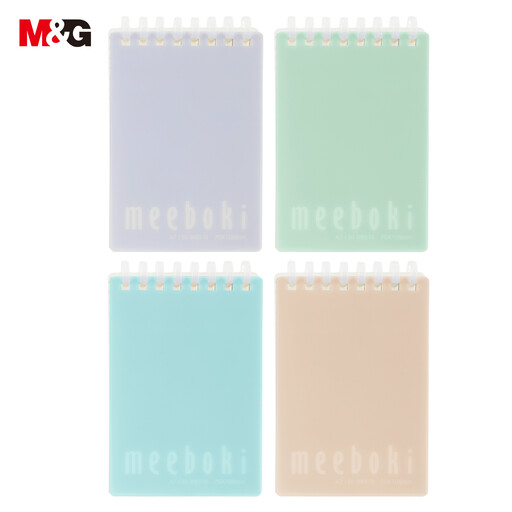
Why this product suits this profile: The set contains four compact A7 notebooks with squared paper, making them suitable for short notes, task lists or organising content by topic.
The A7 size clearly indicates its intended use on the go. The product details state 50 sheets or 100 pages per notebook, helping to avoid confusion about the set contents.
Four notebooks, squared paper, soft covers and top spiral binding for compact one-handed use.
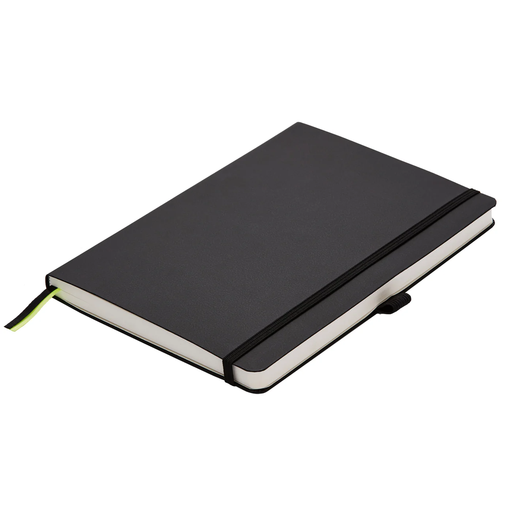
Why this product suits this profile: The A6 soft cover combines a compact format with 192 pages, 90-g/m² paper, two page markers, a pen loop and a back pocket.
The features are clearly specified: Lamy ruling, 192 pages, two bookmarks, an elastic pen loop and a paper pocket. This makes it easy to assess the range of functions before buying.
90-g/m² paper, 192 pages, page markers, a pen loop and a back pocket in a flexible cover.
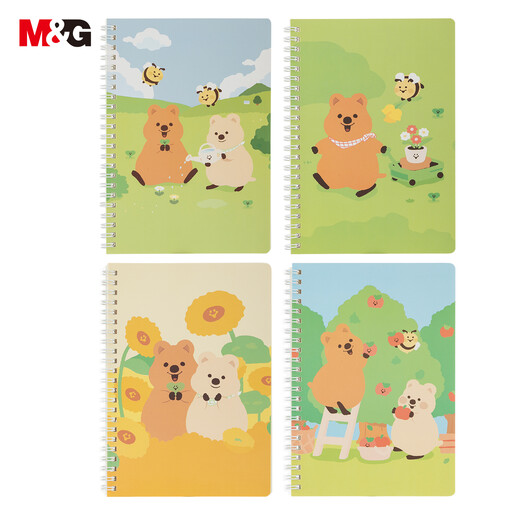
Why this product suits this profile: Four A5 notebooks with lined pages provide space for lessons, university work, office tasks or several separate journalling topics.
The format and ruling are clearly stated. The spiral binding makes turning pages easy, while the four notebooks allow you to separate subjects, projects or types of tasks.
A5 format, lined paper, 60 sheets per notebook and four spiral notebooks with different Quokka designs.
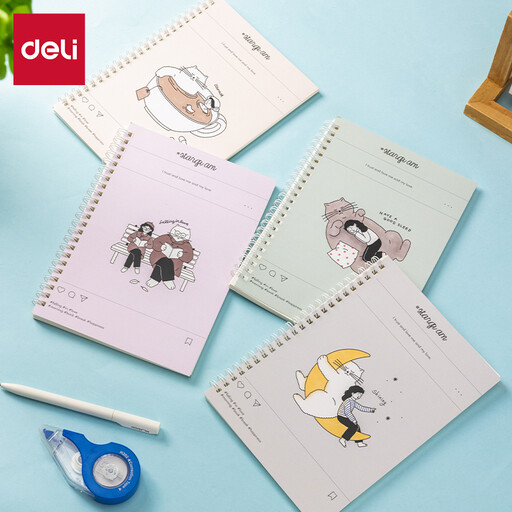
Why this product suits this profile: The A5 set is designed for regular writing tasks and can be used for several subjects, projects or personal notes.
The product name specifies the dimensions of 148 × 210 mm, 70-g/m² paper and a pack size of four. These details make it easier to compare with other A5 sets.
A5 format, spiral binding, 70-g/m² paper and four notebooks for school, office work or journalling.
Paper should be stored in a dry place and protected from prolonged exposure to direct sunlight. With spiral notebooks, it is best not to use the spiral as a carrying handle or squash full notebooks too tightly. A soft cover can be stored in a space-saving way, but the notebook should be carried in a bag that offers sufficient protection.
The service life mainly depends on paper quality, binding, storage conditions and everyday use. It would not be reliable to give a general lifespan. If you regularly write with a fountain pen or gel pen, check the paper weight in advance and, where possible, look at product images showing the paper texture.
We have put together a complete, regularly updated list of products that fully meet these strict selection criteria and the safety regulations applicable in the EU.
That depends on how you plan to use it. Four notebooks, for example, are suitable for four school subjects, projects or categories such as tasks, appointments, ideas and personal notes. For occasional use, a single notebook may be enough.
A5 offers more writing space and is useful for longer texts, study notes and minutes. A7 fits into small bags and is suitable for short entries. If you want to cover both situations, you can use an A5 notebook for detailed content and an A7 set when you are out and about.
Both types of binding have different characteristics. Spiral binding makes pages easy to turn and allows the notebook to lie flat. A soft cover is flexible and compact, but may be subject to greater wear if transported without protection. Durability therefore depends not only on the type of binding, but also on the paper, construction and how the notebook is treated.