What should you look for when buying?
First decide on the consistency in which the nut ingredient will actually be served. Then you can assess the recipe, allergens and nutritional information for the specific product.
| Criteria |
What to check when buying |
Especially important for |
| Consistency |
Don’t choose whole or hard nuts for a baby’s serving. For nut butter and ground nuts, check the consistency of the prepared food. |
If I want to offer nuts as part of baby-led weaning, I need a serving without whole nuts or dry pieces. Around 46% of consumers put suitable consistency first. |
| Ingredients |
Check the ingredients list for salt, sugar, honey and seasoning; the specific product matters, not just the brand name. |
I want to choose what goes into my baby’s food, so I’m looking for a nut ingredient with as few additions as possible. For around 27% of consumers, checking the ingredients is the main priority. |
| Fat content |
Don’t assume that a reduced-fat product comes in a suitable form. Check the nutritional information for the specific product and serving only. |
If ‘reduced fat’ appeals to me, I want to know whether it should really influence my choice. Around 18% of consumers are mainly concerned with this question. |
| Allergens |
Read the ingredients and allergen information on every pack; if there is a known allergy or previous reaction, follow individual medical advice. |
If I have an existing allergy or have had an unclear reaction, I need to be able to identify the product’s ingredients above all. For around 9% of consumers, this is the priority. |
Brands to help you choose
With these brands and retailers, it’s the individual product that matters: whole nuts are still an ingredient to prepare in the kitchen, even when they’re unprocessed.
Seeberger
Seeberger offers, among other things, mixed nuts.
- Seeberger describes its mixed nuts as unroasted and free from added salt and seasoning.
- The mix contains whole nuts. They would need to be prepared to a suitable consistency before being given to a baby.
REWE
When choosing a nut product from REWE, the specific pack is what matters.
- The product name and ingredients list help you tell a nut ingredient apart from a seasoned snack.
- A retailer’s own brand doesn’t, by itself, tell you whether the product is suitable for serving to a baby.
Alesto (Lidl)
Lidl offers both unprocessed nuts and seasoned snacks under the Alesto brand.
- Unprocessed varieties may be suitable as an ingredient to prepare further.
- Seasoned snacks and whole nuts aren’t suitable for a baby’s serving just because of the brand name.
FARMER NATURALS (ALDI SÜD)
ALDI SÜD’s nut range includes unprocessed walnut kernels from its FARMER NATURALS range.
- Unprocessed nuts can be chosen as a kitchen ingredient, provided they’re prepared suitably before serving.
- Whole walnut kernels aren’t suitable as finger food for a baby. Check the ingredients and form of the specific product.
Nut butter on Joybuy
These products are nut butter or smooth peanut butter that could be used as ingredients in moist solid food. They aren’t a selection of reduced-fat nuts; the consistency of the serving and the ingredients and allergen information remain key.
 No image available
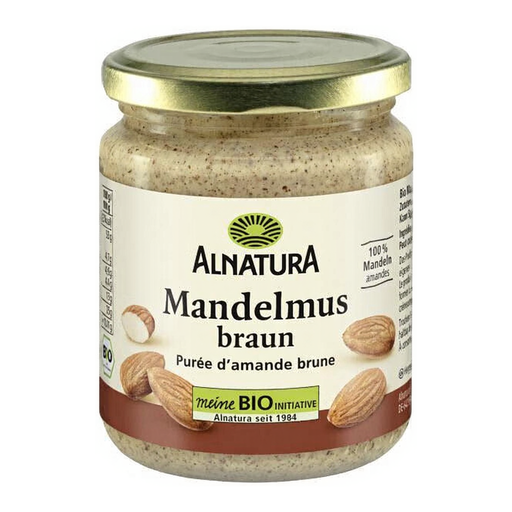
Alnatura organic almond butter made from whole roasted almonds, 250 g
Consider it as an ingredient in moist solid food, provided no firm pieces remain in your baby’s serving once it has been stirred in. Contains almonds; check the ingredients and allergen information on the pack before serving.
View on Joybuy
No image available
Alnatura organic smooth peanut butter, 250 g
The smooth variety can be stirred into moist food; don’t serve it as a thick dollop. Contains peanuts. Read the ingredients and allergen information, especially if there have been previous reactions or you need to follow medical advice.
View on Joybuy
Frequently asked questions
Are whole nuts suitable for baby-led weaning?
No. Whole, hard nuts shouldn’t be given to babies because they can enter the airways. The Federal Institute for Risk Assessment highlights this risk, particularly with peanuts. Nut butter or finely prepared nuts are only suitable if they have the right consistency.
Can I sprinkle dry ground nuts over food?
Ground nuts shouldn’t be served as a dry, loose powder in a baby’s serving. Stir them thoroughly into moist food and check the consistency before offering it.
Are reduced-fat nuts preferable for baby-led weaning?
A lower fat content doesn’t automatically make a nut product suitable for a baby’s serving. Decide first based on the consistency of the food as served, then check the ingredients and allergens. If your baby has a medically prescribed diet, follow the advice given for your individual circumstances.
When can a baby generally start eating solid foods?
The Healthy Start in Life network recommends starting solid foods no earlier than the beginning of the fifth month and no later than the beginning of the seventh month; your baby’s individual readiness for solid food is also important. This isn’t an age at which whole nuts become suitable finger food.
What should I look out for with peanuts and allergens?
Read the ingredients and allergen information on every pack. According to the Federal Institute for Risk Assessment, peanuts must be listed as an ingredient on the packaging. If there is a known allergy or a previous reaction, follow the advice given by your doctor for your individual circumstances.


