Nuts are not a low-calorie choice: the German Nutrition Society highlights their high energy content. If you’d like to pack them as a holiday snack, compare the nutritional information and decide on a portion in advance, rather than taking a large packet along and leaving it open. Whole nuts are not suitable for toddlers because of the risk of choking; if allergies are a concern, check the information for the specific product.
What matters to different people
People planning their snack portions
If you’re taking nuts on a holiday outing, you’ll want to keep track of how much you eat. Compare the kcal per 100 g and decide how much you’re likely to eat before packing them. The German Nutrition Society points out that nuts are energy-dense.
Parents of toddlers
When choosing a snack for toddlers, the form matters more than the type of nut. kindergesundheit-info.de warns against whole nuts because of the risk of choking, and suggests nut butter or finely processed nuts as alternatives.
Households that need to check for allergens
You’ll need to check the ingredients and allergen information for each specific product, especially with mixes. Lebensmittelklarheit explains that the absence of a voluntary ‘may contain’ statement does not rule out accidental contact with allergens.
What to look for when buying
When choosing nuts as a holiday snack, first think about who’ll be eating them. Then compare your planned portion with the ingredients and nutritional information for the most suitable product format.
| Criterion |
What to check |
Who it matters to |
| Portion and energy |
Compare the kcal per 100 g and decide how much of the packet you want to have as a snack. |
When I eat nuts on the go, I don’t want to get through a whole large packet without realising. For around 40% of consumers, being able to plan how much they eat is the main priority. |
| Format for toddlers |
Choose a suitable finely processed format or nut butter instead of whole nuts; don’t serve dry nut flour without processing it first. |
If my toddler is going to have some too, the snack must not contain whole nuts, as they can be swallowed and cause choking. A child-friendly format is the main concern for around 30% of consumers. |
| Allergens and ingredients |
Read the ingredients list and check the highlighted allergens; for seasoned varieties, also compare the sugar and salt per 100 g. |
If someone has an allergy or I’m buying a snack mix for several people, I want to know what’s in it before I buy. Around 30% of consumers primarily look out for allergens and additives. |
Common selection mistakes
-
Assuming ‘natural’ means ‘low in calories’
No added salt or sweet coating doesn’t mean low in energy: EDEKA24 lists unsalted EDEKA Herzstücke Peanuts at 618 kcal per 100 g, while ALDI SÜD lists FARMER NATURALS Almonds at 620 kcal per 100 g.
Check the kcal per 100 g and plan your portion regardless of whether the product is unsalted.
-
Only reading the front of the packet
Even within the same brand, plain nuts and seasoned snack varieties can differ. EDEKA24 lists EDEKA Herzstücke Asia Nuts Wasabi Style at 23.4 g of sugar and 1 g of salt per 100 g.
For every variety, compare the ingredients list as well as the sugar and salt in the nutritional information.
-
Packing whole nuts for toddlers
Whole nuts pose a choking risk for toddlers, as explained by kindergesundheit-info.de.
Choose a suitable format, such as nut butter or finely processed nuts; dry nut flour should not be served without processing it first.
-
Assuming a missing ‘may contain’ statement means a product is safe
Lebensmittelklarheit distinguishes between allergens that must be declared because they have been deliberately added and voluntary warnings about possible traces. If there is no ‘may contain’ statement, accidental contamination has not necessarily been ruled out.
If you have an allergy, check the ingredients and allergen information for the specific product, and follow your personal medical advice.
Brands to help you choose
Seeberger
Seeberger sells plain nuts and kernels as well as mixes. When comparing holiday snacks, it’s the specific variety that matters, not just the brand.
- The range includes natural nut and kernel products in different pack sizes.
- According to the manufacturer, Seeberger Power Nut Mix contains 638 kcal per 100 g; ‘natural’ does not mean low in energy.
EDEKA Herzstücke
This own-brand range includes unsalted peanuts and more heavily seasoned snack products, whose information should be compared separately.
- EDEKA24 lists 0.01 g of salt per 100 g for its roasted, unsalted peanuts.
- The same peanuts contain 618 kcal per 100 g, according to EDEKA24. Other varieties may have significantly different sugar and salt levels.
Alesto
Lidl’s Alesto range includes both natural nuts and seasoned party snacks.
- The different varieties make it possible to compare ingredients and nutritional information for specific products.
- The brand name alone won’t tell you the energy, sugar or salt content of a particular packet.
FARMER NATURALS
ALDI SÜD sells almonds and other nut products under this brand.
- ALDI SÜD lists 0.03 g of salt per 100 g for its roasted almonds.
- The almonds contain 620 kcal per 100 g. ALDI SÜD notes that availability may be limited for special-buy products.
REWE Beste Wahl / REWE
REWE offers nuts and mixes from various own-label and manufacturer brands; REWE Beste Wahl does not refer to one specific type of nut.
- The range includes products you can compare, such as plain and salted varieties.
- Check the ingredients and nutritional information for the specific packet rather than assuming they’re the same as another variety.
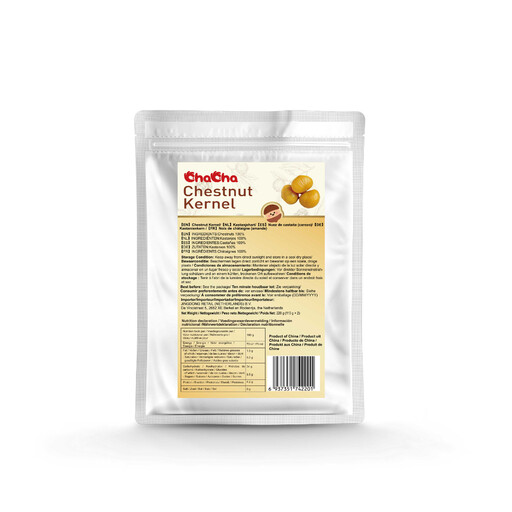
Chestnut kernels at Joybuy
This product selection features chestnut kernels as an on-the-go snack. Compare the nutritional information for the specific packet with the amount you plan to eat; information about other types of nuts may not apply.
 No image available
ChaCha Chestnut Kernels, 220 g
If you’re choosing chestnut kernels for a holiday outing, decide on your snack portion in advance. The packet is labelled 220 g; for comparison, check the nutritional information per 100 g and how much you actually eat.
View at Joybuy
Frequently asked questions
Are nuts a low-calorie holiday snack?
No. Most nuts are energy-dense. The German Nutrition Society highlights their high energy content; examples include unsalted EDEKA Herzstücke Peanuts, at 618 kcal per 100 g according to EDEKA24, and FARMER NATURALS Almonds, at 620 kcal per 100 g according to ALDI SÜD. If you want to keep track of calories, compare the specific variety and plan your portion.
Which nuts should I choose if I want to avoid salt and additives?
Start with natural or explicitly unsalted varieties, but still check the ingredients list. Unsalted doesn’t mean that the product contains only nuts: according to EDEKA24, EDEKA Herzstücke Peanuts also contain sunflower oil as well as roasted peanuts.
Are whole nuts suitable for toddlers?
No. Whole nuts should not be given to toddlers because of the risk of choking. kindergesundheit-info.de suggests nut butter or finely processed nuts as alternatives; dry nut flour should not be served without processing it first.
What does allergen labelling tell me about nut mixes?
The ingredients and allergen information can help you identify peanuts and tree nuts deliberately added to a specific product. Lebensmittelklarheit explains that voluntary ‘may contain’ statements do not provide a standardised indication of the amount or individual risk of possible accidental contact with allergens. If you have an allergy, don’t rely solely on whether such a statement is present or absent.


