People who plan their portions
You want to snack on nuts during your coffee break while keeping an eye on your energy intake. Compare the nutritional information per 100 g, then work out how it relates to the amount you plan to eat.


For a calorie-conscious coffee break, choose nuts by checking their energy content and how much you plan to eat, rather than assuming they are ‘low calorie’. The European Commission sets a limit of 40 kcal per 100 g for this claim on solid foods; even the whole almonds listed by REWE contain 596 kcal per 100 g. Salt, ingredients and allergens may also affect your choice.
You want to snack on nuts during your coffee break while keeping an eye on your energy intake. Compare the nutritional information per 100 g, then work out how it relates to the amount you plan to eat.
You prefer a short ingredients list or want to avoid added salt. Check the specific pack to see whether a variety is plain, roasted or salted – the type of nut alone won’t tell you.
You need to know which types of nuts are included and whether there are any ‘may contain’ warnings, or you’re buying enough for several coffee breaks. Check the current packaging and, for larger packs, plan how you’ll store them once opened.
First, decide how much you plan to eat. Then compare the nutritional information and consider how salt, ingredients and storage fit into your coffee break.
| What to check | What to look for | Who is it important to? |
|---|---|---|
| Energy and portion size | Compare kcal per 100 g and work out the amount for the portion you plan to eat. | When I snack during a coffee break, I want to know how much energy my actual portion contains. Around 36% of consumers prioritise this portion comparison. |
| Salt and ingredients | Check the ingredients list and the salt content per 100 g; roasted doesn’t automatically mean salted. | A short ingredients list matters more to me than a strongly flavoured mix, and I want to avoid added salt. Around 29% of consumers share this priority. |
| Allergens and ingredients | Check which types of nuts are included and read the full ‘may contain’ warning on the current pack. | When I share nuts with others, I need to know which types are included and whether traces of other allergens may be present. Around 21% of consumers prioritise this check. |
| Storage | Check the pack size and storage instructions for after opening. | I buy nuts for several morning breaks and want to be able to store an opened pack properly. This is the main concern for around 14% of consumers. |
The portion size doesn’t determine whether a food meets the requirements for a ‘low calorie’ claim. According to the European Commission, the limit for solid foods is 40 kcal per 100 g; the nut products listed here by REWE and EDEKA are well above that.
Compare the energy per 100 g and work it out for the portion you plan to eat, rather than assuming that nuts are ‘low calorie’.
How the nuts are prepared matters too: REWE lists 0.7 g of salt per 100 g for its roasted and salted almonds. According to the ingredients list, EDEKA’s GUT&GÜNSTIG plain cashews contain cashews only.
Check the ingredients list and salt content for the specific variety, especially if you’re choosing between plain and seasoned nuts.
A mix may contain several types of tree nuts; even products that name just one type of nut may carry additional ‘may contain’ warnings. This is especially important if you’re sharing the pack with others.
Read the full ingredients list and allergen information on the current packaging rather than relying on the picture or product name.
A larger pack may last for several coffee breaks. The German Federal Centre for Nutrition recommends storing shelled nuts in an airtight container, preferably in the fridge.
Choose a pack size that suits how much you’ll eat and follow the product’s storage instructions.
The two almond varieties described by REWE show why it’s worth comparing the type of nut and how it’s prepared separately.
The plain cashews described by EDEKA are an option if you’re looking for a single type of nut.
The EDEKA nut and kernel mix is for people who want several types of nuts and seeds in one mix.
The Seeberger nut mix described by REWE is a raisin-free blend of several types of nuts.
Lidl’s Alesto range includes both plain nuts and seasoned snack options.
This selection includes individual nuts, nut mixes and a trail mix for your coffee break. Trail mix also contains dried fruit, so don’t compare its energy content and ingredients directly with a nut-only mix.
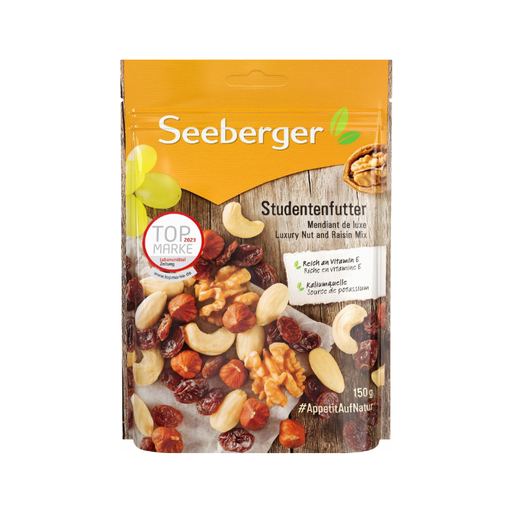 No image available
A good option if you specifically want trail mix with dried fruit for your coffee break, rather than nuts alone.
Pack size: 150 g. Check the nutritional information for your portion and, if needed, the allergen information on the pack.
 No image available
A good choice if you’re looking for roasted cashews with no added salt, rather than a seasoned mix.
Pack size: 150 g. Compare the energy content with the amount you plan to eat and, if you have allergies, check the current packaging.
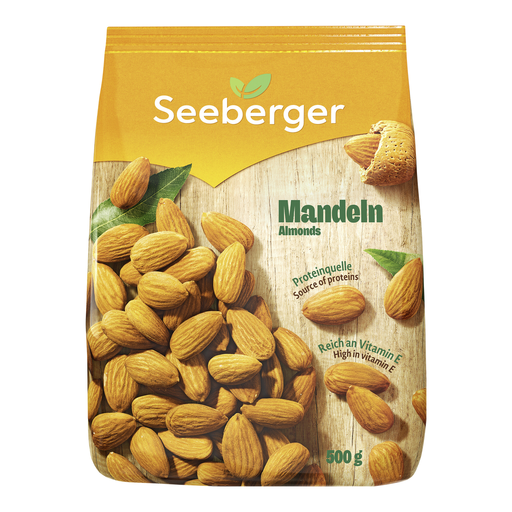 No image available
A good fit if you’re looking for whole almonds rather than a mix; ‘natural’ doesn’t mean they have a low energy content.
Pack size: 500 g. Plan how much you’ll have at each coffee break and follow the storage instructions once opened.
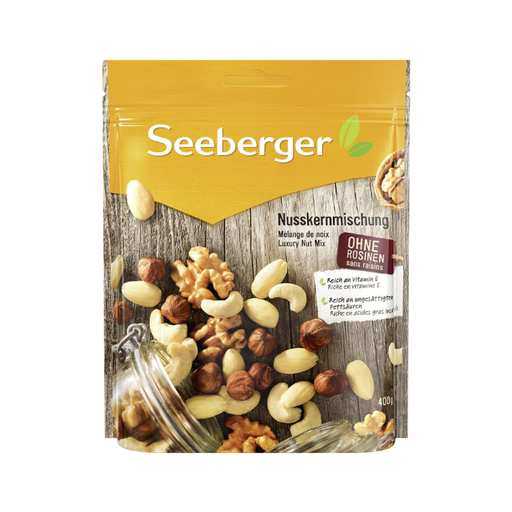 No image available
A raisin-free alternative to trail mix if you’d prefer a nut mix rather than a single type of nut.
Pack size: 400 g. Decide how much you’ll have at your coffee break and check the types of nuts on the packaging.
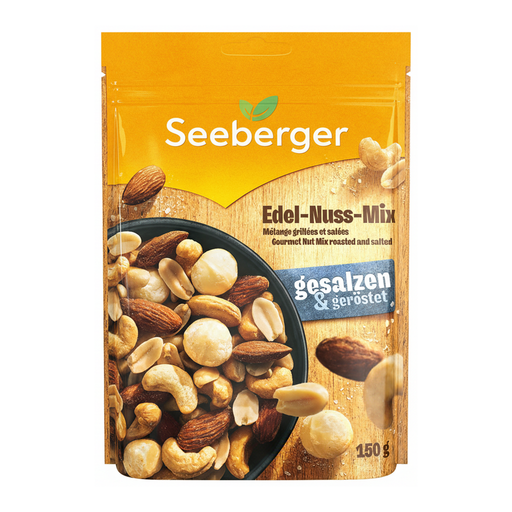 No image available
A good option if you want a roasted, salted mix and are making a conscious comparison of salt content.
Pack size: 150 g. As well as the energy content, check the salt, ingredients and allergen information on the current pack.
The nut products compared here don’t meet the requirements for this claim. According to the European Commission, ‘low calorie’ can only be used for solid foods containing no more than 40 kcal per 100 g; the figures given by REWE and EDEKA for the products discussed here start at 596 kcal per 100 g.
First compare the kcal per 100 g, then work out the figure for the amount you plan to eat. For example, REWE lists 154 kcal per 25 g for its roasted and salted almonds; this figure applies to that specific product and portion size.
No. The description alone doesn’t tell you how their energy content compares. REWE lists its plain whole almonds at 596 kcal per 100 g, while EDEKA lists its plain GUT&GÜNSTIG cashews at 603 kcal per 100 g. Compare the figures for the specific products.
Check the full ingredients list and ‘may contain’ warnings on the current pack. Mixes may contain several types of tree nuts, and even products containing just one type of nut may carry warnings about other allergens.
Store shelled nuts in an airtight container; the German Federal Centre for Nutrition recommends keeping them in the fridge if possible. If you’re buying a larger amount for several coffee breaks, also follow the instructions on the specific pack.