Football fans keeping an eye on portions
If the bowl keeps getting topped up during the match, it can be hard to keep track of how much you’ve eaten. A portion measured out in advance and the energy information on the pack make it easier to compare.


Nuts are not automatically low in calories, even when they're natural. If you want to snack mindfully while watching football, it's best to decide on a portion in advance and compare the energy values per 100 g. When choosing between unsalted and seasoned varieties, salt content is a separate consideration.
If the bowl keeps getting topped up during the match, it can be hard to keep track of how much you’ve eaten. A portion measured out in advance and the energy information on the pack make it easier to compare.
If you want a lower-salt snack for football night, compare unsalted varieties with roasted or seasoned mixes. The salt content of the specific product is what matters.
For peanuts, tree nuts or mixes with several ingredients, check the information on the specific pack. As well as the ingredients list, precautionary allergen information may also help you choose.
For football night, it’s worth deciding how much you plan to eat first, then comparing the energy, salt and ingredients of suitable products.
| Criterion | What to check when buying | Who it matters most to |
|---|---|---|
| Energy per portion | Compare calories per 100 g and use the information on the pack to work out the energy for the amount you plan to eat. | If I’m snacking throughout the match, I want to know how much is in my bowl. For around 50% of consumers, the energy per portion comes first. |
| Salt and seasoning | Check the salt content in g per 100 g and whether the specific pack says “unsalted” or “salted”. | I want a crunchy snack without salt taking priority over what I’m looking for. Around 30% of consumers prioritise their choice of salt level. |
| Ingredients and allergens | Read the ingredients list, highlighted allergens and, where provided, precautionary allergen information on the specific pack. | Before sharing a mix, I need to know which types of nuts it contains. For around 20% of consumers, checking ingredients and allergens is the top priority. |
An unsalted mix can still be high in energy: REWE lists 657 kcal per 100 g and 197 kcal per 30 g for its ja! nut kernel mix.
Compare the values per 100 g and measure out the amount you want in a bowl for the match, rather than eating straight from the pack.
Salted products can differ considerably from unsalted ones. ALDI SÜD lists 1 g of salt per 100 g for one FARMER nut mix, while REWE lists 0 g per 100 g for its unsalted ja! nut kernel mix.
If salt content matters to you, compare values using the same serving basis and take the rest of the evening’s food into account too.
A mix may contain several types of tree nuts. The German Federal Institute for Risk Assessment lists peanuts and tree nuts as potential triggers of food allergies.
Check the ingredients list and any precautionary allergen information on the specific pack every time you buy, rather than relying on the brand name.
Hulled and chopped nuts in particular need to be stored carefully once opened.
Measure out only the amount you plan to eat during the match and seal the rest of the pack. The German Federal Centre for Nutrition recommends storing these types of nuts somewhere cool, ideally in the fridge.
REWE sells a natural, unroasted and unsalted ja! nut kernel mix.
Lidl’s Alesto range includes both natural nuts and seasoned party snacks.
ALDI SÜD’s FARMER range includes a nut mix as a seasoned snack option.
ALDI Nord’s TRADER JOE'S range includes nut mixes and individual types of nuts.
Seeberger sells a range of nuts and mixes, including natural, roasted and salted varieties.
These Seeberger products include a nut and fruit mix, individual types of nuts and a nut mix without raisins for football night. Check the nutritional values per 100 g on the specific pack and decide for yourself how much you’d like to serve.
 No image available
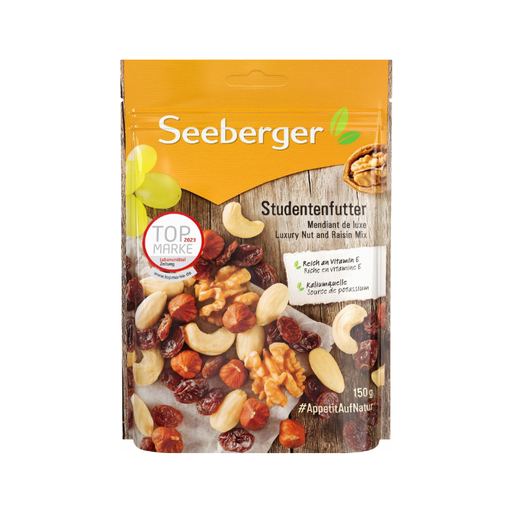
A good choice if you specifically want a nut and fruit mix, rather than just nuts, for match night. The pack contains 150 g; when comparing its energy with that of plain nuts, bear in mind that the ingredients differ.
 No image available
If you’re looking for a single type of nut in an unsalted variety, these roasted cashews could be a good option. The pack contains 150 g; unsalted doesn’t mean low in calories.
 No image available
Whole almonds are a good option if you want to choose one type of nut and measure out your own snack portion. The 500 g pack isn’t a portion size, so check the nutritional information on the pack for the amount you put in your bowl.
 No image available
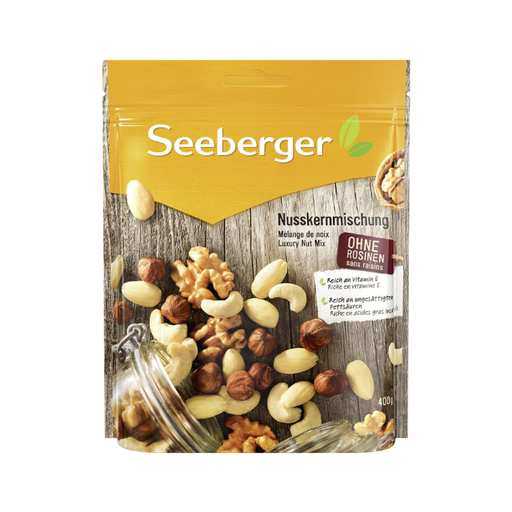
This mix is an option if you want a variety of nuts but no raisins in your snack. The pack contains 400 g; before sharing, check the ingredients and allergen information on the specific pack.
Nuts aren’t automatically low in calories. In its overview of different types, REWE lists 564 kcal per 100 g for peanuts and 703 kcal per 100 g for both pecans and macadamia nuts. How much you eat also matters when working out the energy in your snack.
The energy value for a specific amount you plan to eat is more useful than the pack size alone. The German Nutrition Society gives a small handful of nuts a day as a general guide for healthy adults in Germany aged 18 to 65; REWE lists 197 kcal per 30 g for its unsalted ja! nut kernel mix.
If your main aim is to limit salt, a clearly labelled unsalted variety is the more straightforward choice. But for a calorie comparison, you’ll still need to check the energy per 100 g and your portion size.
Read the ingredients list and any precautionary allergen information on every pack. The Federal Ministry of Food and Agriculture lists tree nuts such as hazelnuts as allergens that must be declared; a mix may also contain several types of nuts.
Seal the remaining nuts again after measuring out your portion for match night. For hulled and chopped nuts, the German Federal Centre for Nutrition recommends storing them somewhere cool, ideally in the fridge.