If you’re mainly comparing nuts by their protein content per 100 g, the specific almonds considered here come out ahead of the cashews: REWE lists 26 g for Seeberger roasted almonds with no added salt, while EDEKA lists 21 g for plain cashews. Even so, nuts aren’t a substitute for a planned source of carbohydrates on longer or more strenuous rides. Also check the ingredients, salt content and allergen information on the pack you choose.
Who is this comparison for?
People comparing nuts by protein content
If getting as much protein as possible matters to you, compare the nutritional information per 100 g for the specific varieties. The figures from REWE and EDEKA show why the type of nut alone isn’t enough to make a fair comparison.
Cyclists planning food for their rides
You want to work out whether you’re looking for a nut snack for everyday eating or around your ride, or a source of carbohydrates for longer, more strenuous efforts. This distinction is also highlighted by the consumer advice centre.
People keeping an eye on salt and ingredients
You’re comparing plain nuts with roasted or salted varieties, and checking the pack’s ingredients and allergen information as well as its nutrition table.
What should you look for when buying?
First decide whether you’re buying nuts as a snack or as fuel for your ride. Then compare the protein content per 100 g and the ingredients of the specific variety.
| Criterion |
What to check |
Who is it important to? |
| Protein content |
Compare protein and energy per 100 g; don’t base your decision on the gram figure alone when considering marketing claims. |
If I’m choosing nuts for their protein content, I want to compare the specific varieties on a like-for-like basis. Around 42 % of consumers would consider protein content a key reason to buy. |
| Salt and ingredients |
Read the ingredients list and check the salt content per 100 g, especially for roasted or seasoned varieties. |
For a regular snack, I want to know whether it contains anything besides nuts, such as oil or salt. For around 33 % of consumers, checking the ingredients comes first. |
| Suitable for rides |
Before buying, work out whether you need a nut snack or a source of carbohydrates for a longer, more strenuous ride. |
For longer, more strenuous rides, I don’t want to choose my fuel based on protein content alone. Around 25 % of consumers would check whether a product is suitable for their ride first. |
What mistakes can you avoid?
-
Assuming a high protein figure means a product can legally be advertised as high in protein
The protein figure per 100 g and a nutrition claim are not the same thing. The European Commission explains that such claims must meet specific conditions.
Use the nutrition table to compare products. A high gram figure alone doesn’t mean a product can legally be labelled “high protein”.
-
Treating salted cashews like plain cashews
For the varieties described by EDEKA, plain cashews contain 21 g of protein and 0 g of salt, compared with 18.6 g of protein and 0.8 g of salt for roasted, salted cashews – in each case per 100 g. The salted variety also contains sunflower oil.
Compare the nutritional information and ingredients for the variety you actually intend to buy.
-
Relying on nuts alone for fuel on long, strenuous rides
For longer, more strenuous efforts, the consumer advice centre describes carbohydrate intake as beneficial for performance. A nut snack chosen for its protein content won’t automatically serve the same purpose.
Choose your snack separately from the source of carbohydrates you plan to take on your ride, making sure it suits you.
-
Overlooking allergen and pack information
The almonds and cashews described here contain the relevant nuts as ingredients. Other ‘may contain’ information could also be important if you have allergies.
Before buying, check the ingredients and allergen information on the current pack rather than relying on the product name alone.
Brands to help you choose
Seeberger
The main variety to consider here is the roasted almonds with no added salt. The information given doesn’t apply to all Seeberger nuts.
- REWE lists 26 g of protein and 0.02 g of salt per 100 g for “Roasted Almonds with No Added Salt”. The ingredient listed is roasted almonds.
- If you have allergies, check the ‘may contain’ information on the relevant pack.
EDEKA Herzstücke / GUT&GÜNSTIG
The almond and cashew products described by EDEKA let you compare specific varieties that have been processed in different ways.
- EDEKA lists 24.7 g of protein per 100 g for ground GUT&GÜNSTIG almonds and 21 g for plain EDEKA Herzstücke cashews.
- For roasted, salted GUT&GÜNSTIG cashews, EDEKA lists 18.6 g of protein and 0.8 g of salt per 100 g. So compare the specific pack, not just the type of nut.
REWE Beste Wahl
REWE stocks various types of almonds, including roasted almond kernels from REWE Beste Wahl.
- You can tell the varieties apart by checking their individual ingredients and nutritional information.
- Information for one almond variety doesn’t apply to the entire range.
Alesto
Lidl’s Alesto range includes plain almonds and cashews, as well as other snack varieties.
- Distinguishing between plain nuts and snack varieties can help you choose based on the ingredients.
- For a protein comparison, check the per-100 g figure on the pack of the variety you choose.
Nut products at Joybuy
This selection includes almonds and cashews as potential snacks, as well as pine nuts, which can also be used as an ingredient in meals. If you’re fuelling up for a longer, more strenuous ride, consider your carbohydrate needs separately.
 No image available
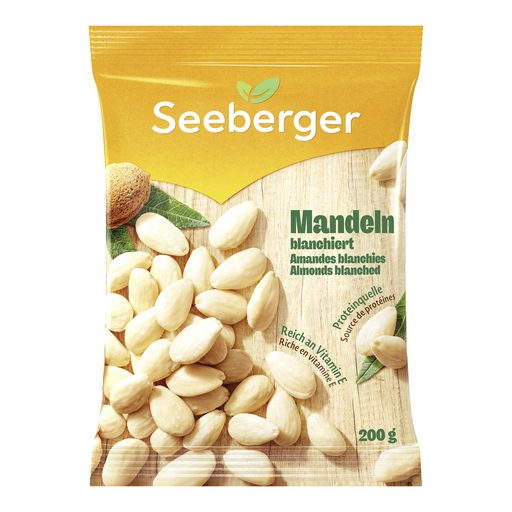
Seeberger whole blanched almonds, 200 g
An option if you’re looking for whole almonds as a snack and want to compare the protein figure on the pack with other nuts. “Blanched” describes this variety; the product name doesn’t tell you its salt content or whether it’s suitable as fuel for a ride.
If you have allergies, check the current pack.
View at Joybuy
 No image available
Jeden Tag organic pine nuts, 50 g
Pine nuts are worth considering if you’re looking for kernels to use as an ingredient in a dish rather than as a typical nut snack on the go. If you’re watching your protein or salt intake, compare the nutritional information on the pack.
If you have allergies, check the ‘may contain’ information too.
View at Joybuy
 No image available
Seeberger roasted cashew kernels with no added salt, 150 g
This variety is a good fit if you’re looking for roasted cashews with no added salt as a snack. To compare their protein content with almonds and other cashews, check the per-100 g figure on the specific pack.
If you have allergies, check the current ingredients and allergen information.
View at Joybuy
Frequently asked questions
Which of the almonds and cashews compared here contain more protein?
Among the specific products described, the almonds come out ahead: REWE lists 26 g of protein per 100 g for Seeberger roasted almonds with no added salt; EDEKA lists 24.7 g for ground GUT&GÜNSTIG almonds and 21 g for plain EDEKA Herzstücke cashews. This compares these particular varieties; it isn’t a general ranking of all almonds and cashews.
Can a nut product be called “high protein” because of its protein content?
Not on the basis of the gram figure alone. The European Commission explains that nutrition claims must meet specific conditions. When choosing, start by comparing the nutritional information for the products in question rather than inferring a marketing claim from the protein figure.
Are nuts enough to fuel a long bike ride?
For a longer, more strenuous ride, you shouldn’t rely on nuts alone instead of a planned source of carbohydrates. The consumer advice centre describes carbohydrate intake as beneficial for performance during longer, more strenuous efforts. The fuel that works for you will also depend on what you can tolerate.
What should I check before buying if I have a nut allergy?
Check the ingredients and ‘may contain’ information on the current pack of the specific variety. The almonds and cashews described here contain the relevant nuts as ingredients; information about possible other allergens can vary between products.


