If you want to compare fat content
For film night, the key thing for you is how much fat the specific variety contains per 100 g. Don’t compare nuts, mixes and coated snacks based solely on an impression such as “light”.


If you’re looking for a lower-fat nut snack for film night, compare the product type first, then check the nutrition information per 100 g. A batter-coated snack may contain less fat than plain nuts, but it doesn’t contain the same proportion of nuts. So check the ingredients, sugar and salt too. Unsalted nuts are another option: they don’t have the same bold seasoning, but that doesn’t automatically make them low in fat.
For film night, the key thing for you is how much fat the specific variety contains per 100 g. Don’t compare nuts, mixes and coated snacks based solely on an impression such as “light”.
You want something to nibble on, but you’re choosing between unsalted nuts and boldly seasoned varieties. As well as taste, the salt content per 100 g can help you decide.
For a sharing bowl, you’re mainly looking for something crunchy and full of flavour. With batter-coated products, it’s also worth checking the nut content: they’re made differently from plain nuts.
First decide whether you want plain nuts, a nut mix or a snack made with other ingredients. Then compare the nutrition information per 100 g and the ingredients of the specific varieties.
| What to look for | What to check when buying | Who it matters to |
|---|---|---|
| Fat content | Compare fat per 100 g across similar product types; if a product is described as “reduced”, check what it’s being compared with. | I want to choose a lower-fat variety for film night without treating a coated snack as equivalent to plain nuts. This comparison is a priority for around 36% of consumers. |
| Salt | Compare salt per 100 g in unsalted, salted and seasoned varieties. | When I’m putting together a bowl of savoury snacks to share, I want to decide for myself how salty it should be. Salt is the main consideration for around 29% of consumers. |
| Ingredients and allergens | Check the product name, ingredients list, allergen information and any precautionary ‘may contain’ statements on the pack. | With a mix or a batter coating, I need to know what else it contains besides nuts and which allergens are listed. This check is a priority for around 21% of consumers. |
| Crunch and sharing | Choose between nuts, a nut mix and a coated snack; for mixes, check the contents and pack size. | For a sharing bowl on film night, flavour and crunch matter more to me than a simple recipe. Around 14% of consumers share this priority. |
The type of product can make a big difference to the fat comparison: EDEKA24 states that EDEKA Herzstücke Asia Nuts Wasabi Style contains 27% peanuts. So a lower fat figure for a snack like this doesn’t describe the same composition as plain peanuts.
Having less fat than another snack doesn’t automatically meet the requirements for a “low fat” claim. Lebensmittelklarheit states that solid foods must contain no more than 3 g of fat per 100 g to qualify.
Check the fat content per 100 g and, if the product makes a comparative claim, see which product it’s being compared with.
A batter coating changes the product’s composition. In the Asia Nuts product described by EDEKA24, peanuts make up 27%; other ingredients include flour and sugar.
As well as the fat information, check the ingredients list and the figures for carbohydrates, sugar and salt. Choose a coated snack for the recipe you want, not as an equivalent substitute for plain nuts.
Unsalted nuts can have much less salt than seasoned varieties without being low in fat. ALDI SÜD lists 52 g of fat and 0.05 g of salt per 100 g for roasted, unsalted peanuts.
Compare fat and salt separately, and, if you like, serve a portion in a bowl for film night.
The information on the packaging is what matters for the specific product. Ingredients and allergen information are especially important when several people are sharing the same bowl of snacks.
Before eating, check the nutrition information, ingredients and allergen labelling on the pack, even if you’ve already looked at the product online.
At REWE, you can check the information for individual nut mixes before buying.
The range also includes savoury nut snacks made with other ingredients.
Lidl’s Alesto range includes both nuts and seasoned party snacks.
The documented peanut varieties differ in their seasoning and nutrition information.
Seeberger offers nuts, kernels and mixes in a range of recipes and pack sizes.
This nut mix could be an option if you’d prefer a mix with dried fruit to plain nuts for film night. Check the current pack to see whether its nutrition information fits your comparison.
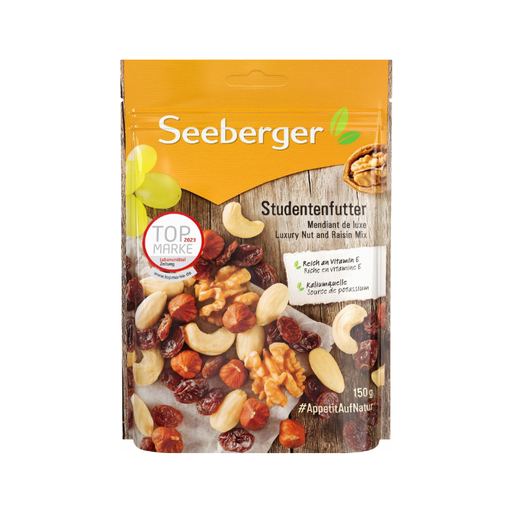 Image unavailable
A 150 g nut mix for anyone who’d prefer student trail mix to plain nuts on film night.
Before buying, compare the fat and sugar per 100 g and check the ingredients on the current pack. The product name alone doesn’t mean it’s reduced-fat or low-fat.
No. Lebensmittelklarheit states that solid foods must contain no more than 3 g of fat per 100 g to qualify as “low fat”. A nut snack can contain less fat than another snack and still be above this limit.
Because a snack like this isn’t made entirely of nuts. EDEKA24 states that Asia Nuts Wasabi Style contains 27% peanuts, as well as other ingredients such as flour and sugar. So compare the product type and nut content before treating its fat figure as equivalent to that of plain nuts.
Use the product page to help you shortlist products, then check the ingredients list, allergen labelling and any precautionary ‘may contain’ statements on the current packaging before eating. Verbraucherzentrale notes that allergens are among the important details on food labels.
Compare their nutrition information per 100 g, not the total amounts in each pack. Your Europe describes the per-100 g figure as the basis for nutrition labelling; with nuts and snacks made with other ingredients, you should also check the ingredients.