Parents planning portions
You’d like to pack nuts as a small extra rather than send in a whole bag. The energy per 100 g and the amount in the lunchbox matter more than a product name that simply sounds wholesome.


Nut mixes are not usually a low-calorie choice for a holiday lunchbox: the German Nutrition Society highlights the high energy content of nuts. If you’d like to pack them, check the nutrition information and portion out a small amount in advance. Whole or chopped nuts are not a suitable snack for toddlers because of the risk of choking. If your child has allergies, or the holiday club has specific rules, you may need to choose a different lunchbox ingredient.
You’d like to pack nuts as a small extra rather than send in a whole bag. The energy per 100 g and the amount in the lunchbox matter more than a product name that simply sounds wholesome.
For these families, the ingredients, allergen labelling and possible ‘may contain’ warnings all matter. Before packing nuts, they should also check the rules at their holiday club.
For toddlers, the form the food takes is important: Gesund ins Leben advises against whole and chopped nuts because of the risk of choking. A different lunchbox ingredient may therefore be a more suitable choice.
First, check whether nuts are suitable for your child and the childcare setting. Then compare the energy, ingredients and pack size for the amount you actually plan to put in the lunchbox.
| What to consider | What to check | Who it matters to |
|---|---|---|
| Energy and portion size | Check the energy in kcal per 100 g and portion out the amount you want before packing. | If nuts are only meant to be a small extra, I don’t want to leave the amount to chance. For around 34% of consumers, keeping an eye on portion size and energy is a priority. |
| Age and allergens | Check the form of the snack, ingredients and ‘may contain’ warnings; find out the childcare setting’s rules in advance. | If my child can’t eat the snack safely, or I need to avoid allergens, suitability comes before product choice. This is a priority for around 33% of consumers. |
| Ingredients and salt | Compare the ingredients list and the salt and sugar information on the specific pack. | If I’m looking for a simple lunchbox ingredient, I want to know what else is in the mix besides nuts. Around 20% of consumers focus first on what a product contains. |
| Packaging and storage | Consider the pack size and how to store the remainder in an airtight container once opened. | If one bag needs to last for several days of the holidays, I need a practical way to divide and store it. For around 13% of consumers, pack size is the most important factor. |
Even natural nut mixes can be high in energy: EDEKA24 lists 636 kcal per 100 g for Alnatura Bio Nusskernmischung and 648 kcal per 100 g for Ültje Pur. These figures apply to those two products, not to every mix.
Check the energy information on the pack you choose and portion out the amount you plan to take. If you’d like the lunchbox to contain more, you could also add fruit, vegetables or a wholegrain option.
A large pack doesn’t determine how much ends up in the lunchbox. The amount you pack makes a difference, especially with energy-dense nuts.
Portion them into a small container in advance. The Federal Centre for Nutrition recommends storing leftover nuts in an airtight container.
Gesund ins Leben advises against whole and chopped nuts for toddlers because of the risk of choking. Peanuts and tree nuts may also be a concern for children with relevant allergies.
Before packing them, check the form of the snack, the allergen information on the pack and the holiday club’s rules. If you’re not sure whether they’re suitable for your child, choose a different snack ingredient.
Unsalted, salted and mixed-ingredient products can vary. For example, ALDI SÜD lists 1 g of salt per 100 g for FARMER Nuss Mix; this figure can’t be applied to other mixes.
Compare the ingredients lists and nutrition information of the products you’re actually choosing between.
Seeberger offers nut mixes and roasted options, so you can compare the ingredients in each pack.
EDEKA24 lists, among other products, unsalted cashews and roasted, salted peanuts from EDEKA Herzstücke.
ALDI SÜD’s own brands include a range of different nut mixes.
Alesto is a Lidl brand with a range of nut products, including the Feine Nussvariation (Nuts Royal) listed by Lidl.
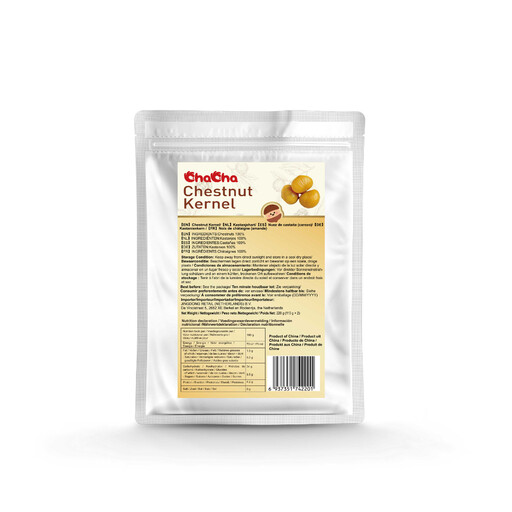
This selection features chestnut kernels as a snack to portion out for a holiday lunchbox. Check their nutrition information and the form they take separately from the details for typical nut mixes.
 No image available
Consider these as a chestnut snack to portion into a lunchbox in advance, provided the ingredients, allergens and form are suitable for your child.
Pack size: 220 g. Check the energy per 100 g on the pack before comparing it with a nut mix.
Nuts are not generally low in calories. The German Nutrition Society points to their relatively high energy content, so compare the kcal per 100 g on the specific pack and plan a small portion.
The ingredients list shows what the mix contains besides nuts. Also compare the salt and sugar information; a short ingredients list alone doesn’t mean the product is low in energy.
No. Gesund ins Leben explains that whole or chopped nuts are not suitable for toddlers because of the risk of choking. Choose another suitable lunchbox ingredient rather than deciding based only on the type of nut.
Check the ingredients, highlighted allergens and possible ‘may contain’ warnings on the product you’re packing, as well as the setting’s rules. The Verbraucherzentrale explains allergen labelling for food in nurseries and schools; this does not establish a single rule for nuts brought in from home.
Store any leftovers in an airtight container. The Federal Centre for Nutrition recommends keeping nuts in the fridge where possible.