If fat content is your main consideration
You compare the fat content per 100 g and would also consider a peanut snack, even if it is not a pure nut mix.


If you fancy proper nuts for a late-night bite, choose a specific unsalted mix and compare its fat, salt and ingredients per 100 g. Unsalted does not mean reduced-fat: EDEKA24 lists 57 and 59 g of fat per 100 g for two such nut mixes. According to the product details listed by REWE, Lorenz ErdnußLocken Leicht Classic contains 17 g of fat per 100 g. However, made with maize grits and 28% peanuts, it is a different type of snack.
You compare the fat content per 100 g and would also consider a peanut snack, even if it is not a pure nut mix.
Your priorities are nut kernels and a short ingredients list. A significantly lower fat content is not your main consideration.
You want a roasted flavour without added salt and check whether the specific mix also contains oil.
First decide whether you want proper nuts or a peanut snack for your late-night bite. Then compare the nutritional information and ingredients of the specific products.
| Criterion | What to check | Who it matters to |
|---|---|---|
| Fat content | Compare the fat and energy per 100 g, as well as the product type. If a product is labelled “reduced-fat”, check what it is being compared with. | If I mainly want less fat per 100 g, I would also consider a snack rather than pure nuts. Around 42% of consumers put this fat comparison first. |
| Nuts and salt | Check the ingredients list and salt content per 100 g for the specific nut mix; don’t assume “unsalted” means “reduced-fat”. | For my late-night bite, I want proper nuts with as little added salt as possible, even if their fat content remains high. This is the most important criterion for around 33% of consumers. |
| Roasting | For roasted mixes, check whether oil has been added as well as looking for information about salt. | I want roasted nuts, but not a salted party snack; whether oil has been added also affects my choice. Around 25% of consumers give this preference priority. |
A reduction in fat is measured against a comparable product. On its own, it doesn’t tell you whether the snack is low in fat or energy overall.
Compare the nutritional information per 100 g and check what the reduced-fat claim refers to.
According to the product details listed by REWE, Lorenz ErdnußLocken Leicht Classic is made mainly from maize grits and contains 28% peanuts. Its lower fat content doesn’t make it a serving of pure nuts.
Check the peanut content and ingredients before choosing between the two product types.
EDEKA24 lists 59 and 57 g of fat per 100 g for the unsalted Gut & Günstig and Seeberger mixes, respectively. Salt and fat content answer different shopping questions.
Read the two nutritional values separately and portion out the amount you want from the pack for your late-night bite.
Lidl stocks Solevita in its drinks range; nuts and snacks can be found under brands such as Alesto.
Check the specific Alesto product, as plain nuts and seasoned snacks have different ingredients.
The nut kernel mix and roasted nut selection offer two different ways to enjoy nuts as a snack.
The unroasted, unsalted Gut & Günstig nut kernel mix is an example of a mix made from nut kernels.
Lidl’s Alesto range includes both plain nuts and seasoned snacks.
At ALDI SÜD, the range includes plain nuts and nut mixes, as well as seasoned varieties.
ErdnußLocken Leicht Classic is a peanut and maize snack to compare with nut mixes, not a nut mix itself.
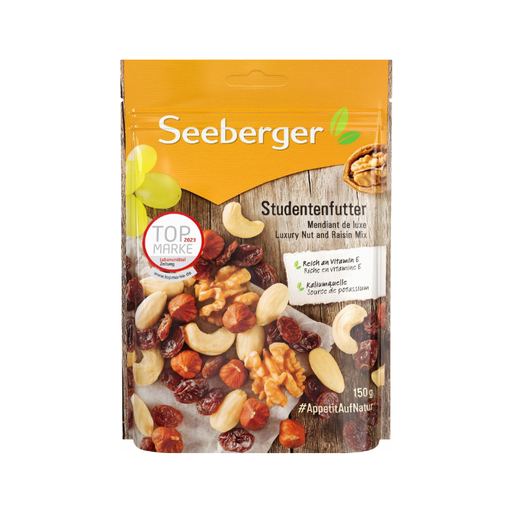
This student mix could suit a late-night bite with nuts and dried fruit. If your main consideration is less fat, compare the nutritional information on the specific pack with that of the nut mix you would usually choose.
 No image available
For a late-night bite with student mix rather than pure nut kernels. The pack contains 150 g; check the fat and salt content per 100 g, as well as the ingredients and allergen information on the specific pack, before making your choice.
No. “Reduced-fat” describes a comparison with a similar product; it doesn’t automatically mean the product is low in fat or energy overall. So compare the nutritional information per 100 g and check which product it is being compared with.
Check the fat, energy and salt per 100 g, as well as the ingredients list for the specific mix. If you want nuts with no added salt, a product labelled accordingly is a good starting point; that doesn’t tell you anything about its fat content.
Yes. Seeberger lists sunflower oil as an ingredient in its unsalted roasted nut selection. So for roasted varieties, check the ingredients as well as the salt information.
Not if you specifically want a nut mix. Lorenz ErdnußLocken Leicht Classic is a snack made mainly from maize grits, with 28% peanuts; the product details listed by REWE state 17 g of fat and 1.7 g of salt per 100 g.
Read the ingredients and allergen information on the specific pack, including any warnings about possible traces. The labelling on another variety from the same brand is no substitute.