If you mainly want to cut down on fat
You’re looking for a nut-like mid-morning snack with considerably less fat than the nuts compared here, and are happy to accept the different texture and carbohydrate content of cooked chestnuts.


If keeping fat as low as possible is your main priority for a mid-morning snack, cooked chestnuts may be a better choice than traditional nuts: Nutritional Value Calculator lists 2 g of fat per 100 g for cooked chestnuts, while the nut products from REWE and ALDI SÜD compared here contain 54 to 58.5 g per 100 g. Chestnuts do have a different texture, however, and Nutritional Value Calculator lists 41 g of carbohydrates per 100 g. If you’d rather stick with nuts, compare the nutritional information for the specific products and decide on your portion, rather than assuming that an unsalted or roasted option will automatically be lower in fat.
You’re looking for a nut-like mid-morning snack with considerably less fat than the nuts compared here, and are happy to accept the different texture and carbohydrate content of cooked chestnuts.
You’re mainly looking for unsalted nuts with a short ingredients list. Even so, check the nutritional information for fat content and choose a portion that works for your snack.
Taste and convenience on the go matter to you. So, when choosing roasted or seasoned nuts, compare the ingredients and the fat and salt content of each option.
A good fit if: A low fat content matters more to you than the characteristic bite of nuts. Nutritional Value Calculator lists 2 g of fat per 100 g for cooked chestnuts.
The trade-off: The same source lists 41 g of carbohydrates per 100 g; chestnuts are not nutritionally identical to nuts.
A good fit if: You want to eat traditional nuts and mainly avoid extra seasoning.
The trade-off: A short ingredients list doesn’t mean low fat: REWE lists 58.5 g of fat per 100 g for its unsalted, unroasted ja! nut mix.
| Criterion | What to check when buying | Who it matters to |
|---|---|---|
| Considerably less fat | Compare fat per 100 g and, for chestnuts, check how they’re prepared and what ingredients they contain. | If my main aim is to reduce my fat intake, I’d also consider a snack with a different texture. For around 36% of consumers, lower fat is likely to be the main reason for buying. |
| Fewer added ingredients | For traditional nuts, read the ingredients list and check the salt content; don’t assume that ‘plain’ means low in fat. | I still want to eat nuts, but without extra seasoning. Around 29% of consumers are likely to be mainly looking for a simple recipe. |
| Portion and energy | Compare the nutritional information per 100 g and, where provided, per portion; decide on your snack portion in advance. | For a mid-morning snack, I want to know how much I’m actually eating rather than treating the whole pack as one portion. Planning portions is likely to be the top priority for around 21% of consumers. |
| Taste and convenience on the go | For roasted or seasoned nuts, compare the fat, salt and ingredients for the specific product. | When I’m out and about, I want a convenient, crunchy snack without relying on its name alone. For around 14% of consumers, this is likely to be the main factor in their choice. |
A short ingredients list tells you about the recipe, not whether a product is low in fat. According to REWE, the unsalted, unroasted ja! nut mix contains 58.5 g of fat per 100 g.
Compare fat and energy per 100 g, and also take your planned portion into account.
ALDI SÜD lists 54 g of fat per 100 g for its roasted almonds and 58 g per 100 g for a roasted nut mix. The preparation description alone won’t tell you how much fat a product contains.
Check the nutritional information and ingredients for each option, especially if it’s seasoned or coated.
Cooked chestnuts differ from the nuts compared here in more than just their fat content. Nutritional Value Calculator also lists 41 g of carbohydrates per 100 g.
Decide whether a lower fat content or a snack made from traditional nuts matters more to you, and check the ingredients for the specific product when buying packaged chestnuts.
Small, hard foods can pose a choking risk for young children. Consumer Advice Centre NRW specifically includes nuts among these foods.
Consumer Advice Centre NRW recommends serving nuts to young children ground or crushed.
REWE sells, among other things, an unsalted, unroasted nut mix under its ja! brand.
EDEKA24 sells a range of nuts and dried fruit, including cashews and peanuts prepared in different ways.
Lidl describes Alesto as a range of plain nuts, dried fruit and savoury snacks.
ALDI SÜD sells, among other things, almonds, cashews and nut mixes under the FARMER NATURALS brand.
Seeberger sells nuts and kernels plain, roasted, salted and in mixes, among other options.
This product selection features chestnuts as a nut-like option for anyone whose main priority for a mid-morning snack is fat content. Before you decide, compare the ingredients and nutritional information on the specific pack.
 No image available
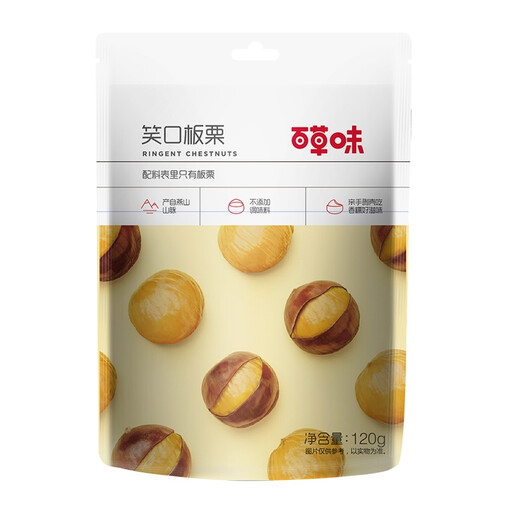
A chestnut option if you’re looking for an alternative to traditional nuts for your mid-morning snack. The product name indicates a 120 g pack; check the ingredients and the fat and sugar content per 100 g for this specific option.
If keeping fat as low as possible is your main priority, the nut products compared here may not be the best fit: REWE lists 58.5 g of fat per 100 g for an unsalted nut mix, while ALDI SÜD’s roasted almonds and nut mix contain 54 and 58 g respectively. If you want to stick with nuts, compare the specific product and decide on your portion.
Cooked chestnuts are not nutritionally identical to traditional nuts. Nutritional Value Calculator lists 2 g of fat and 41 g of carbohydrates per 100 g; their texture is also different from the characteristic bite of a nut snack.
Keep shelled or chopped nuts in an airtight container and, if possible, store them in the fridge. The Federal Centre for Nutrition recommends storing leftover shelled and chopped nuts this way.
You shouldn’t simply offer whole nuts as a snack to young children, as they can pose a choking risk. Consumer Advice Centre NRW recommends grinding or crushing nuts for young children.