Baking several trays at once
If you want to make larger quantities of oat bars in fewer batches, look for an explicitly stated multi-level function. Bosch lists this for the HBA571BB4, while AEG describes it for the BEE43511AB.


Whether a fan-assisted mini oven is suitable for your oat bar baking session depends mainly on the size of your tin and whether you want to bake several trays at once. A countertop model may be enough for suitable tins and single batches; for baking on multiple shelves at the same time, a built-in oven with an explicitly stated multi-level function is the more obvious choice. Manufacturers’ claims about multiple shelves are not a test using your recipe, so also check the usable tray area, included accessories and space available for the oven.
If you want to make larger quantities of oat bars in fewer batches, look for an explicitly stated multi-level function. Bosch lists this for the HBA571BB4, while AEG describes it for the BEE43511AB.
If you already know which recipe and tin you’ll use, compare the tin’s measurements with the usable interior space and check that you can select the required heating mode and temperature. REWE gives a tin size of 30 × 20 cm for one oat bar recipe; EDEKA specifies a different fan-oven temperature for another recipe.
If a built-in oven isn’t an option, allow for the required clearance as well as the countertop space needed for a mini oven. Severin specifies minimum clearances for the TO 2068, but these don’t apply to other models as a general rule.
A good fit if: You want to bake several trays at once and have a suitable kitchen housing unit.
Bear in mind: Check the installation dimensions and any extra accessories you may need. A manufacturer’s claim about multi-level cooking isn’t a test using oat bars.
A good fit if: You’re not planning a built-in installation but want to use a larger tin or baking tray.
Bear in mind: A large tray or several shelf positions alone don’t guarantee even baking across multiple trays.
A good fit if: You’re short on worktop space and use suitably sized tins for individual batches.
Bear in mind: Compare your tin’s dimensions, including its rim, with the oven interior. Some models also have specific clearance requirements.
When choosing a fan oven for a group oat bar baking session, focus on finding a suitable tin, deciding how many batches you want to bake at once, checking the available space and considering how much cleaning will be involved. The percentages indicate which of these factors is the deciding one for consumers.
| Priority | What to check when buying | Who cares about this most? |
|---|---|---|
| Tin and recipe | Measure the tin, including its rim; check the interior dimensions and available heating modes. REWE specifies 30 × 20 cm and 180 °C fan oven, while EDEKA gives 160 °C fan oven for a different recipe. | If I want to use the tin I already own and the recipe that goes with it, the dimensions, heating mode and temperature all need to match. Consumers who prioritise the tin and recipe are likely to make up around 36 %. |
| Several portions | Check the multi-level function, tray sizes, what’s included and the clearance needed between loaded trays. | If we want to bake several portions at once for our group session, an explicitly stated multi-level function matters more than the number of shelf positions alone. Consumers whose main priority is baking several batches at once are likely to make up around 29 %. |
| Available space | Compare the external dimensions and model-specific clearances with the space you have available. | If I don’t have a kitchen housing unit, the mini oven needs to fit in the available space along with the required clearances. Consumers for whom available space is the deciding factor are likely to make up around 21 %. |
| Use and cleaning | For comparable ovens with an energy label, compare consumption per standard cycle; check the cleaning method and accessories. | If I use the oven often or make sticky mixtures, I pay particular attention to its stated energy consumption and how much cleaning it will need afterwards. Consumers whose main priority is running costs and care are likely to make up around 14 %. |
The capacity in litres doesn’t tell you whether a particular tin, including its rim, will fit. The recipe featured by REWE uses a 30 × 20 cm tin.
Measure your tin and compare its dimensions with the published interior measurements or usable tray area.
If the tin doesn’t fit, you may need a different one or have to bake in several batches.
Having several shelf positions isn’t the same as having an explicitly stated multi-level fan function. The AEG BEE43511AB is listed as including one enamelled baking tray; check whether you need extra trays and whether they’ll fit.
Look for specific details about multi-level cooking, what’s included and the space between loaded trays.
You may need extra trays to bake several batches at once.
For the Severin TO 2068, the manufacturer specifies minimum clearances of 12 cm at the sides and rear, and 30 cm above the oven, in addition to its dimensions.
Before buying, check the instructions for the specific model and measure the clearances at the intended location.
Verbraucherzentrale gives energy consumption per standard cycle; according to the European Commission, small and portable ovens don’t fall within the same scope as oven energy labelling.
Only compare energy consumption figures on the same basis for appliances covered by the relevant label. A wattage figure or label alone won’t tell you the cost of baking a particular batch of oat bars.
Built-in ovens for existing kitchen housing units and baking sessions where cooking on multiple levels matters.
The BEE43511AB built-in model, with multi-level use described by the manufacturer.
The freestanding BG 1805/E is an option if you want a larger single baking area without a built-in oven.
The Bake & Style 26 Touch is a compact countertop oven for suitable tins and batches baked one after another.
The TO 2068 is a small, freestanding fan-assisted oven and toaster.
This selection includes built-in ovens with 3D hot air, as well as freestanding ovens for suitable tins and individual batches. Before buying, check the dimensions, required heating mode and space available for the specific model.
 No image available
Worth considering for a group baking session with several trays at once; Bosch describes the HBA571BB4 as offering 3D hot air on up to three levels.
As a built-in appliance, this model needs a suitable kitchen housing unit. The product name lists a 71 l interior and pyrolytic cleaning.
 No image available
A built-in option for a baking session where the 3D hot air mentioned in the product name appeals; a suitable kitchen housing unit is required.
The product name lists AirFry and a width of 60 cm.
 No image available
A freestanding option for individual batches, provided your tin fits inside.
The product name lists a 32 l capacity, 1600 W and a temperature range of 100–250 °C. A baking tray and rack are listed as included accessories in the product name.
 No image available
The fan function suits recipes that call for this heating mode; also check your tin’s dimensions against the interior.
The product name lists a 28 l capacity, temperature control and a timer.
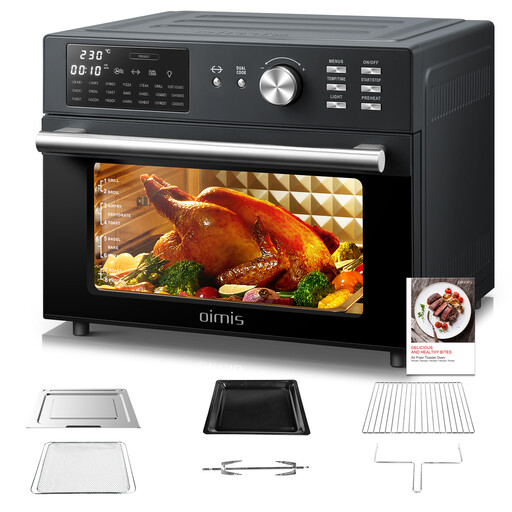 No image available
The product name lists a baking function; check your tin’s dimensions and the heating mode required for your recipe.
Listed features include a 30 l capacity, 21 programmes and 1800 W. Keep the appliance away from flammable materials such as curtains and wooden tables while it’s in use.
Follow the recipe you’re using. For a recipe made in a 30 × 20 cm tin, REWE specifies 180 °C fan oven; EDEKA gives 160 °C fan oven for a different flapjack recipe. These temperatures won’t necessarily suit every recipe.
Measure the tin, including its rim, and compare its dimensions with the published interior measurements or usable tray area for the specific model. One recipe featured by REWE uses a 30 × 20 cm tin; the oven’s capacity in litres alone won’t confirm that it will fit.
Look for an explicitly stated multi-level function rather than relying on the number of shelf positions alone. Bosch lists 3D hot air on up to three levels for the HBA571BB4; AEG also describes the BEE43511AB as suitable for use on up to three levels. These are manufacturers’ claims, not a baking test using your recipe.
Follow the instructions for the specific model. For the TO 2068, Severin specifies at least 12 cm of clearance at the sides and rear, and 30 cm above the oven; this manufacturer’s requirement shouldn’t be applied to other ovens as a general rule.
No. The European Commission excludes small and portable ovens from the scope of this oven energy label. For household ovens that do carry the label, the stated consumption is based on a standard cycle, not on your specific batch of oat bars.