Batch bakers
If you want to make plenty of flat biscuits for a picnic in as few batches as possible and have a suitable built-in space, check whether the oven is recommended for use on several levels and whether the trays are suitable.


If you regularly bake large batches of oat biscuits on several trays and have a suitable built-in space, a built-in oven with explicitly stated multi-level fan cooking could be a good option. For smaller batches without a built-in space, a countertop oven with a fan function may suit you. Check the usable tray area, where you’ll put it and the baking guidance for the specific model.
If you want to make plenty of flat biscuits for a picnic in as few batches as possible and have a suitable built-in space, check whether the oven is recommended for use on several levels and whether the trays are suitable.
A countertop oven could be an option for smaller batches if you don’t have a built-in space. Make sure you have a suitable place for it, and check how much usable tray area it actually offers.
If you’ll use the oven regularly after the picnic too, factors such as energy consumption, cleaning and included accessories may influence your choice as well as the baking area.
A good fit if: You often bake on several trays and the space available in your kitchen suits the oven’s dimensions.
Trade-off: “Up to three levels” doesn’t mean that three biscuit trays are included, or that every recipe will brown evenly on all levels.
A good fit if: You don’t have a built-in space or you bake smaller batches.
Trade-off: The oven’s external dimensions and usable tray area limit what you can do on your worktop. The number of shelf positions alone doesn’t tell you how many biscuit trays you can use at once.
| Buying priority | What to check | Who it matters most to |
|---|---|---|
| Lots of biscuits in a few batches | Whether the manual recommends using several levels for small, flat bakes; the number and dimensions of the trays included. | If you’re baking a large quantity of biscuits for a picnic, the usable tray area matters more than the capacity in litres alone. Around 33% of consumers prioritise baking lots of biscuits in a few batches. |
| A suitable built-in space or place to stand it | For a built-in oven, check the appliance and niche dimensions; for a countertop oven, check its external dimensions and setup instructions. | If you want to bake in your kitchen without making alterations, the oven type needs to suit the space available. That’s why around 27% of consumers prioritise finding a suitable place for their oven. |
| Controlled browning | The recommended heating function and shelf positions in the manual, as well as the temperature and time settings for your recipe. | If you want evenly browned oat biscuits, it’s important to know how your recipe will bake in the specific oven. Around 20% of consumers prioritise having control over the baking results. |
| Energy use and cleaning | For appliances with the relevant label, kWh per standard baking cycle; the cleaning system and accessories. | If you’ll use the oven regularly for everyday cooking too, energy use and maintenance matter beyond the picnic. Around 20% of consumers give priority to these ongoing costs and effort. |
For household ovens covered by the EU energy label, energy consumption is stated per standardised baking cycle. This figure isn’t a measurement for your biscuit recipe, and small ovens aren’t automatically subject to the same rules. Verbraucherzentrale and the European Commission explain the relevant figures and scope.
The number of shelf positions doesn’t tell you how many biscuit trays the oven can hold at once or which levels are suitable for your recipe.
Check the manual, the usable tray dimensions and what’s included with the specific model.
If suitable trays aren’t included, you may need to buy extra accessories or bake in additional batches.
The capacity in litres alone doesn’t tell you how much biscuit-making space a tray offers. For appliances covered by the relevant rules, the energy label gives consumption per standard baking cycle, not the energy used for your own batch.
Compare the usable tray area and, for ovens with the relevant label, the specific kWh figures alongside the oven capacity.
The external dimensions don’t cover every requirement for safely positioning and using an electrical appliance.
Read the setup and safety instructions in the manual for the specific model. Don’t assume the clearances required for another oven will apply.
For its HBA571BB4 built-in oven, Bosch states that 3D Hotair can be used on up to three levels and gives the oven capacity as 71 l.
For its HB314G0S3 built-in oven, Siemens states that 3D Hotair can be used on up to three levels and gives the oven capacity as 71 l.
For the B6ACH7AG3, NEFF states that CircoTherm can be used on up to three levels and that the door is retractable.
The freestanding BG 1805/E is described as having a 42 l capacity and fan-assisted heating functions.
The freestanding TO 2068 is a baking and toasting oven with a 20 l capacity and a fan function.
This selection includes built-in ovens and a freestanding 28 l countertop oven. Compare the oven type with the space you have, and check for each model which baking trays are included and what the manual recommends for using several levels.
 No image available
An option if you’re looking for a built-in oven; the product description mentions fan-assisted heat circulation and baking on several levels.
Specifications include 3 kW, ten functions, an LED timer, AquaClean and an ECO mode.
Check that it will fit your kitchen’s built-in space.
 No image available
For larger batches, the stated 3D Hotair feature for up to three levels may be useful; follow the manual’s recommendations for shelf positions.
The oven has a capacity of 71 l and is listed as having pyrolytic cleaning.
The listed accessories are a wire rack and a universal pan, not several biscuit trays. Check the niche dimensions too.
 No image available
The product description states that 3D Hotair can be used on up to three levels; check the manual to see which shelf positions are recommended for your recipe.
Specifications include a 71 l capacity and pyrolytic self-cleaning.
A baking tray is listed as an accessory, not a set of several biscuit trays. Check that it will fit your kitchen too.
 No image available
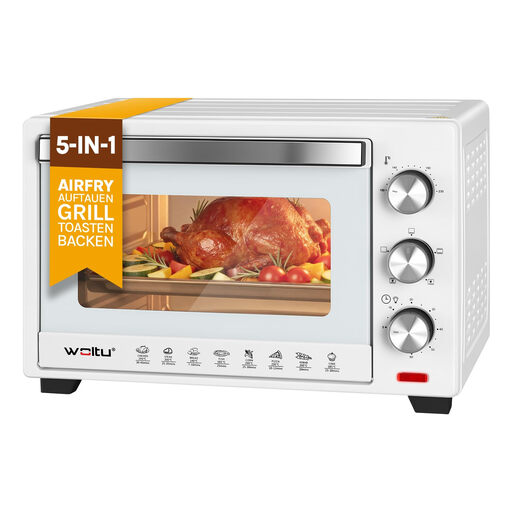
An option for smaller batches without a built-in space; the description mentions several baking trays and three adjustable shelf positions.
Specifications include temperature control from 100 to 230 °C and a 60-minute timer.
One baking tray is listed. Check whether you’ll need extra trays and whether they’ll fit in the oven.
 No image available
If you’d also like to use the oven for everyday baking, the product description lists baking as one of its uses.
Specifications include a 78 l capacity, nine functions, hydrolytic cleaning and a digital timer.
One baking tray is listed. Check the built-in dimensions and whether the accessories will be enough for the quantity of biscuits you plan to bake.
No. AEG distinguishes between fan-assisted cooking, which uses top and bottom heat with a fan, and hot air, which uses a ring heating element. When baking small, flat biscuits on several trays, check the suitable heating function and recommended shelf positions in your model’s manual.
Not necessarily. The European Commission recommends preheating when the recipe or the appliance manual says to. For the heating function and shelf position, follow the baking chart for the specific oven.
For appliances with the relevant label, you can compare the kWh figure per standard baking cycle. This doesn’t show the energy used for your batch of biscuits; your recipe and how you actually use the oven matter too.
The European Commission describes small ovens as being outside the scope it sets out for the energy label for household ovens. So, on its own, a small oven’s lack of an energy label doesn’t prove that it breaches the rules.