If fibre content per 100 g is your priority when choosing porridge or a baking ingredient for Christmas dinner, it’s worth looking at oat bran: Kölln lists 19 g of fibre per 100 g for its oat bran flakes, while Seitenbacher lists 18 g per 100 g for its oat bran. Texture matters too when choosing a recipe: fine rolled oats make a smoother mixture, while jumbo oats are a better fit for dishes with a noticeable bite. If you’re shopping for someone with coeliac disease, check for an explicit gluten-free label, whatever the type of oats or fibre content; this is the advice from the Verbraucherzentrale (German consumer advice centre).
Which oat ingredient is right for you?
If you’re comparing fibre content
If you’re adding oats to porridge, dough or a savoury dish, compare the nutritional information per 100 g. This helps you distinguish fine oat bran from traditional rolled oats, without assuming that the type of oats alone determines the fibre content.
If you’re planning the texture of your dish
Fine rolled oats are a good choice for a smoother porridge base. If you want a crumble, bake or topping to retain a distinct oat texture, jumbo oats are the more obvious choice. The Verbraucherzentrale distinguishes between fine and coarse rolled oats according to how the oat grain is processed.
If you’re shopping for guests with coeliac disease
An explicit gluten-free label matters more here than choosing between oat bran, fine oats or coarse oats. The Verbraucherzentrale advises people with coeliac disease to buy only oats labelled gluten-free; check the current packaging of the other recipe ingredients too.
What to look for when buying
For your Christmas recipe, first decide whether you want a smooth texture or oats with more bite. Then compare the fibre content per 100 g. If you need a gluten-free product, treat that as a separate selection criterion.
Oat bran
A good fit if: You want a fine oat ingredient and a high declared fibre content per 100 g.
Consider: Oat bran won’t give you the clearly defined texture of jumbo oats.
Fine rolled oats
A good fit if: You want a smoother texture for porridge or another oat-based mixture.
Consider: They’re less suitable than jumbo oats for a crumble with visible oats and a satisfying bite.
Jumbo oats
A good fit if: You want your porridge, crumble or bake to retain a hearty oat texture.
Consider: If you’re after a smooth oat base, bear in mind that these oats have a coarser texture.
| Criterion |
What to check |
Who it matters to |
| Fibre content |
Compare the fibre per 100 g on the nutritional information panel; don’t assume oat bran and rolled oats are equivalent based on their names alone. |
If I’m adding oats to a Christmas recipe mainly for their fibre content, the figure on the pack matters more to me than the type of oats. Around 36% of consumers would put fibre content first when choosing. |
| Recipe texture |
Choose fine oats for a smoother mixture and jumbo oats for a more distinct texture. |
I want my crumble to have a satisfying bite, but I’d choose a different type of oats for smooth porridge. Around 29% of consumers would put the right texture first. |
| Gluten-free labelling |
If you’re cooking for someone with coeliac disease, look for an explicit gluten-free label and check the current packaging of all the recipe ingredients. |
If I’m cooking for a guest with coeliac disease, I’d check the label first, then consider texture or brand. Around 21% of consumers would prioritise this label. |
| Organic and pack size |
Check the organic label and pack size on the product itself, and make sure you have enough for your recipe. |
If I’m making several trays of bakes or stocking up, I want to choose the right pack size and, if needed, an organic product. Around 14% of consumers would check these practical details first. |
Common selection mistakes
-
Assuming organic or wholegrain means a particular fibre content
These labels describe different product qualities from the amount of fibre. REWE lists 10 g of fibre per 100 g for its organic rolled oats; Kölln lists 19 g per 100 g for its oat bran flakes, and Seitenbacher lists 18 g per 100 g for its oat bran.
Compare the fibre content per 100 g on the specific pack instead of assuming a particular figure based on an organic label or the word “wholegrain”.
-
Serving regular oats to guests with coeliac disease without checking the label
Regular products may carry a warning that they could contain traces of other cereals containing gluten. The Verbraucherzentrale advises people with coeliac disease to choose oats explicitly labelled gluten-free.
Check the label on the current pack, and remember to check the other ingredients in your Christmas recipe too.
-
Swapping oat bran for jumbo oats in every recipe without adjusting anything
Fine oat bran and larger, coarser oats don’t have the same texture. Swapping one for the other can change the consistency you’re aiming for, especially in porridge, crumble or bakes.
Choose your oats to suit the texture you want. If you’re substituting one type for another, check the liquid quantity and method in the specific recipe.
Brands and product ranges to consider
Kölln
Kölln oat bran flakes are a finer alternative to traditional oats if you’re comparing fibre content per 100 g.
- Kölln lists 19 g of fibre and 7.5 g of beta-glucan per 100 g for its oat bran flakes.
- These figures apply to the product mentioned, not to all Kölln rolled oats.
Seitenbacher
Seitenbacher oat bran is an option for recipes that call for a fine oat texture rather than a hearty one.
- Seitenbacher lists 18 g of fibre and 16 g of protein per 100 g for its oat bran.
- Oat bran doesn’t provide the texture of jumbo oats.
Alnatura
Alnatura’s jumbo wholegrain oats are an option for recipes where you want the larger oats to remain visible.
- Alnatura describes its jumbo oats as hearty and sells them in a 1 kg pack.
- The product mentioned may contain traces of soya, mustard and lupin. An organic label does not mean the product is suitable for a gluten-free diet.
REWE Bio
The rolled oats reviewed are a classic choice for porridge and everyday cooking.
- REWE lists 10 g of fibre per 100 g for its organic rolled oats.
- The product information warns that the oats may contain traces of other cereals containing gluten.
EDEKA Bio
These extra-fine oats offer a finer texture for suitable porridge and baking recipes.
- EDEKA describes its extra-fine oats as cut and rolled oat kernels from certified organic farming.
- EDEKA warns that this product may contain traces of other cereals containing gluten; check the current pack.
H. & J. Brüggen
Brüggen is relevant as a manufacturer of own-label products, rather than as a specific oat product in this comparison.
- The company’s product categories include rolled oats and oat bran flakes.
- For fibre content and ingredients, always check the label on the specific own-label product.
Oat products for porridge and baking at Joybuy
This selection includes fine and coarse rolled oats, as well as a porridge product for Christmas dinner recipes. Choose according to the texture you want, and check the nutritional information, pack size and ingredients on the product packaging.
 No image available
Kölln fine rolled oats, 4 × 500 g
For porridge or baking recipes that call for fine oats. The product title specifies a pack of four, each containing 500 g. If you need a gluten-free product, check for an explicit label on the pack.
View at Joybuy
 No image available
Kölln coarse rolled oats
For porridge or baking recipes where you want a coarser oat texture. Check the pack size on the specific product before buying. If you need a gluten-free product, look for an explicit label.
View at Joybuy
 No image available
Kölln fine rolled oats, 500 g
For a finer oat texture in porridge or baking. The product title states that the pack contains 500 g. If the ingredients or gluten-free suitability matter for your recipe, check the current label.
View at Joybuy
 No image available
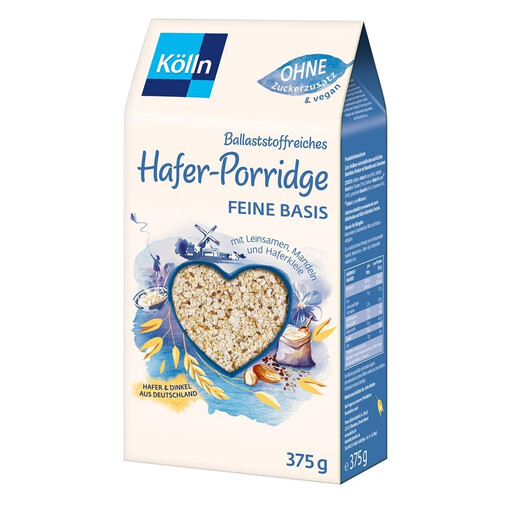
Kölln Pure Rolled Oat Porridge, 375 g
This porridge product is an option if you’re looking for a suitable base for Christmas dinner. Check the ingredients and allergen information on the current pack carefully, particularly if milk or peanuts are a concern.
View at Joybuy
 No image available
Alnatura organic fine rolled oats, 400 g
For porridge or baking recipes that call for fine rolled oats. The product title states that the pack contains 400 g. If you have any relevant allergies, check the ingredients and may-contain warnings on the current pack.
View at Joybuy
Frequently asked questions
When can an oat product be described as high in fibre?
Under Regulation (EC) No 1924/2006, published in the Official Journal of the European Union, a product must contain at least 6 g of fibre per 100 g or at least 3 g per 100 kcal to be labelled “high fibre”. Compare the nutritional information for the specific product; being organic or wholegrain alone doesn’t prove that it meets this threshold.
Is oat bran always the better choice for Christmas dinner?
No. Oat bran is a good choice if you want a fine ingredient with a high declared fibre content per 100 g. Jumbo oats are more suitable for a crumble or porridge with a hearty oat texture. If you’re adapting a recipe, check how much liquid you’ll need too.
Are regular rolled oats suitable for guests with coeliac disease?
The fact that a product is labelled rolled oats isn’t enough. The Verbraucherzentrale advises people with coeliac disease to buy only oats explicitly labelled “gluten-free”. Check the current pack and the other ingredients in your recipe too.
How can you compare the fibre content of a portion?
Start with the figure per 100 g on the nutritional information panel, then take account of the amount you’ll actually use. This makes it easy to compare oat bran and rolled oats, even when the recipe calls for different portion sizes.


