If you’re looking for a fibre-focused Sunday breakfast, oats with clear nutritional information are a good place to start. Jumbo oats work well in porridge or muesli with a bit of bite, while fine oats are better for a smoother texture. Oat bran is another option, but it will change the texture. Whether a particular product meets the regulated claim “high fibre” depends on its fibre content.
Which type of oats is right for you?
For a fibre-focused breakfast
If fibre content is what matters most to you, compare the nutritional information for the specific oats or oat bran per 100 g. Under EU Regulation (EC) No 1924/2006, the claim “high fibre” requires at least 6 g of fibre per 100 g or 3 g per 100 kcal.
For a particular breakfast texture
Jumbo or large-flake oats are a good choice for Sunday muesli or porridge with a bit of bite. If you prefer a smoother bowl, look for fine or instant oats; Kölln and Alnatura describe these differences in their product ranges.
For those who need gluten-free food
If you need to follow a gluten-free diet for medical reasons, the fact that a product contains oats isn’t enough to make your choice. Look for an explicit gluten-free label; according to the Verbraucherzentrale, foods labelled this way may contain no more than 20 mg of gluten per kg.
What to look for when choosing
First, check the fibre content of the type you’re considering, then decide whether you want a breakfast that’s chewy, creamy or quick to prepare. Under EU Regulation (EC) No 1924/2006, the claim “high fibre” requires at least 6 g of fibre per 100 g or 3 g per 100 kcal. The type of oats alone doesn’t prove that a product meets this threshold.
| What to consider |
What to check when buying |
Who it matters to |
| Fibre |
Fibre per 100 g in the nutritional information for the type you’ve chosen; check the relevant threshold if the product makes a nutrition claim. |
If fibre content matters more to me than the type of oats, I want to be able to compare the figures directly. For around 40% of consumers, this is the top priority. |
| Texture |
Descriptions such as “jumbo” or “large flakes” compared with “fine” or “creamy”. |
For a relaxed breakfast, I want to choose whether my porridge has some bite or is smooth. Texture is the main concern for around 30% of consumers. |
| Preparation |
Information about how quickly the oats dissolve and the preparation instructions on the specific pack. |
If I want breakfast without a long cooking time, I look for a product explicitly described as instant. Around 20% of consumers put ease of preparation first. |
| Gluten-free labelling |
An explicit gluten-free label and the information on the current pack. |
If I need gluten-free food for medical reasons, I need to check the label before considering texture and preparation. For around 10% of consumers, this suitability is the main factor in their choice. |
Common buying mistakes
-
Assuming “wholegrain” or “jumbo” means high in fibre
The type of oats doesn’t tell you how much fibre they contain. Under EU Regulation (EC) No 1924/2006, the claim “high fibre” is only permitted from at least 6 g of fibre per 100 g or 3 g per 100 kcal.
So check the fibre information on the specific pack rather than choosing based on the texture description alone.
-
Buying oat bran as a like-for-like substitute for oats
Oat bran changes the consistency of porridge or yoghurt. Seitenbacher also advises using enough liquid with its oat bran and taking individual reactions into account.
If you want a chewy porridge, choose the relevant oats as your base. If you’re adding oat bran, follow the preparation instructions and adjust the amount of liquid.
-
Checking only for oats when you need gluten-free food
Seeing oats on the ingredients list doesn’t confirm that a product is labelled gluten-free. The Verbraucherzentrale gives a maximum of 20 mg of gluten per kg of food for products labelled “gluten-free”.
If you need gluten-free products for medical reasons, check for an explicit gluten-free label and read the information on the current pack.
Brands to consider
Kölln
Kölln offers a range that includes organic fine and jumbo oats, as well as instant oats.
- According to Kölln, both of the organic varieties mentioned contain 9.2 g of fibre per 100 g; its instant oats contain 12 g per 100 g.
- These figures apply to the specific varieties mentioned, not every oat product from the brand.
Seitenbacher
Seitenbacher oat bran can be added to porridge or yoghurt if you’d like a different consistency from that of rolled oats.
- Seitenbacher states that its oat bran contains 18 g of fibre per 100 g.
- Bran won’t replace jumbo or fine oats without changing the texture; follow the manufacturer’s advice on how much liquid to use.
Alnatura
Alnatura describes its large-flake oats as chewy and firm, and also offers creamy oats made from ground oats.
- These two options give you a useful guide to choosing between a bit of bite and a smoother consistency.
- To compare fibre content, you’ll also need to check the nutritional information for the specific variety you’re buying.
EDEKA Herzstücke
The EDEKA24 product page lists fine organic oats as a simple breakfast option.
- The product name tells you that these are fine oats.
- The EDEKA24 product page mentions possible traces of other gluten-containing cereals, lupin, mustard and soya. Check the label on the current pack before choosing.
Brüggen
H. & J. Brüggen KG describes itself as a manufacturer of own-label breakfast products, rather than as a single product range directly comparable with brands of rolled oats.
- Its range includes breakfast cereals.
- When comparing fibre and ingredients, it’s the specific own-label product that matters, not the manufacturer’s name alone.
Oat products on Joybuy
This selection includes jumbo and fine oats, as well as a porridge product for Sunday breakfast. Start by choosing the preparation style and texture you prefer, then compare fibre, ingredients and allergens using the information on the specific pack.
 No image available
Jeden Tag jumbo oats, 500 g
For porridge with a bit of bite or as breakfast cereal if you’re after a chunkier option.
Pack size: 500 g. Check the nutritional and allergen information on the pack to help you choose.
View on Joybuy
 No image available
Kölln jumbo oats, 500 g
For a Sunday breakfast with a hearty oat texture.
Pack size: 500 g. Compare the fibre content of this variety using its nutritional information.
View on Joybuy
 No image available
Kölln fine rolled oats, 500 g
For porridge if you prefer fine oats to a chunkier option.
Pack size: 500 g. Check the nutritional information on this pack when comparing fibre content.
View on Joybuy
 No image available
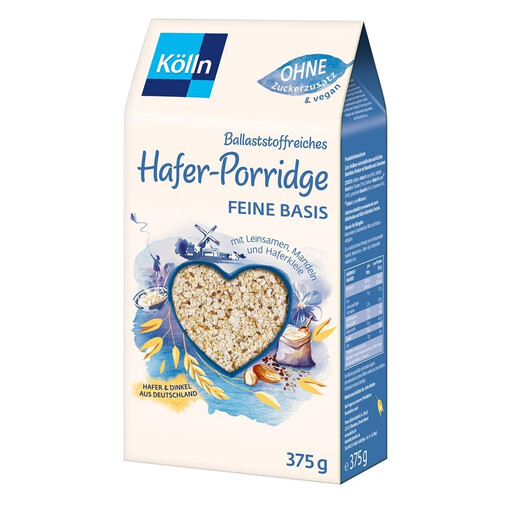
Kölln Pure Rolled Oat Porridge, 375 g
For anyone looking for a product sold as porridge rather than a pack chosen by oat type.
Pack size: 375 g. Before buying, check the ingredients, allergens and preparation instructions on the current pack.
View on Joybuy
 No image available
Alnatura organic fine oats, 400 g
For a breakfast made with fine oats rather than a chunkier variety.
Pack size: 400 g. Compare the fibre and allergen information on the label for this variety.
View on Joybuy
Sunday breakfast with oats: your questions answered
When can oat products be labelled “high fibre”?
Under EU Regulation (EC) No 1924/2006, this claim is permitted when a food contains at least 6 g of fibre per 100 g or 3 g per 100 kcal. When comparing products in store, the nutritional information for the specific variety is what counts.
Which oats are best for smooth or chunky porridge?
Jumbo or large-flake oats are a good choice for porridge with a bit of bite, while fine or instant oats are better for a smoother consistency. If you want breakfast without a long cooking time, check the preparation instructions for the product you’ve chosen.
Are ordinary oats automatically suitable for people with coeliac disease?
No. The fact that a product contains oats doesn’t, on its own, confirm that it’s suitable for a gluten-free diet. If you need gluten-free food, look for an explicit gluten-free label; the Verbraucherzentrale gives a maximum of 20 mg of gluten per kg of food.
How should I store oats and oat bran?
Keep them somewhere dry and away from heat. Also follow the storage instructions and best-before date on the relevant pack.


