For comparing nutritional values
If you choose the oat element of a savoury bowl based on its fibre content, compare the nutritional information per 100 g for each product. The figures on the front of the pack alone aren’t enough.


For a savoury Asian-inspired bowl with as much fibre per 100 g as possible, pure oat bran flakes are an obvious choice: Kölln lists 19 g per 100 g for its product. If you want oats to create a smooth porridge or soup base, fine or instant flakes are worth considering; for a more distinct flake texture, try jumbo rolled oats. Whichever option you choose, check the nutritional information and ingredients for the specific product.
If you choose the oat element of a savoury bowl based on its fibre content, compare the nutritional information per 100 g for each product. The figures on the front of the pack alone aren’t enough.
If you’re looking for a smooth savoury porridge or an oat ingredient for soup and sauce, choose instant or finely milled flakes rather than a coarse, chunky texture.
If you want to season the bowl yourself, check the ingredients, organic labelling and texture. A chunky wholegrain flake serves a different purpose from a finely dissolving variety.
First decide what matters most to you: the stated fibre content, a fine consistency or a simple ingredient list, perhaps with a chunkier texture. Under EU rules on nutrition claims, a product can be described as “high in fibre” if it contains at least 6 g of fibre per 100 g or at least 3 g per 100 kcal. Always check the information for the specific product.
| Criteria | What to check | Who it matters most to |
|---|---|---|
| Fibre content | Compare fibre per 100 g; the “high in fibre” claim can also be based on the threshold per 100 kcal. | If I’m choosing ingredients for my bowl primarily by stated fibre content, I want to compare products using the same serving basis. Around 42% of consumers put this comparison first. |
| Fine texture | Look for “instant” or “finely dissolving” and check how the product is described for use in liquids. | For a smooth savoury porridge or oats in soup and sauce, I don’t want coarse flakes. This texture is the most important buying criterion for around 33% of consumers. |
| Ingredients and texture | Read the ingredients and check the organic labelling; if you want more bite, consider jumbo flakes. | If I’m seasoning my bowl myself, I want to know what’s in the oat base and may choose chunkier flakes. Around 25% of consumers make this their top buying priority. |
Wholegrain doesn’t tell you the exact fibre content. Kölln lists 19 g of fibre per 100 g for its oat bran flakes and 12 g per 100 g for its instant oats; REWE lists 10 g per 100 g for its REWE Bio rolled oats.
Compare the nutritional information per 100 g for the dish you’re making, rather than assuming a value from the product name.
According to Kölln, Kölln Haferkleie Fleks contain, among other ingredients, oat bran, maize flour, dextrose, barley malt extract and salt. This recipe isn’t the same as plain flakes when you’re making a savoury base to season yourself.
For crunchy varieties, check the ingredients, sugar and salt content, then decide whether they’ll work in your dish.
The Verbraucherzentrale advises people with coeliac disease to buy only oats explicitly labelled “gluten-free”.
If you need to follow a gluten-free diet, check the labelling on the current pack.
EDEKA notes that product information may differ from what’s printed on the packaging. When choosing, always check the details on the specific variety you’re buying.
Before buying, read the nutritional information, ingredients and allergen warnings on the pack.
Product-specific information is available to help you choose between oat bran and instant flakes.
Oat bran is one option if you don’t want the texture of the flakes to be the main feature of your bowl.
The wholegrain flakes described here differ mainly in their texture.
An organic oat flake variety with a stated fibre content.
For choosing a texture, EDEKA Herzstücke’s finely milled oats are particularly worth considering.
Brüggen is relevant here primarily as a manufacturer of rolled oats and other cereals.
This selection includes coarse and fine rolled oats, instant flakes and a porridge mix, to suit different texture preferences in savoury oat dishes. If you’re specifically looking for a product labelled “high in fibre”, check the nutritional information for the variety you’re considering.
 Image unavailable
A coarse flake variety for when you want the oat texture to stand out in your savoury bowl.
Pack size: 500 g. To compare fibre content, check the nutritional information for this variety.
 Image unavailable
Fine flakes for an oat base if you’d like to use the same variety for several dishes.
Pack of four 500 g units. If you follow a gluten-free diet, check the labelling on each pack.
 Image unavailable
Fine rolled oats for a porridge where you don’t want coarse flakes to take centre stage.
Pack size: 500 g. Check the fibre content and, if applicable, the gluten-free labelling on the specific pack.
 Image unavailable
An instant variety for when you want to stir oats into a liquid or creamy base.
Pack size: 250 g. Adjust the seasoning and consistency to suit your savoury dish.
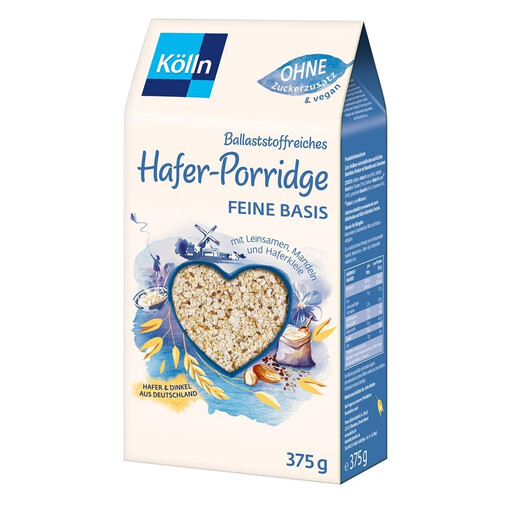 Image unavailable
A porridge option if you’re considering a prepared base for your dish instead of individual flakes.
Pack size: 375 g. If you have a wheat or almond allergy, check the ingredients and allergen information carefully before buying.
Under EU rules on nutrition claims, it must contain at least 6 g of fibre per 100 g or at least 3 g per 100 kcal. Check the nutritional information for the specific product; “wholegrain” on its own doesn’t tell you the fibre content.
Not necessarily. Oat bran flakes are an option if stated fibre content is your priority, while jumbo rolled oats are better suited to a bowl with a more noticeable bite. Kölln lists 19 g of fibre per 100 g for its oat bran flakes; choose the product type separately to get the texture you want.
Fine or finely dissolving flakes are one option. Alnatura specifically recommends its finely dissolving wholegrain oat flakes for soups and sauces. For other varieties, check the suggested uses and adjust the amount of liquid as you cook.
For people with coeliac disease, the Verbraucherzentrale recommends choosing only oats explicitly labelled “gluten-free”. Don’t rely on the word “oats” alone: check the current pack.
Keep them in a dry place away from heat. Reseal the pack after opening or transfer the oats to a clean, airtight container.