For a quick, smooth portion, instant or fine oats are worth considering; for more bite, choose coarser oats. If fibre content is your priority, compare the figures per 100 g and for your portion – including oat bran. If you have coeliac disease, it’s also essential to check that the specific pack is explicitly labelled gluten-free.
Which type of oats suits you?
A snack with a focus on fibre
If fibre is your main consideration, compare the nutritional information per 100 g and work out the amount in your portion. Compare specific products of rolled oats and oat bran, rather than relying on their names alone.
Quick, smooth porridge
If you’re short on time in the evening and prefer a fine texture, instant or melting flakes are worth a look. The Verbraucherzentrale describes melting flakes as particularly easy to dissolve, while Kölln says its instant oats dissolve immediately.
Choosing products with the right labelling
If you need gluten-free food because you have coeliac disease, the word ‘oats’ alone isn’t enough. Look for an explicit gluten-free label and check the ingredients and ‘may contain’ information on the current pack.
What to look for when buying
First decide whether fibre content, quick preparation, bite or labelling matters most for your late-night snack. Then check the specific pack: the type of oats alone doesn’t determine either nutritional value or suitability if you have an intolerance.
| What to consider |
What to check when buying |
Who it matters to |
| Fibre |
Compare fibre per 100 g and in your planned portion; for oat bran, check the figure for the specific pack. |
I mainly want to know how much fibre is in my portion, rather than relying on the packaging. For around 31% of consumers, this clear figure comes first. |
| Preparation |
Look for terms such as instant, melting flakes or fine oats, and read the preparation instructions. |
I want my evening portion to be ready quickly and have a smooth texture. Around 31% of consumers would choose mainly on this basis. |
| Texture and use |
Distinguish between jumbo or coarse oats for more bite and fine oats; check the pack for other suggested uses. |
I want oats with a texture that also works for me in muesli or baking. For around 23% of consumers, this would be their main reason for buying. |
| Labelling |
If you have coeliac disease, look for ‘gluten-free’; if you have allergies, check the ingredients and ‘may contain’ information on the current pack. |
Because I need to eat gluten-free or have an allergy, checking the labelling comes before choosing a type of oats. For around 15% of consumers, this would be their priority. |
Common selection mistakes
-
Assuming ‘porridge’ means a particular fibre content
The product name is no substitute for checking the nutritional information. REWE lists 9.4 g of fibre per 100 g for its organic fine rolled oats, while Kölln lists 19 g per 100 g for its oat bran flakes. These figures are for two different specific products.
Compare the figure per 100 g and work out how much is in your portion. Don’t assume the figure for one oat bran product applies to other packs.
-
Assuming instant, fine and coarse oats are interchangeable
Processing mainly affects the texture: according to the Verbraucherzentrale, melting flakes dissolve particularly easily, while coarse oats offer more bite.
Choose the type to suit the consistency you’d like in the evening, and check the preparation time on the pack.
-
Choosing oats without checking the label if you have coeliac disease
Lebensmittelklarheit points out that oats may come into contact with other gluten-containing cereals during cultivation or processing. So the words ‘rolled oats’ alone don’t tell you whether a product is suitable for a gluten-free diet.
If you have coeliac disease, choose products explicitly labelled ‘gluten-free’ and read the information on the current pack.
Brands to help you choose
Kölln
Instant oats and oat bran flakes cater for different preferences around texture and fibre content.
- Kölln describes its instant oats as dissolving immediately. The manufacturer lists 19 g of fibre per 100 g for its oat bran flakes.
- The oat bran figure applies to this product, not all Kölln oat flakes.
Seitenbacher
The brand describes its rolled oats, oat bran and oat flour as suitable for different recipes.
- According to Seitenbacher, these oat products can be used for porridge, baked goods and savoury dishes, among other things.
- For a fibre comparison, use the nutritional information for the specific product you’ve chosen.
Brüggen
Brüggen describes how it processes oats and other grains into flakes.
- The brand lists cleaning, sorting, steaming and rolling among its processing steps.
- When choosing a product for a snack, check the type, ingredients and nutritional information on the specific pack.
Alnatura
Jumbo oats are an option if you’re looking for a coarser texture.
- Alnatura says its jumbo oats are rolled from the whole grain.
- Organic quality and flake size are no substitute for a fibre figure per 100 g.
REWE Bio
Fine oats are an option for a smoother porridge texture.
- REWE lists 9.4 g of fibre and 13 g of protein per 100 g for its organic fine rolled oats.
- These figures apply to the product mentioned and not to all REWE Bio oat products.
EDEKA
Fine and extra-fine oats offer different product types; checking the label is particularly important if you have allergies.
- EDEKA describes its extra-fine flakes as made from cut and rolled oat kernels.
- Some EDEKA products may contain traces of other gluten-containing cereals and allergens. Check the current pack.
Oat products at Joybuy
This selection includes fine and coarse oats, instant flakes and a porridge mix to suit different preferences for a late-night snack. For each product, check the current ingredients list, nutritional information and, where relevant, allergen labelling.
 Image unavailable
Kölln fine rolled oats, 500 g
For an evening portion if you prefer fine oats to coarse ones. Check the fibre figure per 100 g on the pack.
View at Joybuy
 Image unavailable
Kölln coarse rolled oats, 500 g
For a snack when you’d like coarser flakes and more bite. If you’re making hot porridge, follow the preparation instructions on the pack.
View at Joybuy
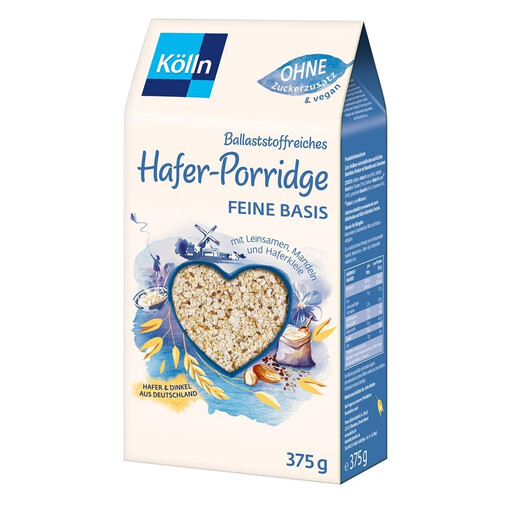 Image unavailable
Kölln Pure Rolled Oat Porridge, 375 g
For a warm bowl of porridge if you’re looking for a porridge mix rather than plain oats. Check the ingredients and allergen information before buying.
View at Joybuy
 Image unavailable
Alnatura organic fine rolled oats, 400 g
For a fine oat texture in your late-night snack. If fibre is a priority, compare the figure per 100 g with other specific products.
View at Joybuy
 Image unavailable
Kölln Instant Melting Oat Flakes, 250 g
For a quick-to-make portion if you prefer instant flakes. To compare fibre, check the basis for the nutritional information on the pack; if you have coeliac disease, look specifically for a gluten-free label.
View at Joybuy
Frequently asked questions
How can I check the fibre content of rolled oats?
You’ll find the figure in the nutritional information on the specific pack, usually per 100 g. Compare this figure across products, then take the size of your portion into account.
Which oats are best for quick, smooth porridge?
Instant or melting flakes are a good choice if you want a particularly smooth consistency. According to the Verbraucherzentrale, melting flakes dissolve especially easily; you should also check the preparation instructions for the specific product.
Are ordinary rolled oats suitable if I have coeliac disease?
No, the words ‘rolled oats’ alone aren’t enough. Look for an explicit gluten-free label on the current pack and check the ingredients and ‘may contain’ information. Lebensmittelklarheit points out that oats may come into contact with other gluten-containing cereals.
Is oat bran the same as coarse rolled oats?
No, oat bran and coarse rolled oats are different oat products. If you’re comparing them for fibre, use the nutritional information per 100 g for each product and take your actual portion size into account.


