What should you look for when choosing?
First decide whether you want to make up your own porridge or choose a ready-made flavour. Then compare the ingredients and nutritional information for the specific products on the same basis.
| What matters to you |
What to check before buying |
Who it matters to |
| Portion and sweetness |
Pack size, ingredients in the base and any extras you’ll need. |
If I often have a sweet breakfast, I want to choose the fruit and sweetness in each portion myself. Around 39% of consumers put this control first. |
| Ready-made fruit flavour |
Fruit ingredients, fruit content and sugar per 100 g of dry product. |
I don’t want to put together a fruit mix every morning, and I’m happy to choose a set recipe instead. For around 31% of consumers, this ready-made flavour comes first. |
| Protein content |
Protein per 100 g on the same basis, and any milk ingredients in the ingredients list. |
If the stated protein content matters more to me than a plain oat base, I also check the other ingredients. Around 15% of consumers make this their priority. |
| Gluten and allergens |
If you have coeliac disease, look for an explicit gluten-free label; also check the ingredients list and allergen information. |
If I rely on a particular label or need to avoid an ingredient, the individual pack determines whether the product is suitable for me. Around 15% of consumers make this their top priority. |
Oats and porridge bases at Joybuy
These products are suited to making your own porridge with added fruit and toppings: three types of oats and one porridge base. Choose between fine and jumbo oats or the ready-prepared mix, depending on the recipe you have in mind.
 No image available
Kölln fine oats, 500 g
A fine oat option if you’d like to make your own sweet porridge.
If needed, check the ingredients and labelling on the pack. If you have coeliac disease, an explicit gluten-free label is essential.
View at Joybuy
 No image available
Alnatura organic fine oats, 500 g
Fine oats for porridge where you choose the fruit and sweetness yourself.
The product title states that the pack contains 500 g. If you have coeliac disease, also look for an explicit gluten-free label.
View at Joybuy
 No image available
Kölln jumbo oats
An option for anyone who prefers jumbo oats to fine oats in their homemade porridge.
Check the pack size on the product you choose. If you have coeliac disease, an explicit gluten-free label is also essential.
View at Joybuy
 No image available
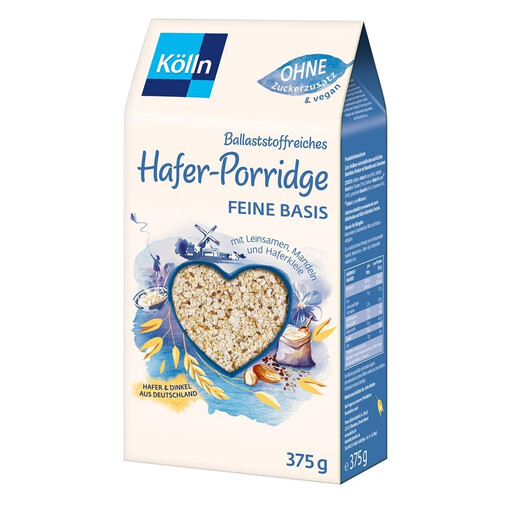
Kölln Pure Oat Porridge, 375 g
A porridge base for when you want a ready-prepared mix and plan to add your own fruit or spices.
When choosing, pay particular attention to the information about wheat and almonds, along with any other allergen details on the pack.
View at Joybuy
Frequently asked questions
Are plain oats a better choice for sweet porridge?
Plain oats are a good fit if you want to choose the portion, fruit and sweetness yourself. A ready-made mix may be more convenient if you’d rather have the same fruit flavour every time than that flexibility.
Does “no added sugar” mean fruit porridge is low in sugar?
No, the claim doesn’t describe the total sugar content. Seitenbacher says its Fruit Porridge has no added sugar, but lists 19 g of sugar per 100 g. So check the nutritional information and ingredients list, too.
Which nutritional values can you compare directly for porridge?
Compare figures on the same basis, ideally per 100 g of dry product. As Lebensmittelklarheit explains, values per 100 g of prepared porridge aren’t directly comparable with those for a dry mix.
Are ordinary oats suitable if you have coeliac disease?
No. If you have coeliac disease, only oats explicitly labelled gluten-free are suitable. The German Federal Centre for Nutrition points out that ordinary oats may come into contact with gluten-containing cereals during growing or processing.
Where can you find allergen information on packaged porridge?
Check the ingredients list and any other allergen information on the specific pack. According to the German Federal Office of Consumer Protection and Food Safety, the main substances that can cause allergies must be listed in the ingredients. Depending on the recipe, relevant allergens in porridge may include cereals, milk or tree nuts.


