Households that eat oats regularly
If you use oats often, you’ll want a pack size that’s easy to store and use up. A simple ingredients list also makes it easier to tell plain oats from mixed products.


For a retirement pantry you’ll dip into regularly, plain wholegrain oats are a natural staple. Choose the pack size and type of flake to suit how much you use and how you like to prepare them. Fine oats make a smoother porridge, while jumbo oats have more bite. If you have coeliac disease, only choose a product explicitly labelled gluten-free on the pack itself.
If you use oats often, you’ll want a pack size that’s easy to store and use up. A simple ingredients list also makes it easier to tell plain oats from mixed products.
Different types of oats suit a smoother porridge or muesli with more noticeable flakes. According to the consumer advice centre, fine oats are made from cut oats, while jumbo oats are made from the whole grain.
If you have coeliac disease, the label on the specific pack is essential. The consumer advice centre notes that oats may come into contact with gluten-containing cereals during processing.
First, think about how you’ll mainly use the oats and whether you need them to be labelled gluten-free. You can then compare pack sizes and other preferences, such as organic farming or where the oats come from.
| What matters | What to check | Who it matters to |
|---|---|---|
| Stock and pack size | Check the pack size, ingredients and storage advice against how much you use. | If I eat oats regularly, I want to be able to use up the pack and store the oats properly. Around 40% of consumers put stocking up first. |
| Type of oat | Choose fine, jumbo or particularly quick-dissolving oats to suit how you’ll prepare them. | I like a smooth texture in my porridge—or deliberately more bite in my muesli. Around 30% of consumers prioritise getting the right texture. |
| Gluten-free labelling | If you have coeliac disease, check that the specific pack is explicitly labelled “gluten-free”. | If I need to eat gluten-free because of coeliac disease, I can’t choose ordinary oats based on the type of grain alone. For around 20% of consumers, the required labelling comes first. |
| Organic farming and origin | Check the organic and origin information for the specific product you’re choosing. | I want to know whether the oats are organically grown or where they come from, without assuming this tells me anything about their texture. Around 10% of consumers put this information at the heart of their choice. |
According to the consumer advice centre, oats may come into contact with gluten-containing cereals during processing. If you have coeliac disease, the fact that they’re oats isn’t enough to make them a suitable choice.
Look for an explicit “gluten-free” label on the specific pack, and don’t treat a standard product as an equivalent alternative.
Fine oats give you a smoother texture, while jumbo oats retain more bite. The consumer advice centre also distinguishes between the types according to whether they’re made from cut or whole oats.
Choose based on how you prepare them most often: fine oats for a smoother porridge, or jumbo oats for flakes you can feel in your muesli.
A bulk pack is only practical if you can store its contents somewhere cool and dry, and use them at a pace that suits your household.
Check the pack size and storage advice before deciding how much to buy.
Organic farming and stated origin don’t, by themselves, tell you what type of oat it is or whether it has the gluten-free labelling you need.
Compare these details alongside the ingredients, type of oat and labelling on the specific product you plan to buy.
Kölln says it offers different types of oats, including gluten-free options.
Seitenbacher describes its oat products as suitable for different ways of serving them, including muesli and porridge.
Alnatura describes its Großblatt oats as organic and grown in Germany under Bioland standards.
REWE lists ja! Jumbo Oats in a 500-g pack, with wholegrain oats as the ingredient.
EDEKA describes its GUT&GÜNSTIG extra-fine oats as a 500-g product.
H. & J. Brüggen describes itself as a manufacturer of cereals and products for own-label brands.
These products include fine oats, as well as one option described as organic and another as gluten-free. Compare each pack with your texture preference and, if you have coeliac disease, check the gluten-free labelling in particular.
 No image available
The fine oats named in the product title are a good choice for a smoother porridge. The pack contains 500 g. If you need to eat gluten-free, check the labelling on the specific pack.
 No image available
This product is described as organic and fine in the product title, making it an option if both details matter to you. The pack contains 500 g. An organic label is no substitute for gluten-free labelling.
 No image available
The product title describes this 500-g option as gluten-free and fine. If you have coeliac disease, check that the specific pack is explicitly labelled “gluten-free” before you buy.
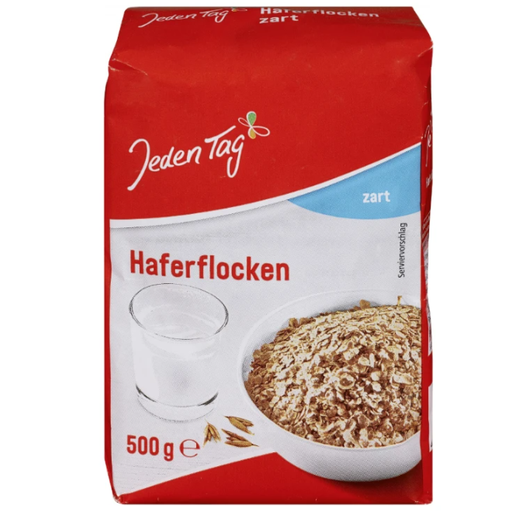 No image available
The fine oats named in the product title are worth considering if you prefer a smoother porridge. Before buying, check the product type and ingredients on the 500-g pack: the product details list oat flour as well as oats.
Not necessarily. The consumer advice centre warns that oats may come into contact with gluten-containing cereals. If you have coeliac disease, only buy oats explicitly labelled gluten-free on the specific pack.
Fine oats make a smoother porridge than jumbo oats. According to the consumer advice centre, instant oats dissolve particularly easily. If you prefer flakes with more bite, look for a jumbo variety instead.
No. According to the Federal Ministry of Agriculture, Food and Regional Identity, the best-before date is not a use-by date. If the oats have been stored correctly, check their appearance and smell after the date has passed, and inspect them before eating.
Check the ingredients, allergens, pack size and type of oat. If organic farming, origin or gluten-free suitability matters to you, check the relevant details on the specific product.