People keeping an eye on salt in their porridge
A simple base is important to them. They compare the declared salt content per 100 g and check the ingredients, rather than relying solely on a claim on the front of the pack.


For salt-conscious porridge in a small household, plain oats with a salt value that’s easy to compare per 100 g are a good starting point: Kölln lists 0 g for both Blütenzarte and Kernige Köllnflocken, while EDEKA24 lists 0.02 g for Gut & Günstig extra fine oats. Fine oats make a softer porridge, coarse oats have more bite, and instant oats take less time to prepare. The salt content of the finished meal also depends on the other ingredients; the values listed do not automatically make a product “reduced salt”.
A simple base is important to them. They compare the declared salt content per 100 g and check the ingredients, rather than relying solely on a claim on the front of the pack.
They want to make individual portions without any fuss. As well as the type of oats, they consider whether the pack size suits how much they use.
They need to choose oats based on more than just texture or salt content. The German Federal Centre for Nutrition advises people with coeliac disease to choose oats specifically labelled gluten-free and to consider their individual tolerance.
For smaller households, start by checking the ingredients and salt information. Then consider your preferred texture and how much preparation you’re willing to do. If you need gluten-free oats for medical reasons, check this separately.
| What matters | What to check | Who it matters to |
|---|---|---|
| Salt and ingredients | Compare the salt content per 100 g and the ingredients list; for porridge mixes, check the other ingredients too. | When I make my own porridge, I want to know what’s already in the base. This is the top priority for around 36% of consumers. |
| Texture | Choose fine or thinly rolled oats for a softer texture, or coarse or large-flake oats for a firmer bite. | I want my porridge either soft or with some bite, so my choice of oats depends on the texture I’m after. Around 29% of consumers prioritise texture. |
| Preparation time | Check the preparation instructions and pack size; distinguish instant oats from regular fine oats. | For a single portion, I want to keep preparation and washing-up to a minimum. Easy preparation is a priority for around 21% of consumers. |
| Gluten-free suitability | If you need to avoid gluten for medical reasons, look for an explicit gluten-free label. | If I need gluten-free oats, an organic or wholegrain claim isn’t enough. This is a key consideration for around 14% of consumers; the German Federal Centre for Nutrition recommends oats specifically labelled gluten-free for people with coeliac disease. |
You can’t infer this kind of effect from the description of a type of oats. The salt content of the specific product is a more useful guide when choosing, and other ingredients add to the salt content of the finished meal.
Compare the salt information per 100 g and check what you add to your porridge.
Different types of oats vary in texture and preparation time. Kölln describes its instant oats as dissolving immediately, while coarse oats have a firmer texture.
First decide whether you’d prefer soft porridge, more bite or the quickest possible preparation.
These claims are not a substitute for a gluten-free label. The German Federal Centre for Nutrition notes that people with coeliac disease need to choose oats carefully because they may be contaminated with other cereals containing gluten.
If you need to follow a gluten-free diet for medical reasons, check for an explicit gluten-free label and seek professional advice about your individual tolerance.
The range includes fine, coarse and instant oats, giving you different textures and preparation options.
Alnatura’s range includes organic oats in fine-flake, large-flake and smooth-melting varieties.
The products considered are fine oats that can be used as a base for porridge.
Brüggen says it processes oats, among other grains, into flakes.
This selection includes instant, coarse and fine oats, as well as a porridge product. Choose according to how you want to prepare it, and check the ingredients, salt information and, where relevant, gluten-free labelling on each pack.
 No image available
A quick-to-prepare option if you’re looking for instant oats. EDEKA24 describes Kölln instant oats as dissolving immediately and made from 100% wholegrain oats, with 0 g salt per 100 g. If you need gluten-free oats, check the labelling on this pack.
 No image available
For porridge with more bite rather than a very fine texture. The pack contains 500 g; compare the salt content per 100 g on the label and, if you need gluten-free oats, look for an explicit gluten-free label.
 No image available
For anyone who prefers finer oats for a soft porridge. The pack contains 500 g; check the salt information and, if required, the gluten-free labelling on this specific variety.
 No image available
A fine-flake option if you prefer a softer porridge and are looking for a 400 g pack. Organic does not replace checking the salt information or any required gluten-free labelling.
 No image available
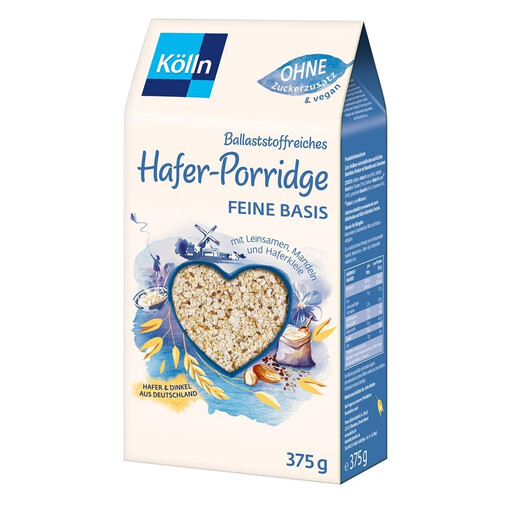
For anyone considering a product sold as porridge rather than a pack of plain oats. The pack contains 375 g; check the full ingredients list, salt information and allergens before comparing it with plain oats.
Check the ingredients and salt content per 100 g on the specific pack. Kölln lists 0 g for both Blütenzarte and Kernige Köllnflocken, while EDEKA24 lists 0.02 g per 100 g for Gut & Günstig extra fine oats. Remember to consider the other ingredients in your meal too.
Fine or thinly rolled oats make a softer porridge. Smooth-melting and instant varieties are worth considering if you also want to keep preparation time short. If you prefer more bite, choose coarse or large-flake oats.
People with coeliac disease shouldn’t assume regular oats are suitable just because they’re oats. The German Federal Centre for Nutrition recommends choosing oats specifically labelled gluten-free; a healthcare professional can advise on individual tolerance.