Families who want to make smooth porridge
If your child prefers a soft consistency that’s easy to eat with a spoon in the evening, fine oats are one option. Alnatura describes its fine oats as extremely finely rolled and quick to dissolve.


For a smooth, warm evening porridge, fine or instant oats are good options; jumbo oats are better suited if your child likes a more distinct texture. If you want to keep an eye on the salt content of the meal, choose plain oats and check the ingredients list and salt value per 100 g. If a gluten-free diet is medically necessary, you should also look for an explicit gluten-free label on the specific product.
If your child prefers a soft consistency that’s easy to eat with a spoon in the evening, fine oats are one option. Alnatura describes its fine oats as extremely finely rolled and quick to dissolve.
Plain oats make an unseasoned base for evening porridge. What matters is the salt value of the specific product and the other ingredients in the finished meal.
If a gluten-free diet is necessary, the words “oats” or “porridge oats” on their own aren’t enough. Check for an explicit gluten-free label, along with the ingredients and any may-contain information on the current pack.
If a gluten-free diet is medically necessary, the gluten-free label comes first. Otherwise, the consistency you want, the preparation instructions and the salt value can help you choose.
| Criteria | What to check when buying | Who it matters most to |
|---|---|---|
| Soft porridge consistency | Oat texture and porridge preparation instructions; cooking or soaking time, if applicable. | If my child only likes smooth porridge, I want the oats to soften without a long preparation time. This consistency is likely to be the main concern for around 45% of consumers. |
| Simple, salt-conscious base | Ingredients list and salt value per 100 g; take the other ingredients in the meal into account too. | I want to choose what goes into the evening porridge myself, rather than use a seasoned mix. This kind of control over ingredients and salt would be the top priority for around 36% of consumers. |
| Gluten and allergen labelling | If a gluten-free diet is medically necessary, look for an explicit gluten-free label; also check the ingredients and may-contain information. | If my child needs to avoid certain ingredients, the labelling on the individual product determines which one I choose. This would take priority over texture and salt values for around 19% of consumers. |
The texture describes the oats, not their salt content. EDEKA24 lists Kölln Instant Oats as containing 0 g of salt per 100 g, while Gut & Günstig Extra Fine Oats contain 0.02 g per 100 g.
Read the ingredients list and nutrition information for the specific product. The other ingredients in the finished meal matter too.
Muesli and flavoured oat products may contain other ingredients. Their composition can’t be inferred from the information for plain oats.
Check the full ingredients list if you want to make porridge using a simple oat base.
These terms don’t replace a gluten-free label. Kölln sells gluten-free oats as separate varieties; EDEKA also includes information about other gluten-containing cereals and possible traces on one of its oat products.
If a gluten-free diet is medically necessary, choose a product that is explicitly labelled as gluten-free and check the current pack.
Even if fine oats are quick to prepare, warm porridge needs to reach a suitable temperature before eating.
Leave it to cool after heating and check the temperature before serving.
Kölln offers oats in a range of textures, including instant oats and separate gluten-free varieties.
Alnatura sells oats in a range of textures; according to the manufacturer, its fine oats are intended for porridge.
Both ranges include fine oats, which you can compare using the information for each individual product.
Seitenbacher offers a range of cereal products. For evening porridge, the key thing is the specific variety of oats you choose.
Brüggen says it produces oats and own-brand products for retail chains, among other things.
These fine oats may be suitable as a base for warm evening porridge. To get the consistency you want, compare the preparation instructions; for a salt-conscious meal, check the details on the relevant pack.
 Image unavailable
A finely rolled variety of oats for warm porridge when you want a soft consistency. Check the preparation instructions, ingredients and salt value on the current pack.
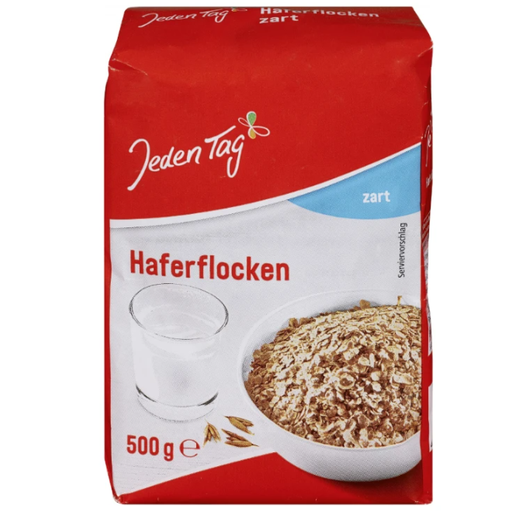 Image unavailable
The fine texture may suit you if you want soft evening porridge. Read the preparation instructions and salt value per 100 g, and check the current pack labelling if you have allergies.
 Image unavailable
Fine organic oats for warm porridge when you want a soft texture. Check the instructions and, if you have allergies, the ingredients and may-contain information for the specific product.
Fine or instant oats are the more obvious choice for smooth porridge. Alnatura describes its fine oats as extremely finely rolled and quick to dissolve, while jumbo oats give a more distinct texture. Follow the preparation instructions and check the temperature before serving.
Start with the ingredients list, then compare the salt value per 100 g. EDEKA24 lists Kölln Instant Oats as containing 0 g of salt per 100 g, and Gut & Günstig Extra Fine Oats as containing 0.02 g per 100 g. These values apply to the oats themselves, not to the finished evening porridge with other ingredients added.
If a gluten-free diet is medically necessary, don’t rely on the type of cereal alone. Choose a product that is explicitly labelled as gluten-free. Kölln sells these oats as separate varieties. Also read the ingredients and may-contain information on the current pack.
You don’t need to add salt to make oat porridge. The Verbraucherzentrale says that seasonings, including salt, can be introduced gradually from the age of two; if you’re keeping salt low, remember to take the other ingredients into account too. This general guidance doesn’t replace individual medical advice.