
Lieferung heute & morgen

Qualitätsgarantie

Willkommens-Angebote freischalten: KOSTENLOSE Lieferung | Bis zu 80 % RABATT | Kostenlose 30-Tage-JoyPlus-Testphase
App herunterladen
Modern vehicles are complex systems where electronics play a central role. When a warning light illuminates on the dashboard, finding the cause without the right tool is often difficult and time-consuming. For professional auto repair shops, experienced DIY mechanics, and ambitious car enthusiasts, a powerful OBD2 diagnostic tool is therefore essential. It's no longer just about reading and clearing fault codes; today's demands include in-depth analysis, customisation, and advanced maintenance tasks.
This guide will help you choose the right diagnostic tool. We'll introduce various models with different feature sets and explain which criteria are crucial for your specific needs.
The market offers a wide range of devices, from simple code readers to complex diagnostic stations. The following points will help you make the right decision.
A basic device can read fault codes from the engine control unit. However, professional requirements go far beyond that. Look for the following advanced functions:
A crucial factor is how many control units the device can access. While simple scanners often only connect to the engine control unit, an all-system car diagnostic tool should also be able to access the ABS, airbag, transmission, air conditioning, and body electronics.
Furthermore, vehicle communication protocols are constantly evolving. For compatibility with newer vehicle models, modern protocols like CAN FD (especially on General Motors from 2020) and DoIP (Diagnostics over Internet Protocol, e.g., on BMW, Jaguar, Land Rover) are essential. A future-proof tool should support these.
For specialised jobs, other functions are relevant. The ability to program keys (IMMO functions) can be crucial if a key is lost or a new one needs to be paired.
Some vehicle manufacturers add extra protection to their systems. For example, vehicles from the FCA Group (Fiat, Chrysler, Dodge, Jeep) from model year 2018 onwards require "AutoAuth" access to use secured diagnostic functions. Check whether your chosen tool meets such manufacturer-specific requirements.
Based on the criteria mentioned, we have compiled a selection of tools suitable for different user groups.
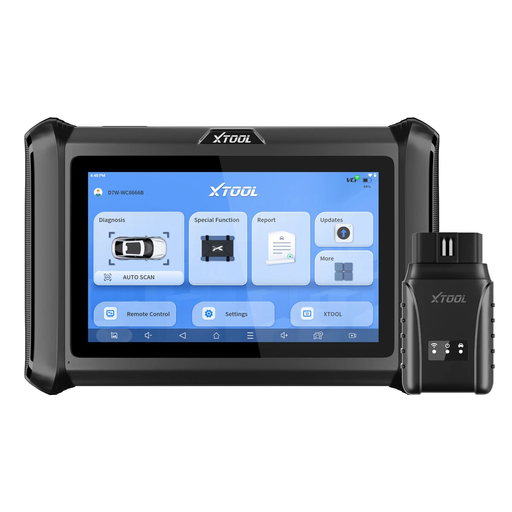
What sets it apart: The XTOOL D7W is a wireless diagnostic tablet that communicates with the vehicle via a fast Wi-Fi connection. It offers a very extensive feature set that covers even demanding tasks. This includes advanced ECU coding for selected brands, Programmable Module Installation (PMI) for Ford/Lincoln/Mazda, and over 39 service functions. Support for CAN FD & DoIP makes it a future-proof tool.
Advantages:
Best for: Professional workshops and highly experienced DIY mechanics who need a flexible, wireless device with a maximum feature set for a wide variety of vehicle brands.

What sets it apart: The VDIAGTOOL VD10 focuses on the core functions of OBD2 diagnostics. It is an easy-to-use handheld device, ideal for quickly reading and clearing fault codes, monitoring live engine data, and checking I/M readiness for emissions tests. It supports all standardised OBD2 protocols and offers broad compatibility with vehicles from 1996 (petrol) or 2004 (diesel in the EU).
Advantages:
Best for: Car owners and DIY mechanics looking for a reliable and affordable tool for basic engine diagnostics, clearing the check engine light, and preparing for vehicle inspections.
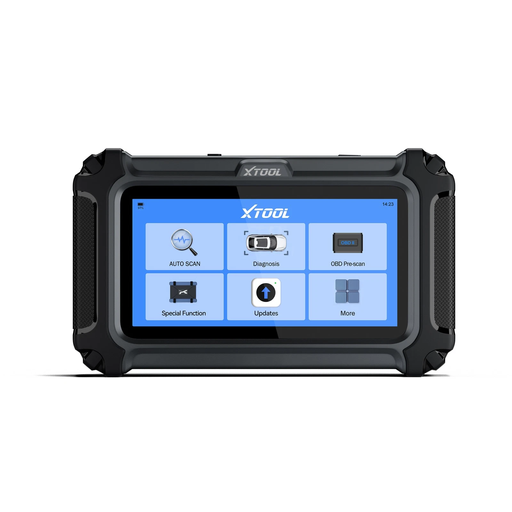
What sets it apart: The XTOOL D6 is positioned as a powerful all-round tool for ambitious users. It offers diagnostics for all vehicle systems and covers the most important maintenance tasks with over 15 service functions, including oil reset, ABS bleeding, and throttle relearn. Support for CAN FD and the FCA AutoAuth function ensures good compatibility with modern vehicles. A special feature is the lifetime free updates.
Advantages:
Best for: Ambitious DIY mechanics and small workshops looking for a workshop-grade diagnostic tool that combines a broad feature set with future-proof protocols and has no ongoing update costs.
The choice of the right tool depends heavily on individual requirements and the vehicles you work on. If the models presented here don't exactly meet your needs, there are many more options to discover.
Discover our full range of vehicle diagnostic tools and find the perfect tool for your projects.
A basic OBD2 reader typically only accesses the engine control unit to read and clear emissions-related fault codes (DTCs). In contrast, a professional diagnostic tool can access all vehicle systems, including ABS, airbag, transmission, and comfort electronics. It also offers advanced functions like bi-directional control, ECU coding, and numerous service resets.
Yes, many advanced diagnostic devices also function as a Service Reset Tool. They allow you to reset the oil service indicator, the electronic parking brake (EPB) after a brake change, and other maintenance intervals. However, the exact range of functions depends on the specific diagnostic tool and the vehicle model. It is advisable to check compatibility before purchasing.
A workshop-grade diagnostic tool should offer comprehensive system diagnostics for a wide range of makes and models. Indispensable features include bi-directional control for rapid troubleshooting, ECU coding for replacing control units, support for new protocols like CAN FD & DoIP, and special functions such as programming keys or calibrating Advanced Driver-Assistance Systems (ADAS).