
Lieferung heute & morgen

Qualitätsgarantie

Willkommens-Angebote freischalten: KOSTENLOSE Lieferung | Bis zu 80 % RABATT | Kostenlose 30-Tage-JoyPlus-Testphase
App herunterladen
An upper arm blood pressure monitor should be easy to use every day: fit the cuff, start the reading, check your results and save them if needed. Yet certain product claims often lead to disappointing purchases. A budget model may be impractical if the cuff does not fit or the display is hard to read. On the other hand, a feature-packed model may go unused if you do not need an app, Bluetooth or multiple user profiles.
Choosing the right cuff size is essential. A cuff that is too tight or too loose can make the monitor harder to use and affect the reading. Before you buy, check your upper arm circumference, not just the general product description.
Many models cover a range of 22 to 42 cm. Some come with cuffs for 22 to 45 cm, making them suitable for people with larger upper arms too. The important thing is to make sure the stated size fits your arm.
A blood pressure monitor with a large display can be helpful for older people and anyone with impaired vision. The numbers, units and symbols should also be easy to distinguish. A backlit or high-contrast display makes readings easier to see in different lighting conditions.
Consider how the monitor works, too. A start button and clear indicators are often more practical for everyday use than lots of menus.
A blood pressure monitor with irregular heartbeat detection can alert you to an irregular heartbeat while taking a reading. However, these alerts are no substitute for medical advice. Colour-coded classifications, average readings and app charts are also just tools to help you record and interpret your results.
If your readings remain unusual or you have symptoms, seek medical advice. Do not change your medication based on individual readings without consulting a healthcare professional.
Measure the circumference of your bare upper arm and compare it with the stated cuff range. The cuff is usually fitted two to three centimetres above the elbow crease. Rest your arm on a support and keep it relaxed, with the cuff roughly level with your heart.
Models such as the yuwell YE670A(S) and yuwell YE660D are available with cuffs for an upper arm circumference of 22 to 45 cm. The stated range for the Beurer BM 48 and several Treesmile models is 22 to 42 cm.
An automatic blood pressure monitor inflates and deflates the cuff for you. For everyday use, look out for:
A digital blood pressure monitor with a large display is particularly useful if several people in your household want to check their readings themselves.
A blood pressure monitor with a memory function can store readings with the date and time. Two user profiles help keep each person’s readings separate. Depending on the model, there may be 90 or 120 memory slots per user.
Bluetooth is useful if you want to keep a long-term record of your readings in an app. Before buying, check that the app is compatible with your smartphone and find out which data you can store or export.

Why it suits this user: With one-button operation and two controls, this monitor is easy to use regularly at home. The product details state that the cuff fits arms measuring 22 to 45 cm.
The stated cuff range helps reduce the risk of choosing a model with a cuff that is too small. Memory for 90 readings and an average of the last three readings make it easier to keep a record.
According to the product description, it comes with an irregular heartbeat alert, movement detection and four AA batteries.
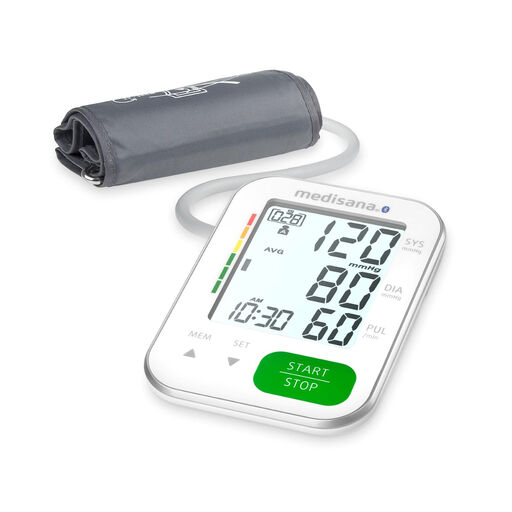
Why it suits this user: This model combines a large, backlit LCD with Bluetooth and app connectivity for keeping a long-term record.
The product description lists cuff position control and movement detection, so you don’t have to rely on memory alone to get these important steps right.
The listed features include 199 memory slots for two users, guest mode, Bluetooth and an irregular heartbeat indicator.
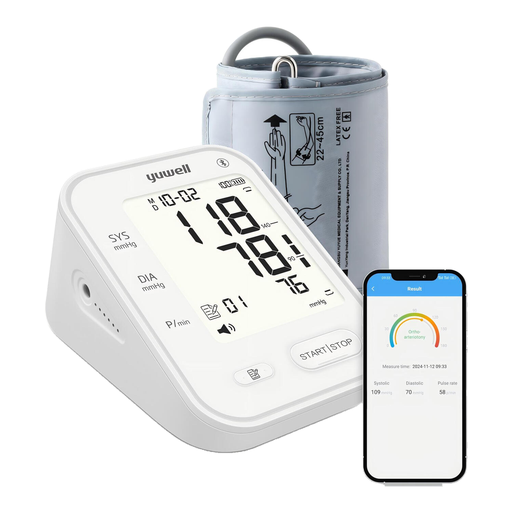
Why it suits this user: Aimed at tech-savvy users, this model offers Bluetooth, a rechargeable battery, a 22 to 45 cm cuff and an app for iOS and Android.
App connectivity is clearly stated, so you can check before buying whether the digital record-keeping you want is supported.
According to the product details, it supports reading storage, PDF or CSV export and a backlit display.
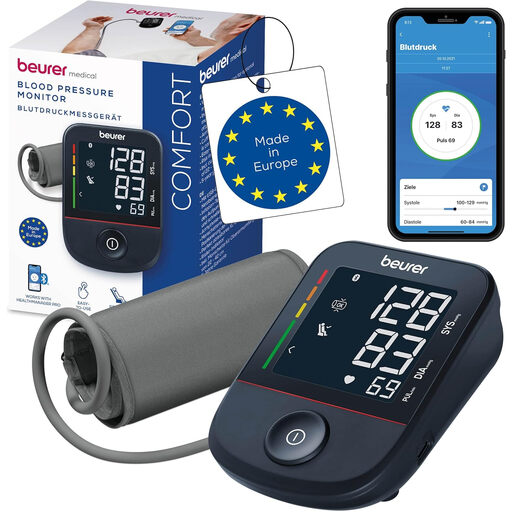
Why it suits this user: One-button operation, an extra-large display and automatic data transfer make this a good choice if you want clear readings and straightforward record-keeping.
The 22 to 42 cm cuff and cuff position control address two common causes of errors when taking readings at home.
The listed features include Bluetooth transfer to the Beurer HealthManager Pro app, plus support for Apple Health, Samsung Health and Health Connect.
We’ve put together a complete, regularly updated list of products that meet these strict selection criteria and fully comply with the safety regulations in force in the EU.
Its lifespan depends on the model, how it is stored, the batteries and the cuff. Keep the monitor somewhere dry, away from direct sunlight and where it will not be knocked about. Check the cuff regularly for signs of wear. You’ll find details of the product’s lifespan and warranty in the manual or on the product label.
Battery-powered models have ongoing costs when the batteries need replacing. Monitors with a rechargeable battery need to be charged regularly instead. Bluetooth models may also require an app, so check that it is compatible with your smartphone before buying.
Upper arm monitors are designed for regular self-measurement at home, as long as the cuff fits and you use it correctly. The results are for your personal records and are not a substitute for a medical diagnosis. If your readings remain high or unusual, or you have symptoms, seek medical advice.