
Lieferung heute & morgen

Qualitätsgarantie

Willkommens-Angebote freischalten: KOSTENLOSE Lieferung | Bis zu 80 % RABATT | Kostenlose 30-Tage-JoyPlus-Testphase
App herunterladen
A compressor cooler uses technology comparable to that of a household refrigerator. A gaseous refrigerant is compressed by a compressor, which causes it to heat up. It then flows through a condenser, where it releases heat into the environment and liquefies. Inside the cooler's evaporator, the liquid refrigerant expands, turns back into a gas, and in the process, draws heat from the interior. This cycle enables powerful cooling that is largely independent of the ambient temperature and can even reach deep-freezing temperatures. This fundamentally distinguishes them from thermoelectric models, whose cooling performance is highly dependent on the ambient temperature.
The decision for a specific model should be based on an analysis of its technical specifications and intended use case. The following criteria are of key importance.
The core component is the compressor. Its efficiency determines the cooling speed and energy consumption. Pay attention to the specified temperature range, which typically extends from approx. +20 °C to –20 °C. Models with a cooler with a freezer function allow for the deep-freezing of food. Some units also offer two independently controllable temperature zones to cool and freeze simultaneously.
The usable volume, specified in litres, defines the cooler's capacity. Consider the quantity of food and drinks you plan to transport. A car fridge for day trips requires less volume than a camping fridge for a multi-week journey. At the same time, check the external dimensions to ensure the portable cooler fits into your vehicle or boat.
The flexibility of the power supply is crucial for mobile use. A 12V/230V cooler is standard, capable of operating from both a vehicle's cigarette lighter socket (12V/24V DC) and a conventional wall outlet (100-240V AC). For maximum off-grid capability, a cooler with a battery is recommended. Some models also support charging via solar panels. The energy consumption, often stated in watts (W) or kilowatt-hours per 24 hours (kWh/24h), is an indicator of operating costs and the load on the vehicle or an auxiliary battery. An integrated battery monitor protects the vehicle's battery from deep discharge.
A robust construction is essential for outdoor use. The thickness and material of the insulation (e.g., polyurethane foam) have a direct impact on efficiency and the ability to maintain temperature when unplugged. Features like reinforced corners, sturdy carrying handles, or an IP protection rating (e.g., IPX4 for splash protection) indicate a durable design.
Based on an analysis of technical data and functional features, we present a selection of models here.

Why We Recommend This Product The ECOFLOW GLACIER Classic stands out for its high flexibility. Its dual-zone cooling allows for simultaneous cooling and freezing. With the optional 298 Wh battery, it achieves an off-grid runtime of up to 39 hours, according to the manufacturer. The variety of charging options, including solar, makes it a self-sufficient solution for extended trips.
Pros
Who It's For This model is designed for users who value high capacity, the flexibility of dual temperature zones, and maximum independence from external power sources, such as van-lifers, boat owners, or families on multi-day camping trips.
View More Details on the ECOFLOW GLACIER Classic 45L
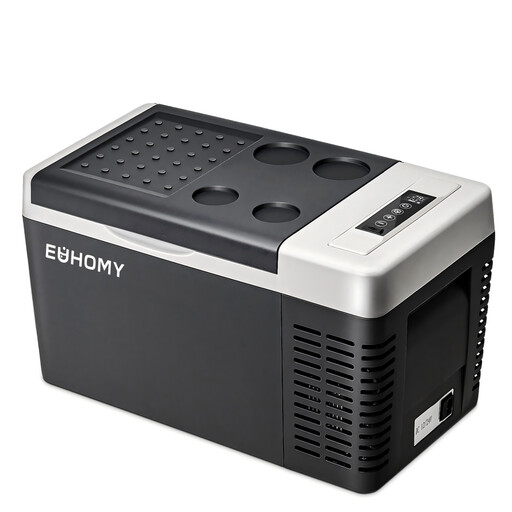
Why We Recommend This Product The EUHOMY cooler is a compact and lightweight solution for mobile use. With an 18-litre volume, it is well-suited for shorter trips or as a supplement in smaller vehicles. App control and three-stage battery protection offer modern convenience and safety for the vehicle's battery. The magnetic lid seal design enhances insulation efficiency.
Pros
Who It's For Ideal for solo travellers, commuters, or as a secondary unit in a car. Its compact dimensions and low weight make this electric cooler particularly easy to handle for day trips, grocery runs, or use in a truck cab.
View More Details on the EUHOMY 18L Cooler Box

Why We Recommend This Product This 45-litre model from Foursun combines a generous volume with practical mobility features like integrated wheels. The focus is on energy efficiency, reflected in its ECO mode with a stated consumption of just 0.18 kWh/day. Compatibility with various power sources, including solar panels, and control via the Tuya Smart App make it a versatile companion.
Pros
Who It's For This model is aimed at users looking for a balance of capacity, energy efficiency, and easy portability. It is well-suited for camping, road trips, and use in an RV, where low power consumption and easy manoeuvrability are advantageous.
View More Details on the 45L Car Fridge Freezer
If, in addition to cooling solutions, you are also interested in other mobile organisation and storage systems for your travels, you can find more options to optimise your storage space in our portable wardrobe category.
1. What is the difference between a compressor cooler and a thermoelectric cooler? A compressor cooler works like a refrigerator and achieves high cooling performance independent of the ambient temperature, including a freezer function. A thermoelectric cooler (Peltier element) can only achieve a certain temperature difference relative to the ambient temperature (e.g., 20 °C cooler than outside) and is less effective in high ambient temperatures.
2. How much power does a compressor cooler use in a car? Power consumption varies depending on the model, set temperature, ambient temperature, and insulation. A typical value in cooling mode is around 40-60 watts. Many models feature an Eco mode that further reduces consumption. The compressor's start-up current is briefly higher. An integrated battery monitor prevents the car battery from draining.
3. Can a compressor cooler also be used as a portable freezer? Yes, most compressor coolers can reach temperatures as low as –18 °C or –20 °C and can therefore be used as a portable freezer. Some models even offer separate zones to cool and freeze at the same time.