Weekend home with several devices
If you want to power several devices during regular visits, plan their energy use, the runtime you need and your options for recharging together.


Start by listing the devices you want to run at the same time, their power requirements and how long you’ll use them each day. Then check whether the battery and solar panel are a good match for your location and the months you plan to use them. A power station is worth considering if you need to run several devices or compatible 230 V appliances; smaller solutions may be enough for a single light or USB device. If you have an allotment, also check your plans for use and installation against local rules and your tenancy agreement before buying.
The German consumer advice centre lists gardens and weekend homes as potential uses for off-grid solar systems. The right solution depends on which devices you actually want to power there.
If you want to power several devices during regular visits, plan their energy use, the runtime you need and your options for recharging together.
For individual permitted uses on your plot, check whether the installation and use comply with local rules and the intended purpose.
If you mainly need to power lights or USB devices, consider whether a power bank, solar charger or individual battery-powered alternative would be enough.
First work out your energy use and how long you’ll be staying, then consider potential solar recharging and the connections you need. After that, it’s easier to assess how portable the solution needs to be and what size you need.
| What you need | What to check before buying | Who should consider this? |
|---|---|---|
| Energy needs and length of stay | Note each device’s power rating in W and how many hours you’ll use it; allow for days without enough recharging. | If I want to power several devices throughout my stay, I add up their energy needs rather than relying on the capacity figure alone. Around 31% of consumers are likely to prioritise this. |
| Solar recharging at your location | Take account of the months you’ll use it, shade and panel orientation; check the panel specifications against the power station’s input limits. | If I want to recharge at my location or between visits, I need to take local conditions into account. Around 25% of consumers are likely to place particular importance on recharging. |
| Power output and connections | Compare the devices’ continuous power requirements and, where relevant, starting power with the specific output; check which connections you need. | If I want to run compatible 230 V appliances or several devices, the output rating of each relevant socket matters. Around 19% of consumers are likely to focus on this. |
| Transport and installation | Compare the weight and panel portability with your own route; if you’re renting the plot, check local requirements. | If I need to carry the power station regularly or set up a panel on the plot, the solution needs to suit both the journey and the location. Around 13% of consumers are likely to prioritise this. |
| Solution for individual devices | List the devices and connections you need; compare a power bank, solar charger or individual alternatives. | If I only need to cover individual tasks such as lighting or charging USB devices, I may not need a shared power supply. Around 12% of consumers are likely to have this more straightforward, individual need. |
The yield from an off-grid solar system depends on factors including location, month of use and energy consumption. The European Commission’s PVGIS tool can provide monthly energy figures and the likelihood of an empty battery based on specific inputs.
Plan around the months you expect to use the system and your actual daily energy needs, rather than relying on the panel’s wattage alone.
Depending on your location, you may need more panel area or a different recharging strategy.
Capacity in Wh describes the energy stored; continuous power in W indicates the load the unit can supply. DJI lists different AC voltages for different versions of the Power 1000.
Check capacity, continuous power and, where relevant, starting power, connections and the exact regional version separately.
The German Federation of Allotment Garden Associations generally distinguishes between electricity for essential tasks that may be permitted on a plot and a power supply to a shed, which is usually prohibited.
Before buying, check the intended use and installation location against your tenancy agreement and garden rules with the association or landlord.
The purchase may not be suitable for its intended purpose if the planned use isn’t permitted at your location.
For individual uses, the German consumer advice centre also mentions battery-powered or non-electric solutions, solar chargers and power banks.
First work out which tasks really need a shared power supply, then compare suitable individual alternatives.
A larger power station and panel mean extra equipment to manage and transport.
The specifications below relate to the models listed and the manufacturers’ claims. They are not a general assessment of each brand’s entire range.
According to EcoFlow, the DELTA 2 Max is an option for higher storage capacity and AC power needs.
According to Anker, the C1000 Gen 2 is a useful example to consider for medium storage needs and power-hungry AC appliances.
The Explorer 300 Plus and separate SolarSaga 40 Mini are examples of a portable power station and direct charging for small devices.
BLUETTI’s German product page lists an AC70 version with 768 Wh and 1,000 W continuous output.
According to DJI, the Power 1000 shows why it’s important to check the regional model version for its AC output.
This selection includes portable power stations for recurring power needs and potential solar recharging. Before buying, check that the power requirements of your devices, the solar input and what’s included with the specific version suit your needs.
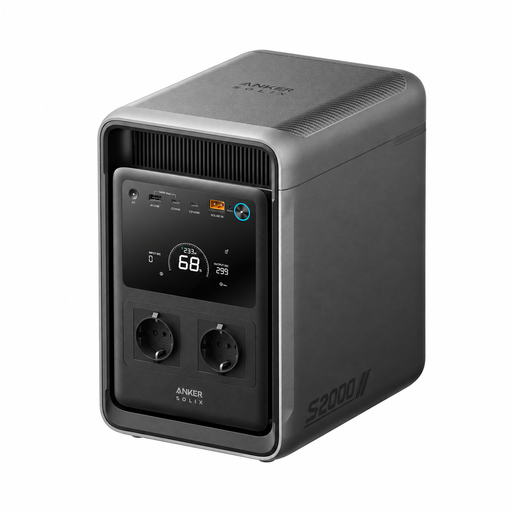 No image available
An option if you’re looking for a power station for regular use and several devices.
The product name lists a capacity of 2,000 Wh and power output of 1,500 W.
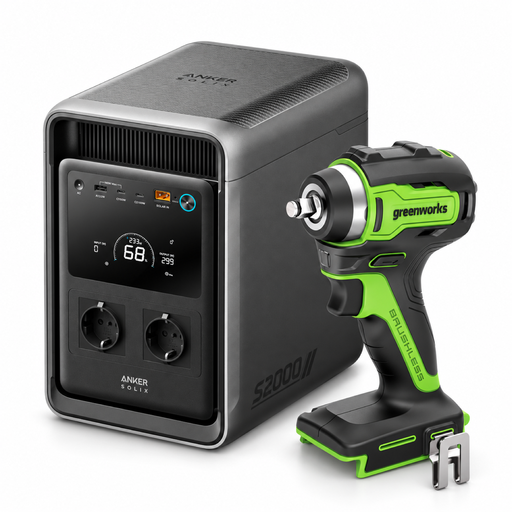 No image available
This bundle pairs the power station with a Greenworks 24V Brushless Impact Wrench.
The product name lists 2,000 Wh and 1,500 W for the power station, and 200 Nm and 1/2 inch for the tool. The tool’s battery and charger are not included.
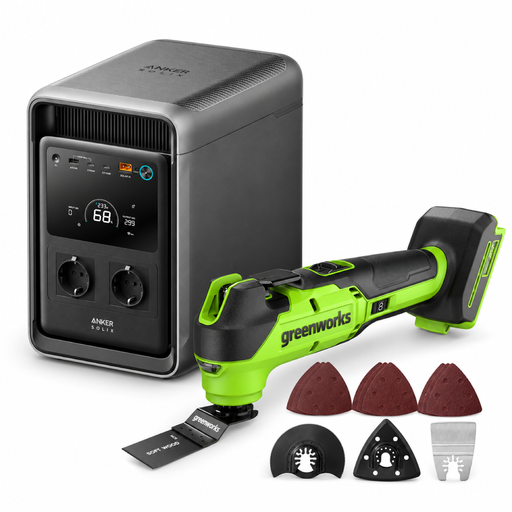 No image available
This bundle pairs the power station with a Greenworks 24V Cordless Multi-Tool and accessories.
The product name lists 2,000 Wh and 1,500 W for the power station. The tool’s battery and charger are not included.
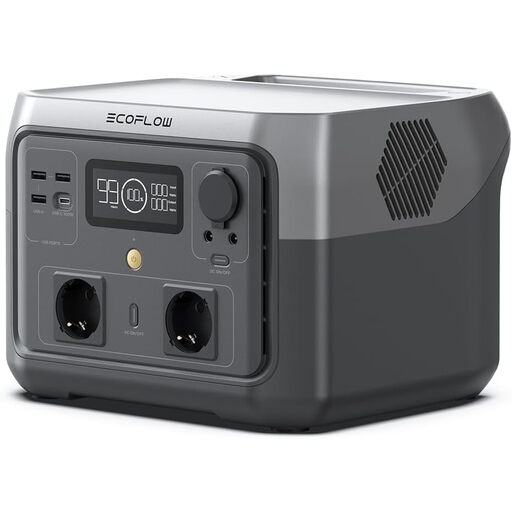 No image available
A portable power station for more modest needs, with the option of solar charging.
The product name lists a capacity of 512 Wh.
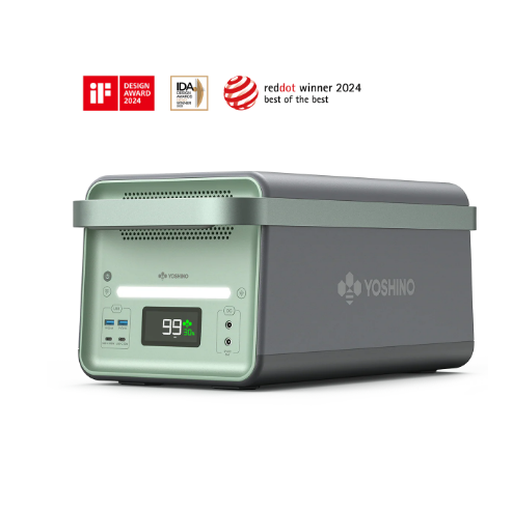 No image available
An option if you’re looking for a power station with the AC, DC and USB-C outputs listed in the product name.
The product name lists 3,600 Wh, 2,200 W and six outputs.
For each device, multiply its power rating in W by the number of hours you’ll use it to work out its theoretical energy requirement in Wh. The European Commission’s PVGIS tool lets you simulate an off-grid system for a specific location using details such as panel output, battery size and daily consumption. It shows monthly results and the number of days with an empty battery. To plan accurately, you’ll need to take your location, shading and energy-use profile into account.
No. Check that the specific panel is compatible with the power station. This includes the connection, any MPPT accessories required, and voltage, current and power limits, including those for the planned configuration. Anker lists a maximum solar input of 600 W and 60 V for the C1000 Gen 2; DJI says the Power 1000 requires a separate MPPT adapter module.
There’s no blanket answer. The German Federation of Allotment Garden Associations generally distinguishes between electricity for essential tasks that may be permitted on a plot and a power supply to a shed, which is usually prohibited. It also refers to local association rules, tenancy agreements and garden regulations. Before buying, check your intended use and installation location with the association or landlord. These guidelines don’t automatically apply to other types of property.
Follow the storage and charging instructions for the specific device. DJI warns against leaving the Power 1000 in storage for a long time when fully discharged; the German Environment Agency advises against using damaged or deformed lithium batteries. Old batteries should never go in household waste.
Check the specific offer to see whether it includes a compatible panel, any connection or adapter cables you need, and a solar charge controller if required. DJI lists a separate solar panel adapter module with MPPT for charging the Power 1000 by solar power. Warranty terms may differ for the device and its accessories.