
Lieferung heute & morgen

Qualitätsgarantie

Willkommens-Angebote freischalten: KOSTENLOSE Lieferung | Bis zu 80 % RABATT | Kostenlose 30-Tage-JoyPlus-Testphase
App herunterladen
Published on: 2026-07-28By: Joybuy Product Recommendation Officer
A remote control car that tears over rough terrain is a fascinating hobby for all ages. However, the excitement can quickly fade if the newly purchased model fails after a short time or doesn't meet expectations. Many buyers fall into the same traps, often lured by exaggerated marketing claims and hidden defects. Before you make a decision, it's crucial to understand the common weaknesses.
The selection of off-road RC cars is vast, but not every model lives up to its promises. Three problems are particularly common and lead to disappointment.
A frequent source of frustration are vehicles whose body or chassis is made of simple, brittle plastic. An unfortunate impact with an obstacle or a fall from a low height can lead to an irreparable break. Especially for a gift for boys or for use in demanding terrain, a robust material is essential to ensure a long lifespan.
Manufacturers often advertise long runtimes. However, these figures are typically measured under ideal conditions—on smooth surfaces and at a constant, low speed. In real-world off-road use, with inclines and uneven ground, the actual runtime of a low-quality battery can drop dramatically. A fast RC car with a battery needs a power source with sufficient capacity (mAh) to keep the fun from ending prematurely.
Many budget-friendly models are marketed as "off-road" but only feature two-wheel drive (2WD). Such a vehicle will quickly get stuck on loose surfaces, in grass, or on small inclines. For a truly all-terrain remote control car, all-wheel drive (4WD) is a fundamental requirement to distribute power to all four wheels and ensure maximum traction.
To avoid the pitfalls mentioned above, you should pay attention to a few key technical parameters when making your selection. These significantly determine the performance and durability of your RC vehicle.
All-wheel drive (4WD) is crucial for off-road driving. It ensures that the motor's power is delivered to all four wheels. This significantly improves traction on slippery or uneven surfaces like gravel, sand, or damp soil. An RC rock crawler 4x4 can climb steep slopes thanks to this drive system, while a remote control monster truck with 4WD transfers its power to the ground more effectively and drives with greater stability.
Pay close attention to the material specifications for the chassis, suspension, and body. Models with components made of metal or fiber-reinforced plastic are significantly more resilient than those made of simple ABS plastic. An independent suspension with real shock absorbers (instead of simple springs) allows the wheels to adapt to the ground independently. This not only improves off-road capability but also protects the vehicle's components during jumps and on rough terrain.
The battery capacity, measured in milliampere-hours (mAh), indicates how long the battery can supply energy. A higher mAh rating generally means a longer runtime. For an RC car for adults or for extended play sessions, models with swappable batteries or sets that include a second battery are a smart choice. Lithium Polymer (LiPo) batteries often offer higher power density and more consistent power output than Nickel-Metal Hydride (NiMH) batteries, but they also require more careful handling.
Based on these objective criteria, we have compiled a selection of models for different user profiles.

Why This Fits Their Persona: Ideal as a first durable model or as a gift. The metal body and all-wheel drive can handle rough driving in the garden or park, providing a solid foundation for getting into the hobby.
Instead of brittle plastic, this model features a resilient metal body. The inclusion of two batteries avoids the short runtime trap and ensures extended driving fun of up to 60 minutes, according to the manufacturer.
Robust metal construction and 4WD for good off-road capability; two batteries included for extended total playtime.
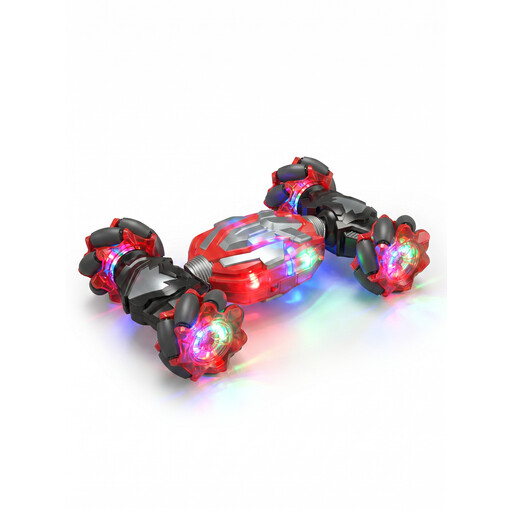
Why This Fits Their Persona: Perfect for users who want more than just driving. The gesture control and transformation ability offer an interactive and varied experience that goes beyond classic RC action.
With its transformable design and 4WD system, it masters obstacles where rigid models fail. It's specifically designed for uneven terrain and tricks, thus avoiding the trap of limited off-road capability.
Dual control (remote and gesture-sensing watch); transformable chassis for stunts and climbing at the push of a button.
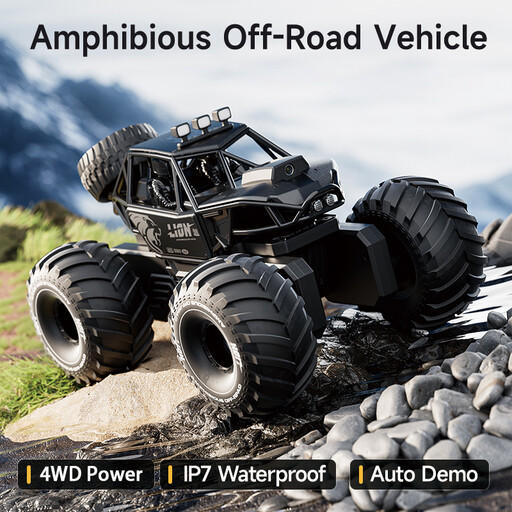
Why This Fits Their Persona: For those who know no limits and want to use their vehicle at the lake, in puddles, or in the snow. The amphibious function opens up entirely new ways to play and enormously expands its range of use.
This model is classified as waterproof with an IPX7 rating, thereby bypassing the hidden weakness of most RC cars: vulnerability to water damage. The 4WD system ensures traction on both land and water.
Fully amphibious and waterproof (IPX7); capable of 360° spins on land and in water; long playtime of over 60 minutes according to the manufacturer.
We've compiled a complete, up-to-date list of products that fully meet these strict selection criteria and rigorous safety standards.
The scale indicates the size ratio of the model to its real-life counterpart. A scale of 1:12 means the RC car is twelve times smaller than the actual vehicle. A smaller second number (e.g., 1:10) means a larger model, while a larger number (e.g., 1:24) indicates a smaller model. Larger models are often better suited for rough terrain, while smaller models are more agile and easier to transport.
The actual battery life depends on several factors: the battery's capacity (mAh), the intensity of use (constant acceleration and braking consume more energy), the vehicle's weight, and the terrain. On demanding terrain with many inclines, the runtime can be 20-40% shorter than on flat asphalt. Look for models that include a second battery or for which a spare can be easily purchased.
A higher price often correlates with higher-quality materials like aluminum chassis, oil-filled shock absorbers, and metal gears, which increases durability. However, price alone is no guarantee of robustness. It's more important to check the product specifications carefully. An inexpensive model with a metal body and 4WD might be more resilient than a more expensive 2WD model made of plastic. Compare the objective features rather than relying on price alone.