
Lieferung heute & morgen

Qualitätsgarantie

Willkommens-Angebote freischalten: KOSTENLOSE Lieferung | Bis zu 80 % RABATT | Kostenlose 30-Tage-JoyPlus-Testphase
App herunterladen
An office chair with a footrest promises a significant boost in comfort—whether for a short relaxation break in the home office or during long gaming sessions. The ability to put your feet up improves circulation and can enhance concentration. However, the market is crowded, and not every model delivers on its promises. Before you make a decision, it's crucial to understand the common weaknesses that can quickly undermine its benefits.
As a Joybuy Product Recommendation Officer, I analyse product data to provide you with objective decision-making guidance. This guide will show you what to look for to avoid marketing traps and find a model that reliably serves its purpose.
Many chairs look convincing at first glance but reveal their flaws only in everyday use. Pay close attention to these three critical points:
To make a sound purchasing decision, you should focus on verifiable technical specifications rather than marketing promises.
The functionality of a desk chair with a footrest depends heavily on its mechanics. Check the specifications for the retractable support's construction. Models with a metal guide system offer significantly greater stability and longevity than those made purely of plastic. The backrest's recline angle is just as crucial. An executive chair with a recline function should reach an angle of at least 135 degrees to allow for a relaxed reclining position. Models designed for gamers or deep relaxation often offer up to 170 degrees.
A good computer chair with lumbar support is defined by its adjustability. An integrated, height-adjustable lumbar support is preferable to a loose cushion, as it provides targeted support to the lower back and can be adapted to your spinal curve. Adaptive systems that dynamically adjust to your movements represent an advanced solution. Also, pay attention to the armrests: are they height-adjustable or even flip-up? This increases flexibility when you need to slide the chair under your desk.
The specified high weight capacity of an office chair is a critical indicator of the entire chair's robustness. A standard value for good office chairs is 120 kg (approx. 265 lbs), while models for more demanding requirements should support 150 kg (approx. 330 lbs) or more. Look for recognised certifications like BIFMA or SGS. These standards test the durability of casters, the frame, and the gas lift under continuous load, ensuring a higher level of safety and quality.
Here are some models that are well-suited for specific user groups based on their objective features.
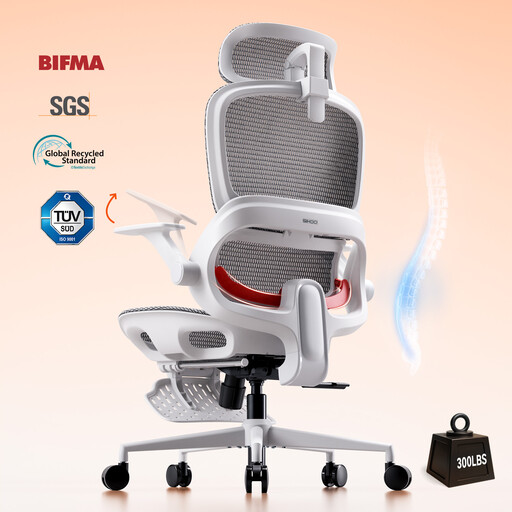
Why This Fits Their Persona: Ideal for professionals who need a functional chair for focused work and occasional relaxation breaks. The design is focused on office ergonomics, not gaming aesthetics.
This model avoids the "fake ergonomics" trap with an adaptive lumbar support system, which offers more dynamic and targeted support than a simple cushion.
The combination of adaptive lumbar support and flip-up armrests provides excellent flexibility at the workstation. The wide headrest offers additional neck support.
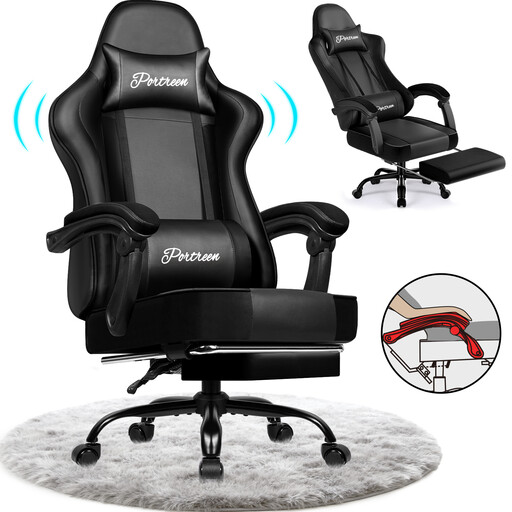
Why This Fits Their Persona: Designed for long hours of use, whether for gaming or watching movies. Its deep recline angle and high weight capacity make it a multifunctional chair for a dorm room or home office.
It addresses the weaknesses of instability and low weight capacity. The product description specifies a rust-resistant metal frame for the footrest and certification to BIFMA and SGS standards.
The backrest reclines up to 170 degrees, allowing for a near-flat position. The weight capacity of 150 kg (approx. 330 lbs) indicates a robust overall construction.
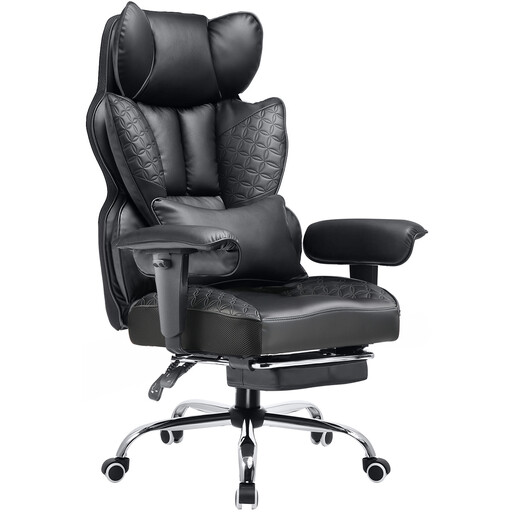
Why This Fits Their Persona: Specifically designed for large and heavy individuals who require a chair with above-average stability and durability, without compromising on comfort features like the footrest.
This model is explicitly marketed as "Heavy Duty" and "Big and Tall," directly countering the weakness of insufficient weight capacity that is a problem with standard chairs for this user group.
The reinforced construction and design for a high weight capacity ensure safe and long-lasting use. The combination of an executive chair aesthetic and full functionality is another plus.
We have compiled a complete, up-to-date list of products that fully meet these strict selection criteria and applicable safety regulations.
Stability depends directly on the material and construction. Models with metal rails and a metal frame are significantly more stable and durable than plastic versions. Look for product descriptions that explicitly mention metal construction. A good footrest should not wobble or sag under the weight of your legs when extended.
A truly ergonomic chair offers more than just padding. Look for the following features: an integrated and adjustable lumbar support, height-adjustable armrests, an adjustable seat height, and a tilt or synchro-tilt mechanism that supports the body during movement. The recline function should be lockable, allowing you to fix it in a desired position.
The lifespan of a gas lift depends on its quality and usage. For chairs with certifications like BIFMA, the lifts are tested for tens of thousands of cycles. With a high-quality chair used within its weight limits, you can expect a lifespan of several years. Models designed for high weight capacity typically use more robust Class 3 or Class 4 gas lifts.