A considerate office blender user
You want to blend fresh pineapple in a shared office without disturbing your colleagues unnecessarily. Noise levels and having a suitable place to blend matter more to you than a high wattage.


For making pineapple shakes in a shared office, a compact plug-in blender is a good fit if there’s a socket at an approved blending spot and the specific model is suitable for your ingredients – especially frozen pineapple. If you can’t use a socket, a cordless blender is more practical for a single serving, but you’ll need to plan when to charge it and make sure the cup is the right size. Wattage alone won’t reliably tell you how noisy a blender is or how well it will blend. Cleaning and office rules also need to factor into your decision.
You want to blend fresh pineapple in a shared office without disturbing your colleagues unnecessarily. Noise levels and having a suitable place to blend matter more to you than a high wattage.
You often use frozen chunks and want to check that the specific model is explicitly approved for those ingredients, rather than relying on wattage alone.
You want to minimise pouring between containers, carry your cup safely and clean it easily after blending at the office.
A good fit if: There’s a socket at an approved blending spot and you regularly make your shake there.
The trade-off: A suitable to-go cup can save you having to pour your shake into another container, but the cable and motor base need space on the worktop.
A good fit if: You can’t use a socket where you blend and a single serving is enough.
The trade-off: You’ll need to plan for charging and check the cup size. Information about frozen ingredients applies only to the specific model.
A good fit if: Blending on site could disturb others, or it would be difficult to clean the blender promptly at the office.
The trade-off: You won’t be making your shake just before you drink it. The German Federal Institute for Risk Assessment recommends keeping cut fruit chilled until it is eaten.
| Buying priority | What to look for | Who is it most relevant to? |
|---|---|---|
| Noise | Only compare measurements when the ingredients and test conditions are clearly described and similar. Wattage is not a noise rating. | If I’m blending in a shared office, I want to disturb my colleagues as little as possible; noise matters more to me than high wattage. Around 31% of consumers put noise at the top of their buying priorities. |
| Blending pineapple | Check that the complete model is approved for fresh or frozen ingredients, and read the corresponding instructions. | If I use frozen pineapple too, I need to check that my model is approved for those ingredients and don’t want to rely on wattage. Around 25% of consumers put blending pineapple first. |
| Cleaning and hygiene | Check the manual to see which parts can be removed and are dishwasher-safe, and whether you can clean the blender promptly where you use it. | If I use the blender in a shared office, I want to be able to clean the cup and any parts that come into contact with food easily. Around 25% of consumers prioritise cleaning. |
| Portability and power supply | Check the cup size and lid, and whether the specific model needs a mains connection or a charged battery at your chosen blending spot. | If I want to take my shake with me in the cup or blend without a socket, a suitable way to carry it matters more to me than extra features. Around 19% of consumers prioritise portability and power supply. |
IMTEST assessed power and noise separately in its comparison. For a red smoothie, IMTEST measured 74.2 dB for the Beast Mega 1200 Plus. This figure applies to that model and those test conditions, not to pineapple or other operating conditions.
Only compare tests of specific models when the ingredients and measurement conditions are described. A test using a different recipe doesn’t mean the blender has already been tested with pineapple.
The two removable, dishwasher-safe 0.6-l cups are listed for the Severin SM 3735. Information about crushed ice and a maximum short operating time of around one minute applies instead to the separate SM 3743 model.
Before buying, check the full model number, what’s included and the instructions for ingredients and use.
A sealable cup doesn’t replace hygienic preparation and storage of cut fruit. The German Federal Institute for Risk Assessment recommends using fresh ingredients with no signs of spoilage and keeping cut fruit chilled until it is eaten.
Keep prepared pineapple chilled as recommended and clean the parts you’ve used according to the instructions.
The Kult X Mix & Go is a compact plug-in blender with a 0.6-l blending and drinking cup.
The Portable NBP003B is a cordless option for a single serving when there’s no socket where you blend.
The SM 3735 is a plug-in blender with two to-go cups; the SM 3743 is a separate model with two speeds and a pulse function.
The VitaPower Series 2 includes compact plug-in blenders which, according to Bosch, blend directly into a to-go bottle.
The Mega 1200 Plus was tested by IMTEST in a comparison of eight appliances.
This selection includes portable blenders for making shakes at work or on the go, including models with to-go cups.
 No image available
An option if you want to make your shake directly in the travel cup.
The cup holds 710 ml. Removable parts are described as dishwasher-safe, and the product is listed as suitable for smoothies and frozen fruit.
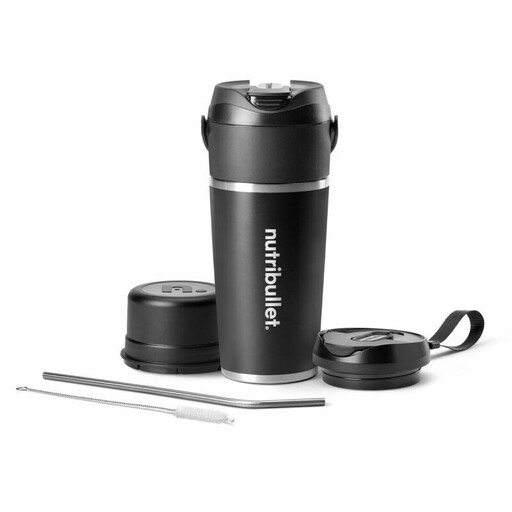 No image available
A cordless option for a single serving at a blending spot without a socket.
The cup holds 590 ml; USB-C charging and an insulated stainless steel cup are listed. The description mentions hard and frozen ingredients. According to the instructions, blend only in short bursts and for no longer than one minute at a time. The blades are very sharp, so take extra care when cleaning.
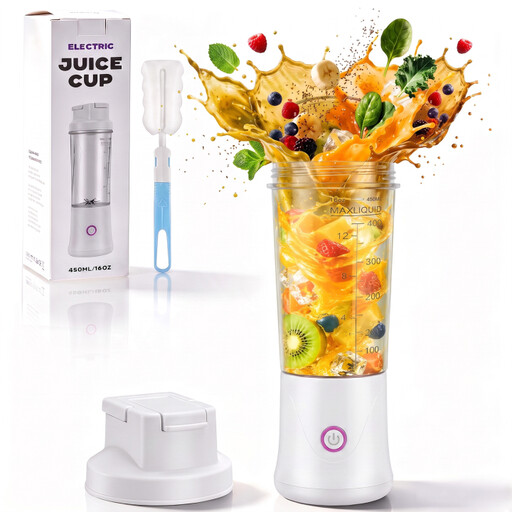 No image available
An option if you’re looking for a blender to make shakes at work or on the go.
The cup holds 652 ml and is described as having a leak-proof lid. Removable parts are described as dishwasher-safe. The description advises cutting ingredients into smaller pieces before blending and not overfilling the cup.
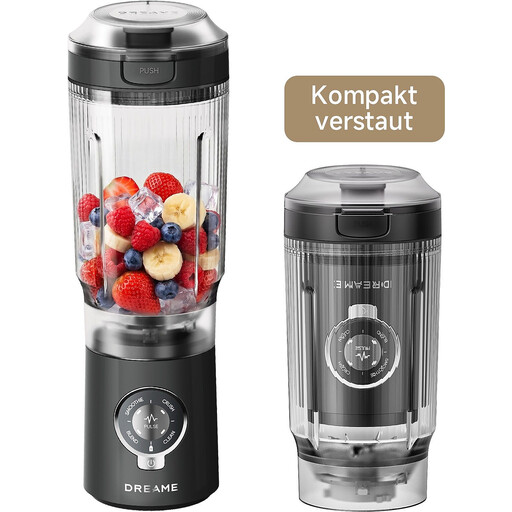 No image available
A cordless option if you’re looking for a blender with a drinking lid.
The mixing cup holds 0.88 l. It is listed as having 120 W, a lithium-ion battery, USB-C charging and an ice-crushing function.
That depends on your office rules and the designated blending spot. Check where you’re allowed to use the appliance, and consider the noise as well as whether you can clean the parts you’ve used promptly.
No. The product category alone doesn’t mean a blender is approved for frozen ingredients. Check the instructions for the full model and the conditions specified. Test results using other ingredients don’t automatically prove a particular result with pineapple.
The German Federal Institute for Risk Assessment recommends using fresh ingredients with no signs of spoilage and keeping cut fruit chilled until it is eaten. Clean the parts you’ve used according to the instructions. This is food hygiene advice, not approval for a particular blender model.
Your statutory rights apply against the seller; a manufacturer’s guarantee is an additional voluntary service with its own terms. The Verbraucherzentrale describes a request for a remedy as the first step when goods are faulty.
No. According to the European Commission, for product categories covered by the rules, the manufacturer uses the required CE marking to declare that the relevant EU requirements have been met. There is no central EU body that issues a CE certificate as a blanket approval; the marking alone doesn’t establish whether a specific product meets all applicable requirements.