People who regularly top up the office biscuit tin
You need enough to share with several people, but may not want to open the whole pack or fill the tin all at once. Pack size, individual portions and dry storage are particularly important.


For an office biscuit tin that’s topped up regularly, a 400–450 g pack is a sensible starting point if you only fill the tin partly and store the rest somewhere dry. EDEKA24 describes a 450 g Brandt pack containing four portion packs; the Brandt twin pack shown below is labelled as 2 × 225 g, so you should check its inner packaging separately. If particular ingredients or a vegan recipe are essential, choosing a smaller pack that meets your needs may matter more than buying as much as possible.
You need enough to share with several people, but may not want to open the whole pack or fill the tin all at once. Pack size, individual portions and dry storage are particularly important.
When rusks are shared, everyone should be able to check the ingredients and allergen information on the specific pack. Claims such as vegan, unsweetened or wholegrain only apply to the variant carrying that label.
You’ll want to compare the pack weight with the usable capacity of your tin and how much you expect to get through. A large pack is only practical if you can store the remainder separately.
First, work out how many rusks you want to put in the tin and how you’ll store the rest. Then check the ingredients in the variant you’re actually planning to share at work.
| What to consider | What to check when buying | Who it matters to |
|---|---|---|
| Stock and storage | Compare the pack weight, individual portions and instructions for keeping the rusks dry. | If I’m topping up the tin over several breaks, I don’t want to leave the rest open all the time. This stock-related consideration is the main priority for around 31% of consumers. |
| Tin capacity | Compare the tin’s usable capacity and the amount you want to put in it with the pack size. | I want to be able to fill a smaller tin without decanting the whole pack. This is the main concern for around 25% of consumers. |
| Ingredients and allergens | Read the ingredients list and allergen information on the specific pack you’re buying. | Before sharing rusks with everyone, I want to know whether anyone needs to avoid particular ingredients. This check takes priority for around 25% of consumers. |
| Preferred recipe | Check claims such as vegan, unsweetened or wholegrain for the specific variant. | For our team, a particular recipe matters more than buying a large single pack, so I’m happy to top up the tin more often if needed. Around 19% of consumers prioritise this. |
Burger describes its 400 g rusks as made without added egg or dairy products, but also lists possible traces of milk and egg, among other things. So this recipe claim is no substitute for checking the label if you have a relevant allergy.
Before sharing the rusks, read the ingredients and precautionary allergen information on the pack you’ve bought.
Alnatura describes its spelt rusks as vegan; it also states that spelt is a type of wheat. ‘Vegan’ doesn’t mean gluten-free.
If gluten-free is essential, check that the specific pack is clearly labelled rather than assuming this from the type of grain or its vegan claim.
If the tin is opened frequently, storing the remaining rusks matters just as much as how much the tin holds. EDEKA24 describes a 450 g Brandt pack as containing four portion packs, making it possible to top up the tin gradually.
Only fill the tin with an appropriate amount and store the rest somewhere dry, following the instructions on the pack. Check the inner packaging of your chosen variant before relying on it being divided into separate portions.
The details below apply to the specific rusks mentioned, not to a brand’s entire range.
Classic branded rusks in a 450 g pack; EDEKA24 describes this pack as containing four portion packs.
Classic rusks in a 400 g pack; Burger describes the recipe as made without added egg or dairy products.
Spelt rusks in a 200 g pack for teams who value a vegan, unsweetened option more than a large single pack.
Wholegrain rusks for choosing by recipe rather than by pack size alone.
This Brandt twin pack could work well if you regularly top up an office biscuit tin. The key is whether the way the pack is divided and its ingredients suit your team’s needs.
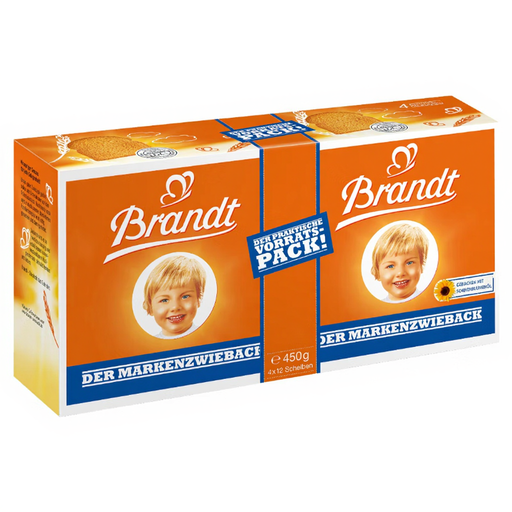 Image unavailable
For an office biscuit tin that’s topped up regularly: according to the product name, this twin pack contains 450 g of rusks in total.
Before buying, check whether the two 225 g packs are individually sealed if you want to store them separately. Before sharing the rusks, read the allergen information on the specific pack, paying particular attention to the egg declaration.
If several people top up the tin regularly, 400–450 g could be a good starting point; the tin doesn’t need to hold the entire pack. EDEKA24 describes a 450 g Brandt pack as containing four portion packs. Check how the pack you choose is divided and store the rest somewhere dry.
Only put in an amount that suits how quickly you’ll get through it and the size of the tin, then store the remaining rusks somewhere dry. REWE recommends keeping Brandt branded rusks in a cool, dry place; once opened, follow the instructions on the specific pack.
No. Alnatura describes its spelt rusks as vegan, but also points out that spelt is a type of wheat and lists possible traces of sesame. Check the ingredients and allergen information on the pack against the needs of anyone who wants to eat them.
In particular, check the ingredients, allergen information, nutritional details and best-before date of the variant you’ve chosen. The Federal Ministry of Agriculture, Food and Home Affairs notes that the ingredients list and best-before date must be clearly legible on the label.