
Lieferung heute & morgen

Qualitätsgarantie

Willkommens-Angebote freischalten: KOSTENLOSE Lieferung | Bis zu 80 % RABATT | Kostenlose 30-Tage-JoyPlus-Testphase
App herunterladen
A large marker set can look appealing at first glance. In practice, however, it’s not just the number of colours that determines whether an Ohuhu Dual-Tip Marker is right for your projects. Lettering, portraits, bullet journaling, colouring books and work on wood all have different requirements.
As a Joybuy Product Recommendation Officer, I’ll give you a clear, factual breakdown of the most important product details. This way, you can avoid common buying mistakes and choose markers more precisely for your intended use.
A set with 120 colours offers a wide selection, but it takes up more space and needs good organisation. For occasional journaling, a Brush Marker Set with 40 or 60 colours can be more practical. What really matters is whether the colour range actually suits your project.
Specialist sets with 24 or 36 skin-tone markers, on the other hand, focus on skin, hair and portrait colours. They won’t replace a broadly coloured marker set for drawing, but they can be a useful addition.
The tip combinations vary significantly:
A soft brush pen behaves differently for lettering compared with a broad chisel tip. So before you buy, check the millimetre measurements and the tip shape.
Water-based markers are typically intended for paper, journaling, sketches and calligraphy. Depending on the paper, you can blend them with water to create watercolour-like effects. Alcohol markers dry quickly and can often be layered and blended on suitable smooth paper. However, their ink can bleed through paper more easily and has a stronger smell.
Acrylic markers, meanwhile, contain an opaque, usually water-based paint formulation and are suitable – depending on the product specification – for wood, glass, ceramic, stone or canvas. So you should choose your ink base not just for the colour effect you want, but above all for the surface you’ll be working on.
For fine outlines, a tip of around 0.4 mm is practical. Flexible brush tips in the range of 1 to 5 mm or 1 to 6 mm allow both thin strokes and broader shading. For large areas, a chisel tip can be more efficient.
If you’re looking for calligraphy pens, go for a flexible brush tip. For technical details, small lettering or journaling pens, an integrated fineliner is more helpful.
With water-based ink, we recommend using a heavier watercolour or mixed-media paper if you plan to blend colours with water. Thin notebook paper can buckle or let ink show through to the other side. A quick test on an inconspicuous area will show you how much the ink spreads.
With alcohol markers, use smooth marker paper and put a protective sheet underneath. The term “permanent” means that stains on fabrics or surfaces may be lasting. Acrylic markers often need to be shaken and the tip pumped gently before the ink flows evenly.
A numbered colour chart makes it easier to buy replacements and compare colours. Storage cases with handles are useful for students, courses or creative work on the go. Always close markers fully after use and store them according to the product instructions; for many water-based pens, horizontal storage is recommended.
With sets that include replacement tips, check which tips are supplied. Small parts and pen caps should be kept away from children under three years old. Alcohol markers should be used in well-ventilated rooms and kept away from heat or open flames. Safety certifications such as ASTM D-4236 are product-specific and should not be assumed to apply to other sets.
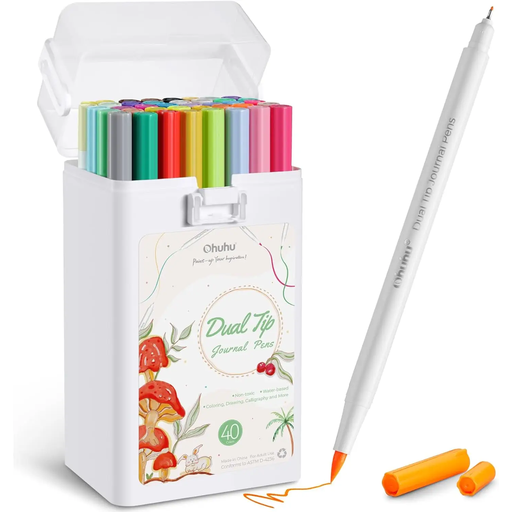
Why this product suits the profile: This compact set offers a brush tip and fine tip for journaling, drawing and first calligraphy projects. The carry case with handle makes storage easy.
The tips are clearly specified at 0.4 mm and 1 to 5 mm. This makes it easier to assess the functionality before buying than with a purely colour-based description.
40 numbered colours, water-based low-odour ink and DIY colour chart.
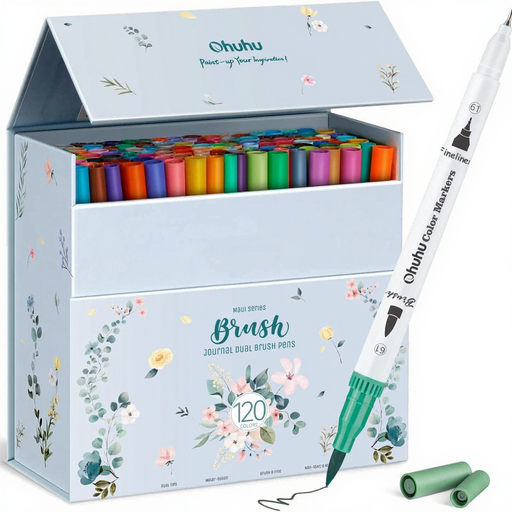
Why this product suits the profile: For illustrations, extensive colour gradients and regular use, this set offers a large palette and a sturdy storage solution.
The water-based ink, 0.4 mm fineliner and 1 to 6 mm brush tip are clearly stated. A colour chart helps reduce duplicates and misidentification.
120 numbered colours, replacement tips and white storage case.
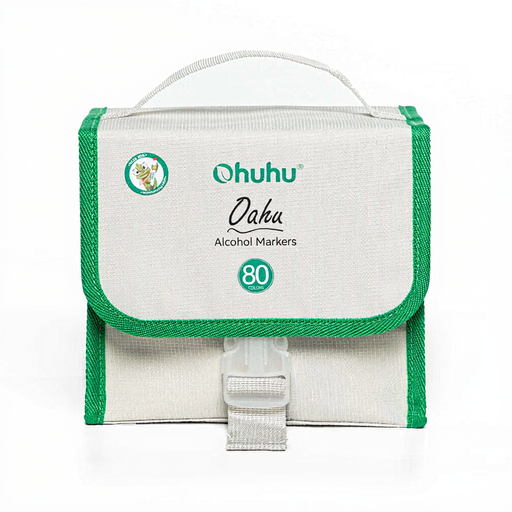
Why this product suits the profile: This alcohol-based set is designed for users who need blendable colours, fast drying and a wide selection for sketches or illustrations.
The ink base and the combination of chisel and fine tip are clearly stated. This makes it easy to distinguish from water-based journaling pens.
80 colours plus colourless blender and nylon carry bag; remember to use in well-ventilated rooms.
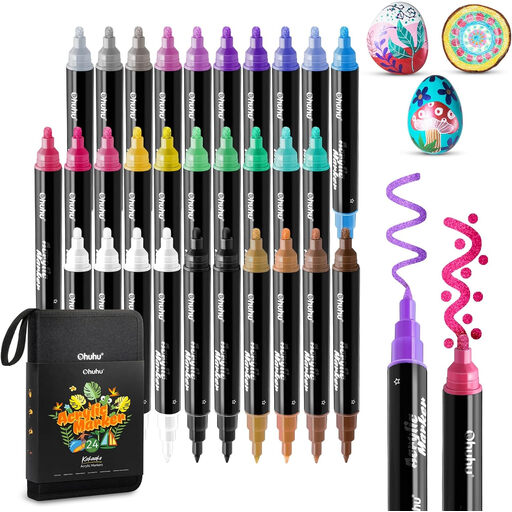
Why this product suits the profile: These acrylic markers are designed for paper, wood, glass, ceramic, stone and other specified surfaces, making them a great addition to traditional art supplies.
The application isn’t limited to paper. However, before each project you should still check that adhesion and durability are sufficient for your chosen material.
30 markers with fine and medium round tips, metallic colours, replacement tips and carry bag.
We’ve put together a complete, regularly updated list of products that fully meet these strict selection criteria and the safety regulations in force in the EU.
That depends on the individual set. Some products contain small parts and are not suitable for children under three years old. Alcohol-based markers can also release fumes and should only be used under supervision and in well-ventilated rooms. Always follow the product information and warning labels.
For bullet journaling, water-based brush pens with an integrated 0.4 mm fine tip are often practical. They combine decorative headings with small notes and outlines. Before regular use, test them on your specific paper, as bleeding and buckling depend on the paper weight.
Close each tip immediately after use and store the pens according to the manufacturer’s instructions. Avoid direct sunlight and heat. With acrylic markers, you may need to shake them and gently pump the tip before use. Replacement tips, if included, can extend the life of worn tips.